Albania Motorcycle Tour Balkans 2026
Albania Motorcycle Tour Balkans 2026
Category: Motorcycle Tours | Travel Recommendations
Seven Riders, Seven Countries, One Road: Albania and the Balkans on BMW GS Motorcycles
Our 2026 motorcycle tour through Albania and the Balkans began in Trogir, Croatia, on 20 August and took seven experienced riders across seven countries and a total of 4,648 km. From Croatia, our route led through Bosnia and Herzegovina, Serbia, Romania, North Macedonia, Albania and Montenegro before returning to Trogir at the end of the journey.
This particular tour was deliberately different from the standard itinerary published on our website. For these seven riders, we created a specially adapted version of our Balkan-Carpathians-Albanian Alps Tour 1, changing parts of the route, choosing different overnight stops and adding roads and destinations that we considered particularly worthwhile. The published tour therefore served as the foundation — but this was our own route for this particular group.
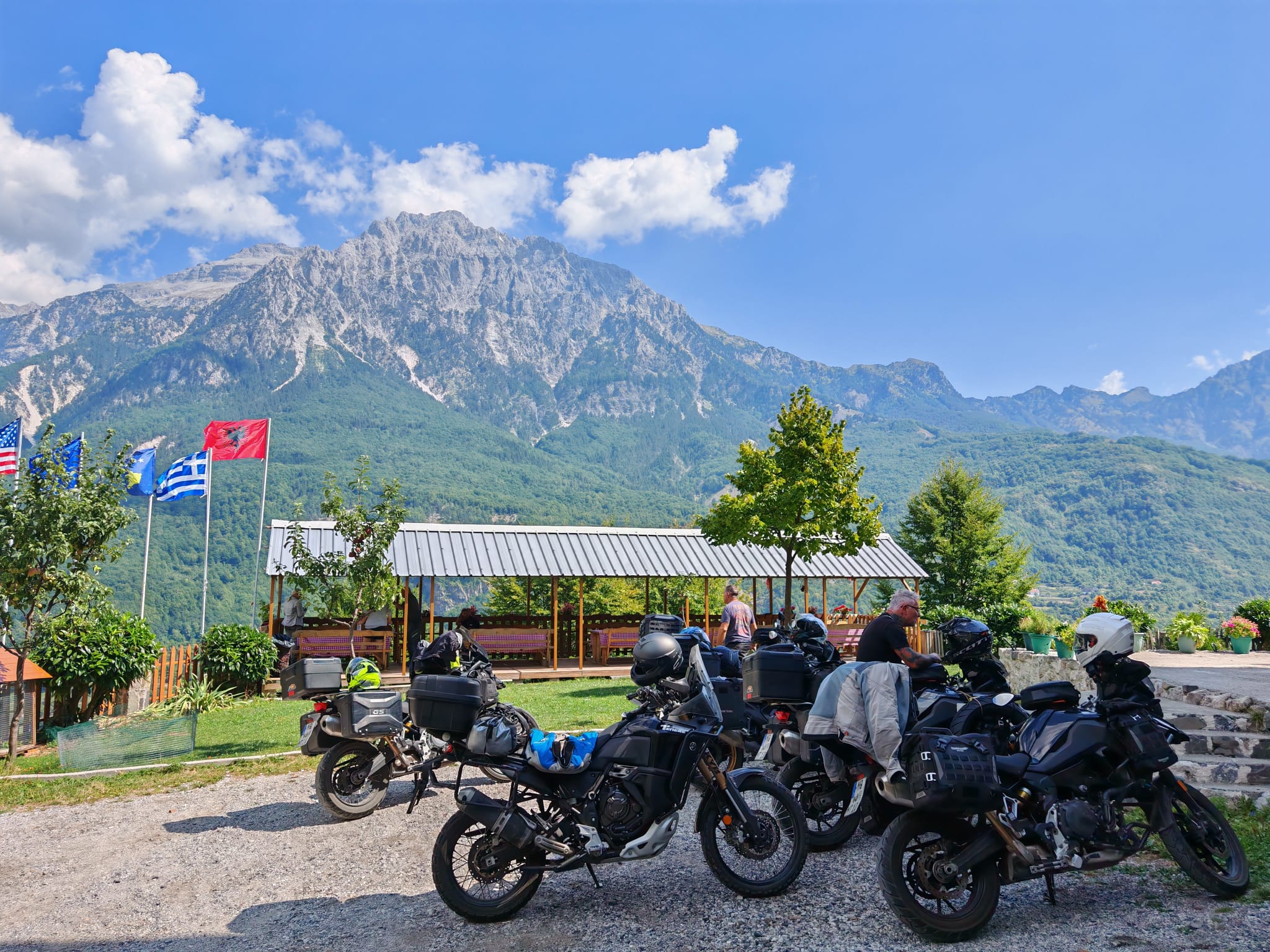
All seven riders travelled to Croatia with their luggage and riding gear, while the motorcycles came from our own BMW GS rental fleet at MotoGS Rental Croatia. No motorcycles had to be shipped across continents, and no support vehicle followed the group. Everything needed for the journey travelled with us on the bikes.
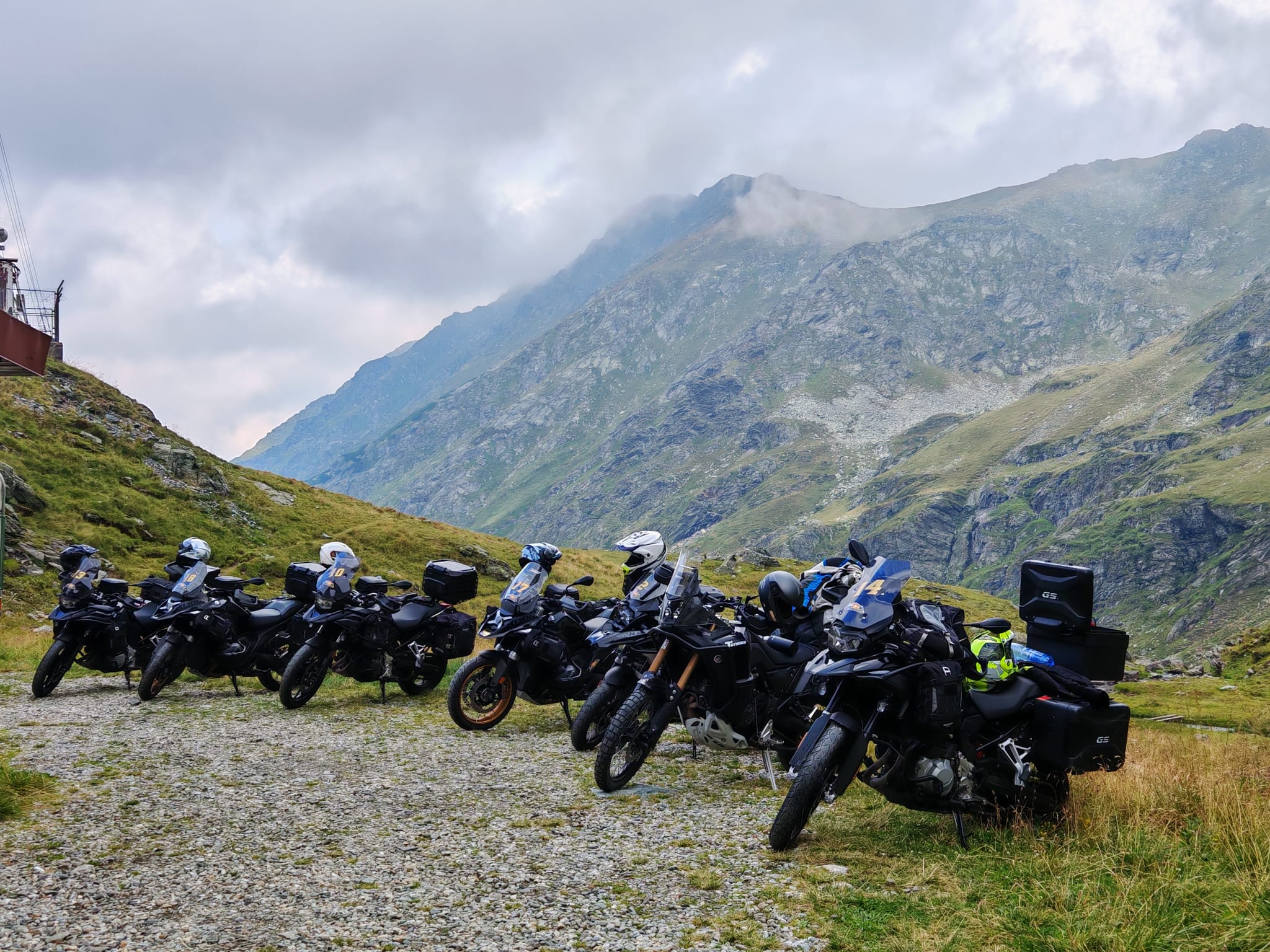
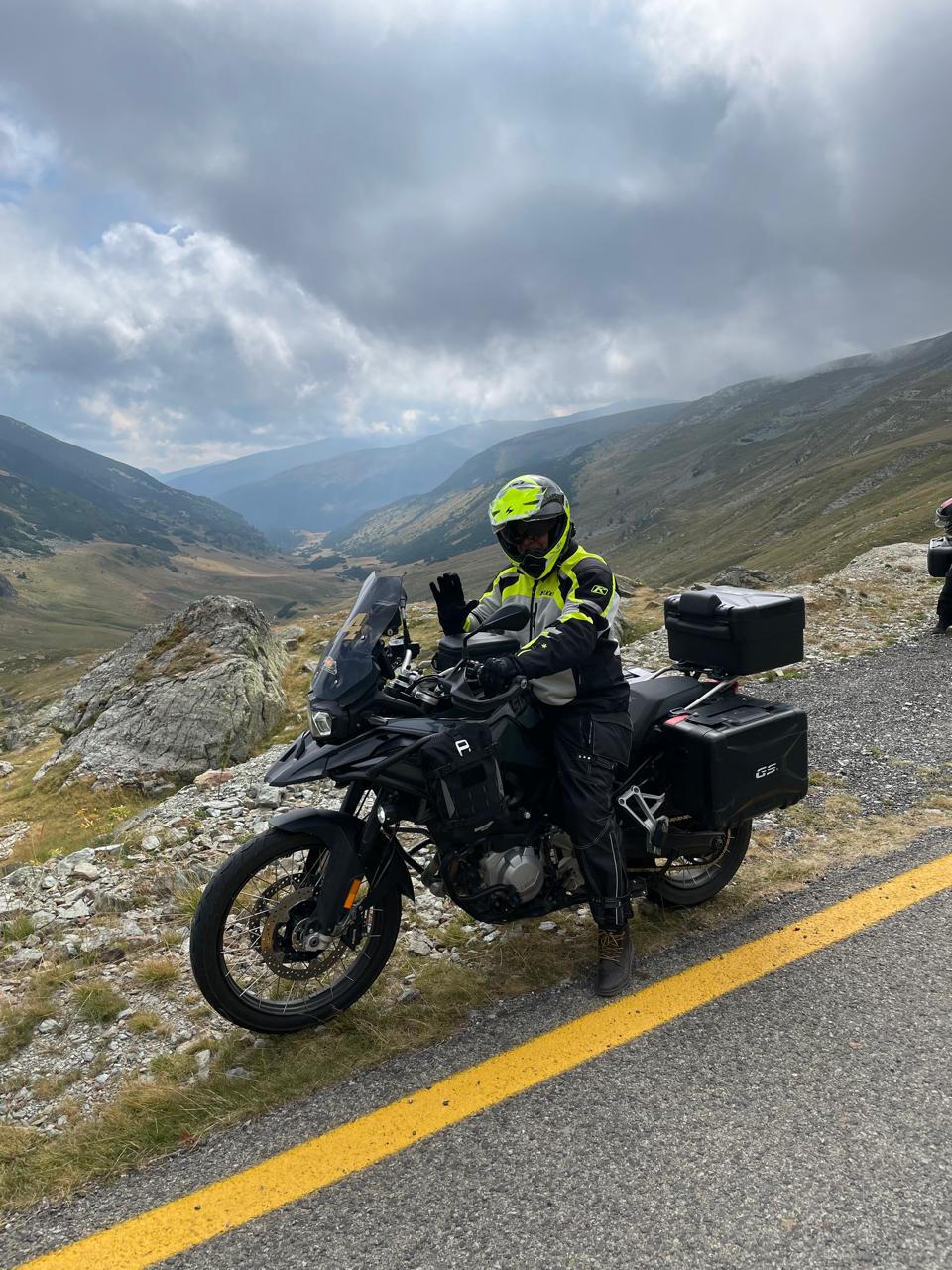
The group came from four countries and three continents. Avi travelled from the United Kingdom and rode an F800GS. Adolfo came from Uruguay on an F850GS, while Bill from Canada rode another F850GS. Peter and Juan travelled from Chile, riding an R1250GS and an R1300GS respectively, while Tony and Lisa came from Canada and each rode an R1300GS.
What followed was not simply a ride from one famous destination to the next. The route combined the great motorcycle roads of the Carpathians and the Balkans with small towns, remote mountain roads, spectacular viewpoints, historic places and several overnight stops far away from the usual tourist routes. Some of the most memorable moments would come in places where there was almost nothing around us except mountains, rivers and the road ahead.
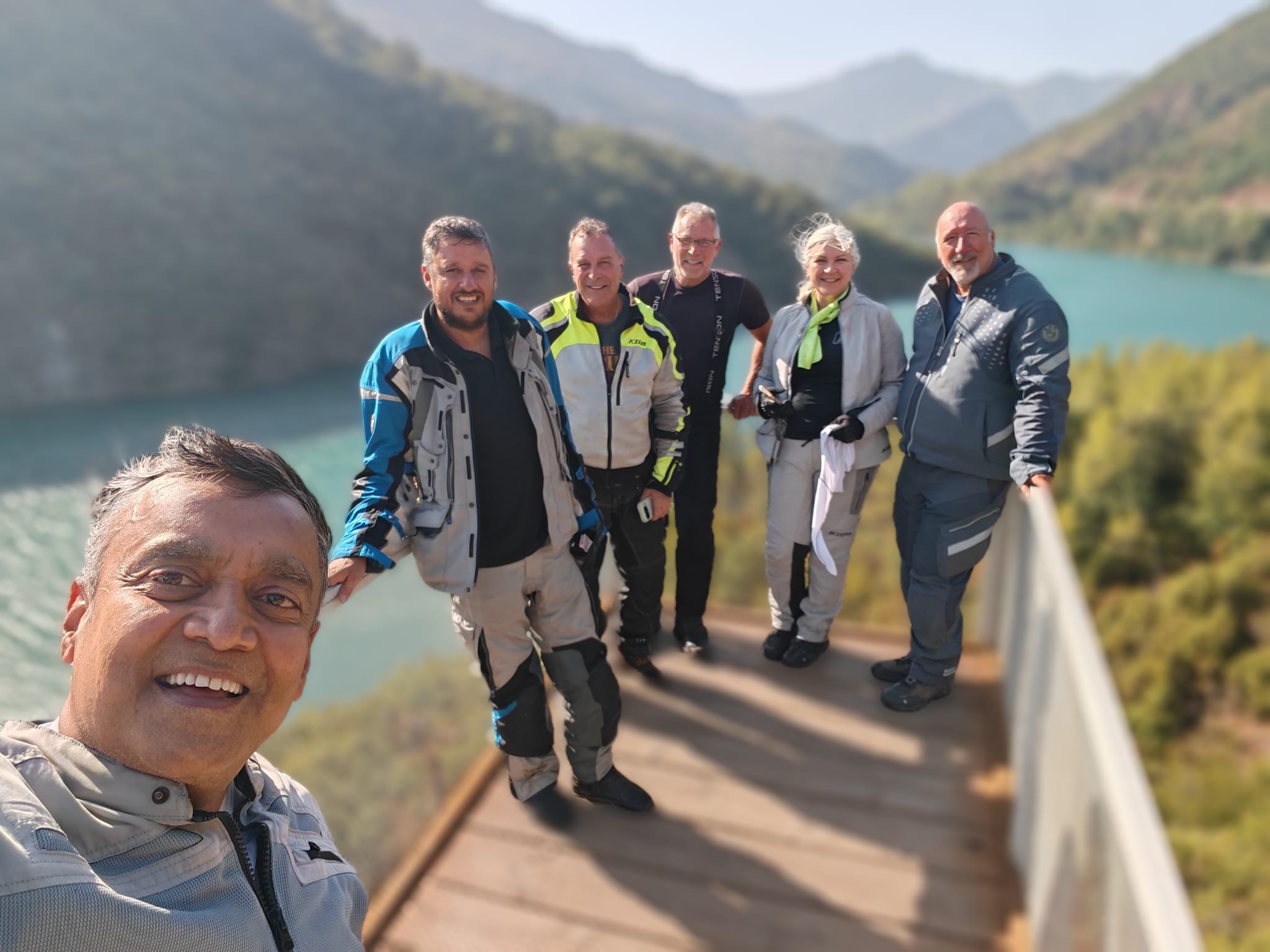
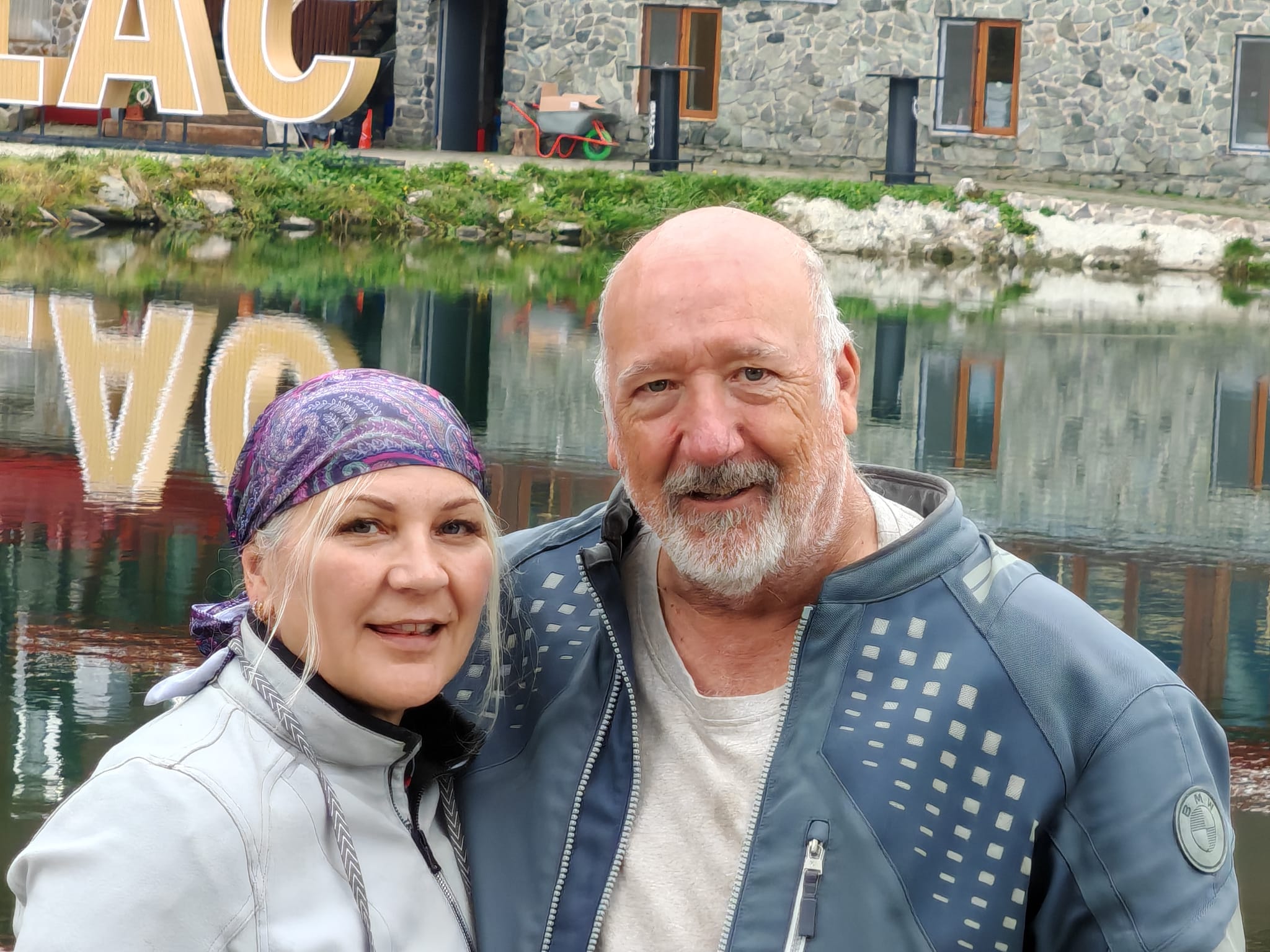
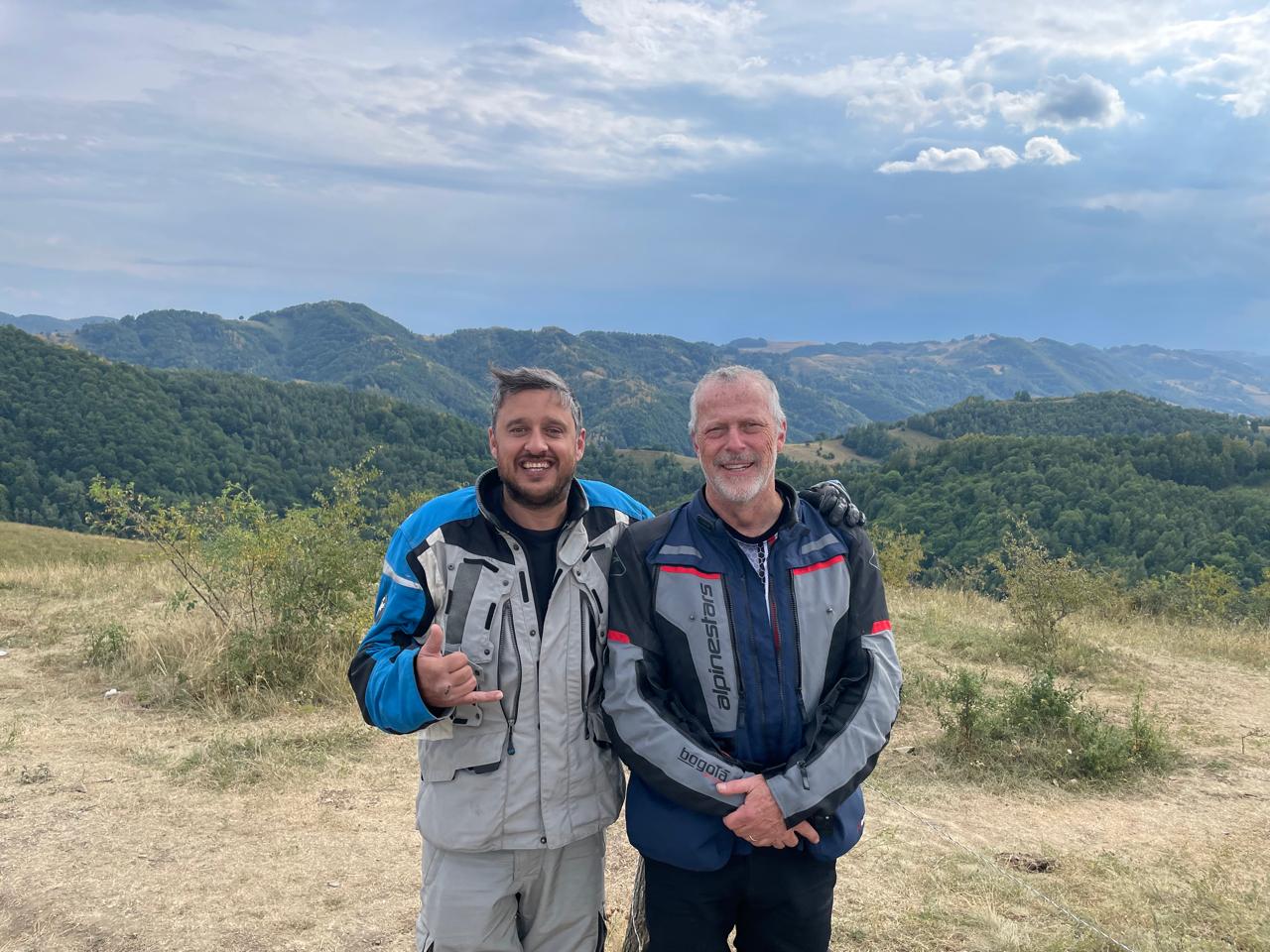
From Trogir to Mostar: Klis Fortress and the First Roads of the Balkans
Our motorcycle tour started in Trogir, just a few minutes from Split Airport on the Croatian Adriatic coast. All riders were collected from the airport and transferred to the hotel, so nobody had to organise transport after arriving with luggage and motorcycle gear.
The real preparation began on the morning before departure. At around 10:00 a.m. we met for the rider briefing, went through the route, border crossings, group riding procedures and the practical details for the days ahead. The BMW GS motorcycles were prepared and loaded at the same time, giving everyone enough opportunity to become familiar with their bike before the tour actually started. Anything that was not needed during the tour could remain safely stored at our base in Croatia.
There is no support vehicle on this tour. Everything we need travels with us on the motorcycles. Each BMW GS was therefore equipped for long-distance riding with lockable side cases, a top case, tank bag, removable inner bags and additional storage on the bike. The system is simple: in the evening, the inner bags go into the hotel while the cases remain on the motorcycle.
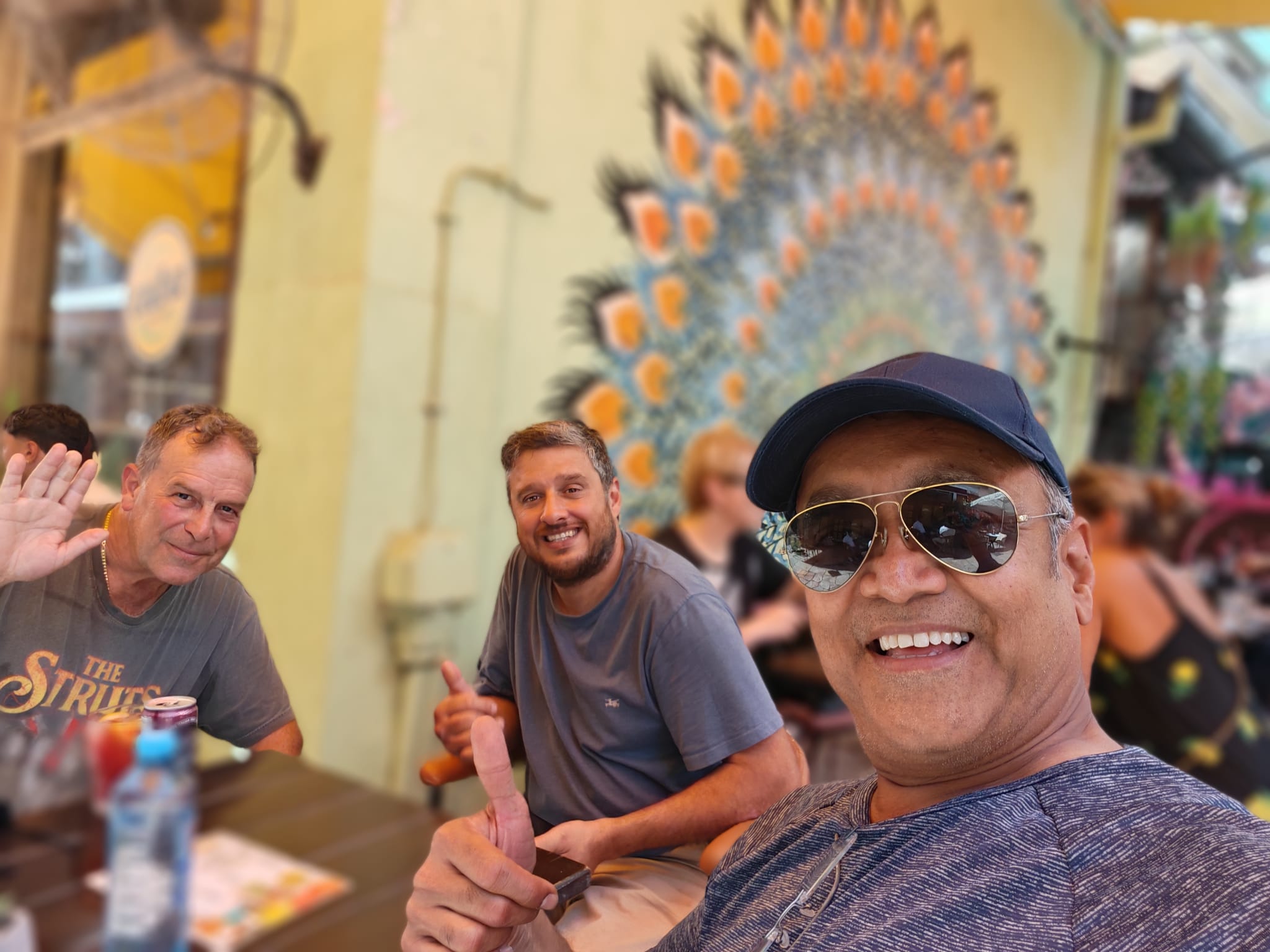
Once the preparations were finished, we walked into Trogir’s historic old town for our welcome dinner. This group already had an interesting connection to one of our previous tours. Tony and Lisa had ridden with us the year before on our Sicily tour and enjoyed it so much that they decided to join us again for Albania and the Balkans.
Peter and Juan from Chile came to us through another rider from that same Sicily tour. Alvaro, also from Chile, was riding with Tony and Lisa when he called Peter during the tour and told him that he had to experience a MotoGS WorldTours tour for himself. The recommendation worked quickly: Peter and Juan booked this Balkan tour while we were still riding through Sicily.
So when we sat down together in Trogir, the group was a mixture of returning riders, personal recommendations and new faces. It did not take long before the conversations turned to motorcycles, previous tours and the roads waiting ahead.
At 8:00 the following morning, the tour finally began. Instead of heading directly for the border, our first destination was Klis Fortress, high above Split. The old fortress sits on a rocky ridge between the mountains and the Adriatic and offers a spectacular view over Split, the coastline and the islands beyond. It was an ideal first stop — not because we had already ridden very far, but because it immediately showed what this tour was going to be about: motorcycles, history, mountains and roads with a view.
From Klis we descended back toward the Adriatic and continued south to Omiš, where the Cetina River reaches the sea between steep limestone mountains. After a coffee and a short break, the route left the Croatian coast and turned inland toward Bosnia and Herzegovina.
The first riding day covered only around 200 km, deliberately giving everyone time to get comfortable on their motorcycle and settle into the rhythm of riding as a group. After crossing the Croatia–Bosnia and Herzegovina border, the landscape gradually changed again as we continued toward Mostar.
By late afternoon, the motorcycles were parked at our hotel and the riding gear was put away. But the day was not finished. We walked into the centre of Mostar and down toward the famous Stari Most — the Old Bridge — before ending our first riding day together over dinner in the historic old town.
It was not a long first stage, and that was exactly the idea. There would be much longer days ahead. The first 200 kilometres were about getting comfortable on the motorcycles, finding the rhythm of the group and properly arriving in the Balkans.
Across Bosnia and Serbia: Zlatibor, Risovača Cave and the Road to Romania
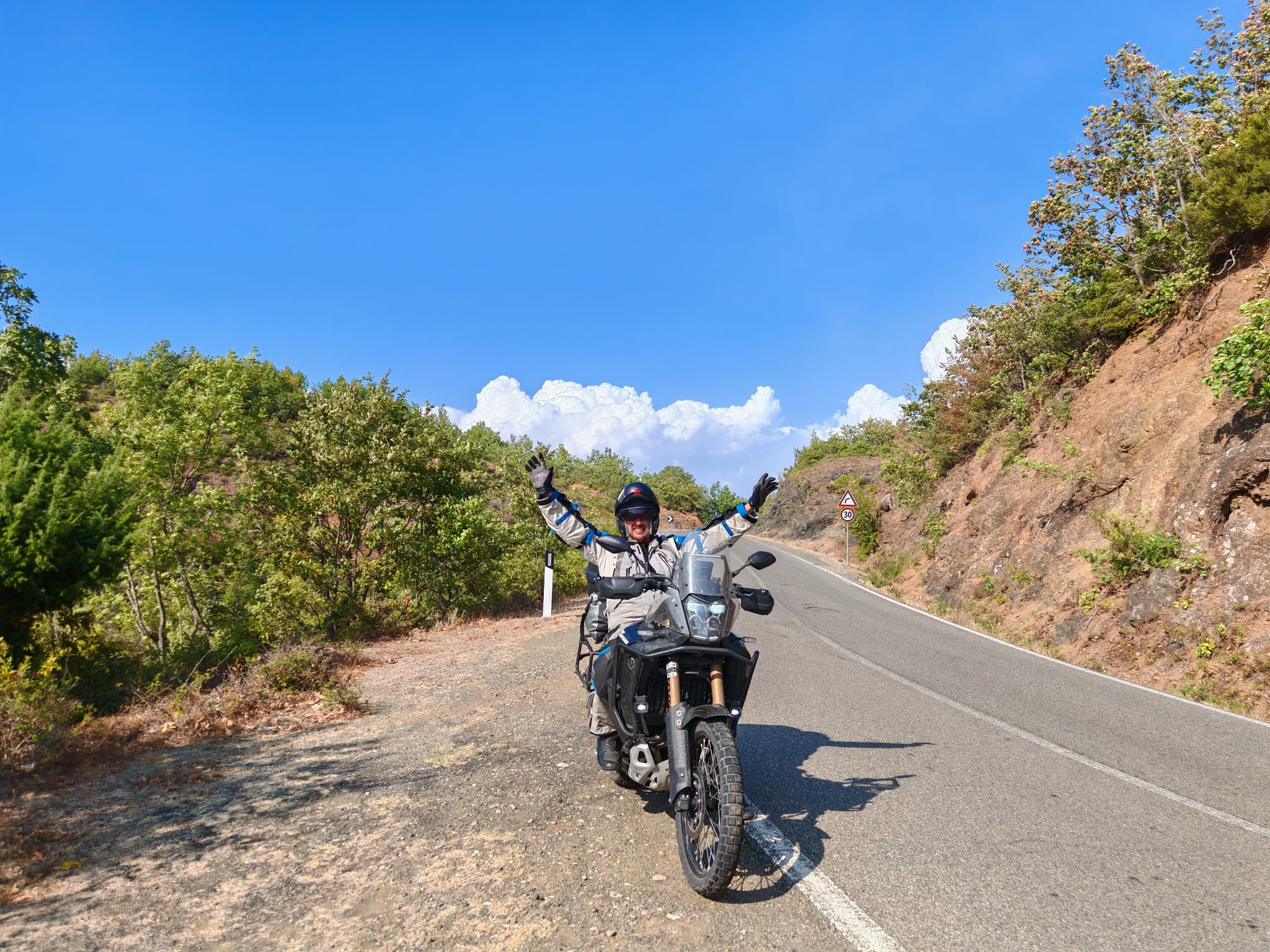
Leaving Mostar the following morning, the character of the tour changed quickly. The Adriatic coast was now behind us, and the route turned deeper into the Balkans. We continued through Bosnia and Herzegovina toward the Serbian border, riding through a landscape of mountains, forests, small towns and villages where international tourism is still far less visible than along the Croatian coast.
Our destination that evening was Zlatibor, one of Serbia’s best-known mountain regions. The riding was not about reaching a famous pass or landmark as quickly as possible. This part of the journey was about the transition itself: narrower roads, less traffic and long stretches through rural countryside. It was the kind of riding where the kilometres pass almost unnoticed because the scenery keeps changing around you.
The next morning we continued east through Serbia toward Risovača Cave near Aranđelovac. The cave is one of Serbia’s important prehistoric and archaeological sites, with evidence of human occupation dating back tens of thousands of years. After several days dominated by motorcycles and roads, it was a welcome change to park the bikes, walk underground and spend some time exploring a very different part of the region’s history.
After lunch we were back on the motorcycles and continued toward Kovin, a small Serbian town close to the Danube and well away from the major tourist routes. Kovin had been deliberately added to this particular version of the tour because it gave us a better progression toward Romania and allowed us to stay somewhere that felt much more local than the usual overnight destinations. Seven fully loaded BMW GS motorcycles parked on a private parking spot outside a small hotel in a quiet Serbian town were enough to attract a few curious looks.
This is one of the reasons we do not design our tours only around famous names. The Transalpina, Transfăgărășan, Theth or Durmitor may be the places people recognise before booking, but a long motorcycle journey through the Balkans is also made up of evenings in towns such as Kovin, conversations over dinner and roads that most visitors would never have a reason to use.
The following morning we headed for the Serbia–Romania border. The Danube dominates this part of the region, forming one of Europe’s great natural boundaries before cutting through the mountains between Serbia and Romania. Once across the border, the landscape began to change again and the first serious Romanian mountain roads lay ahead.
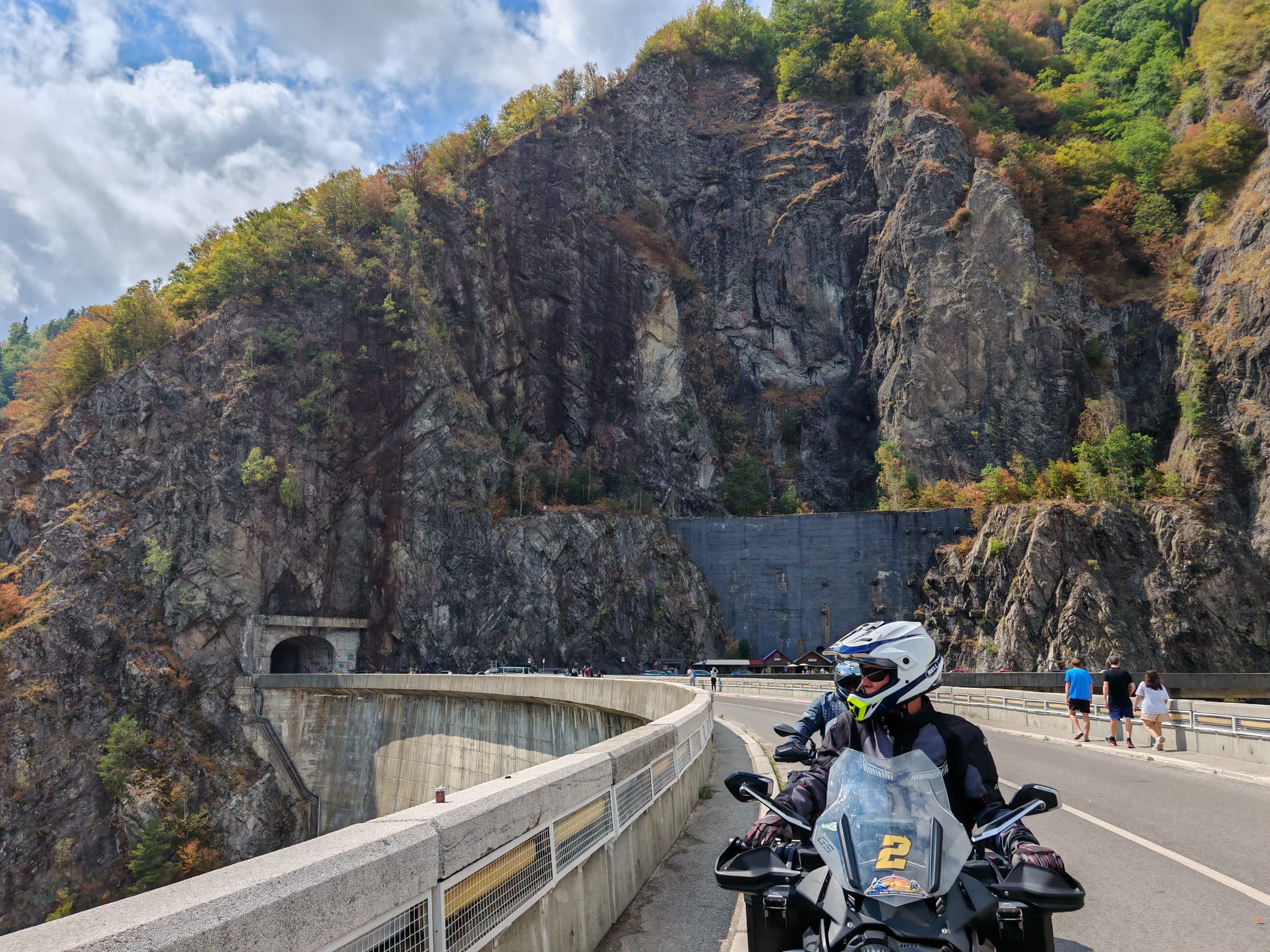
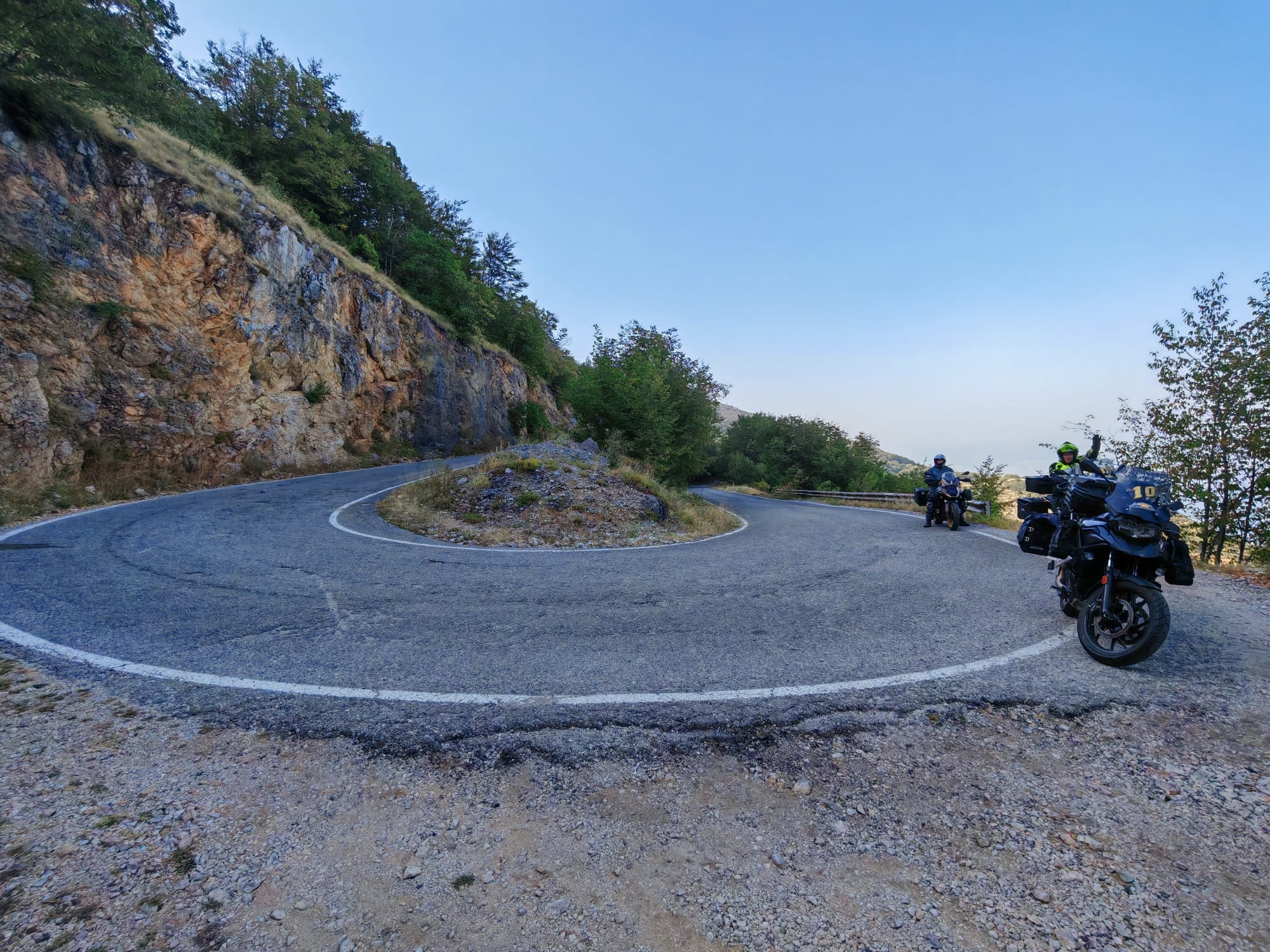
Before reaching the famous high passes of the Carpathians, however, Romania had another surprise for us: the TransSemenic, also known as the TransAlpina Banateana. Running through the Banat Mountains, it is far less famous internationally than the Transalpina or Transfăgărășan, but that does not make it less interesting on a motorcycle. Winding roads, forested mountains and comparatively little traffic made it a perfect introduction to riding in Romania.
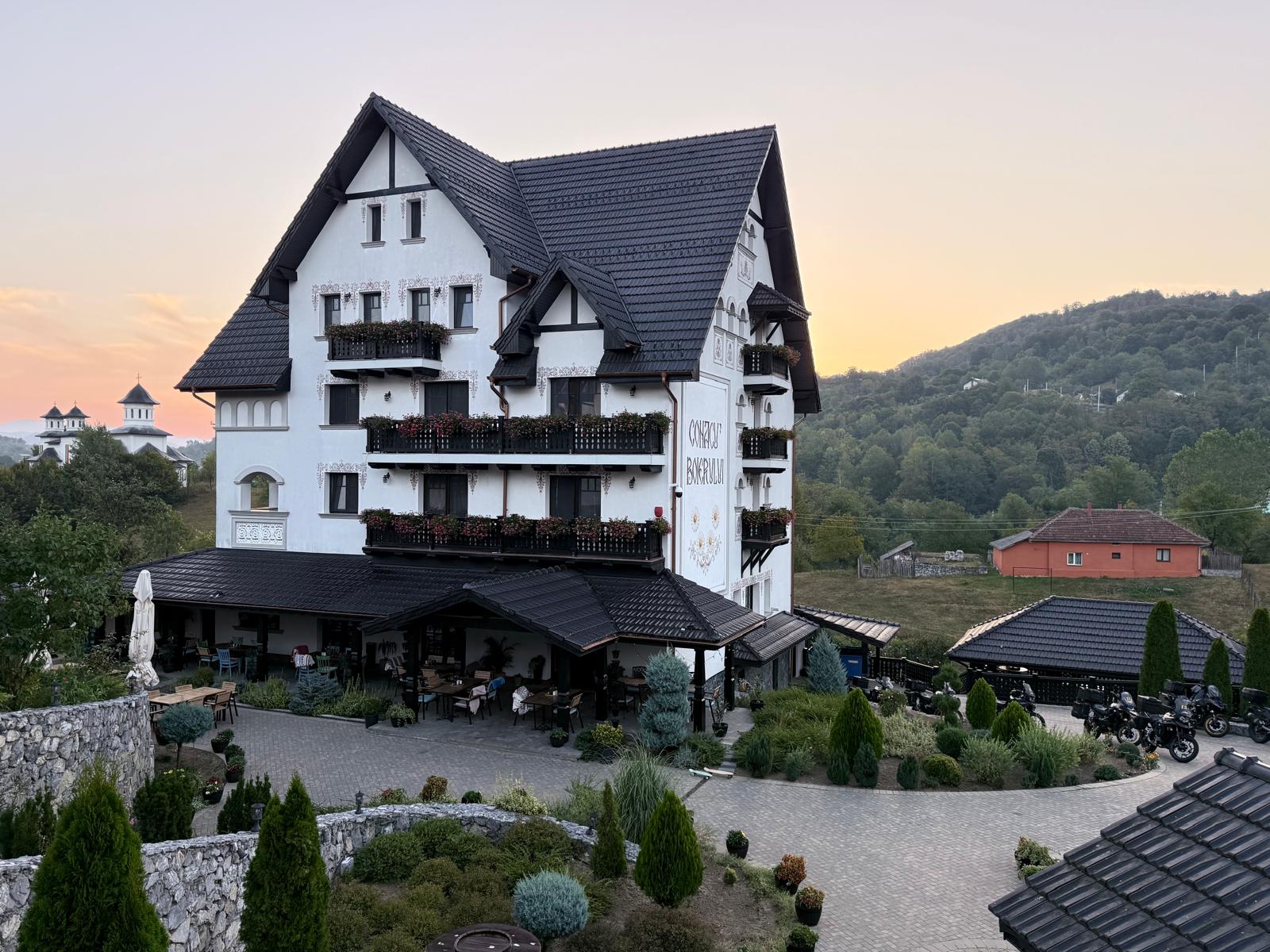
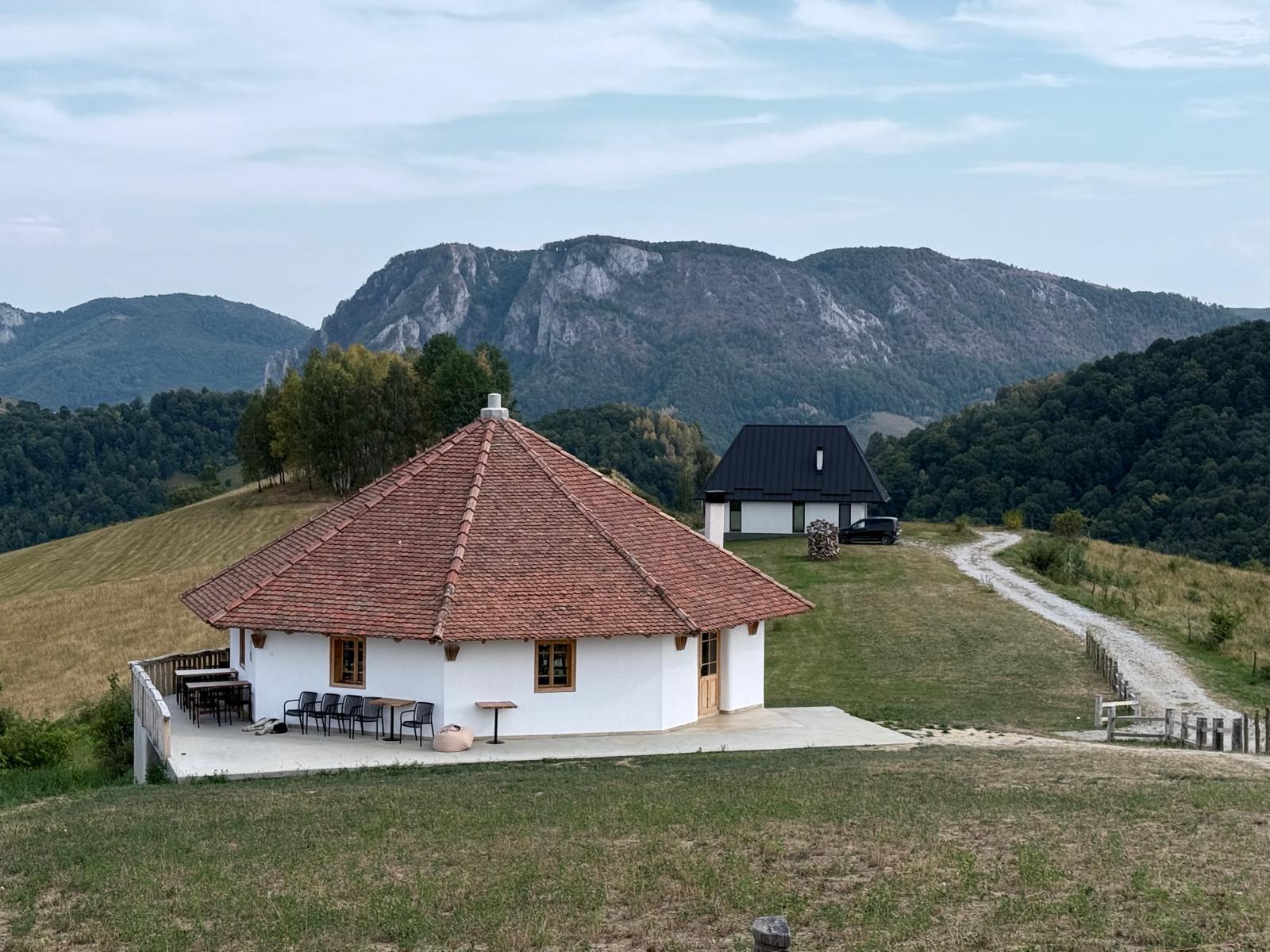
By late afternoon we reached Ponoarele, where we stayed at Conacu’ Boierului. It was another overnight stop far removed from large cities and mass tourism — exactly the type of place that suited this route. After several days crossing Croatia, Bosnia and Herzegovina and Serbia, we had now reached Romania and the Carpathians.
And this was where some of the biggest motorcycle roads of the entire tour were about to begin.
Romania’s Greatest Motorcycle Roads: Transalpina, TransApuseana and Transfăgărășan - Carpathians
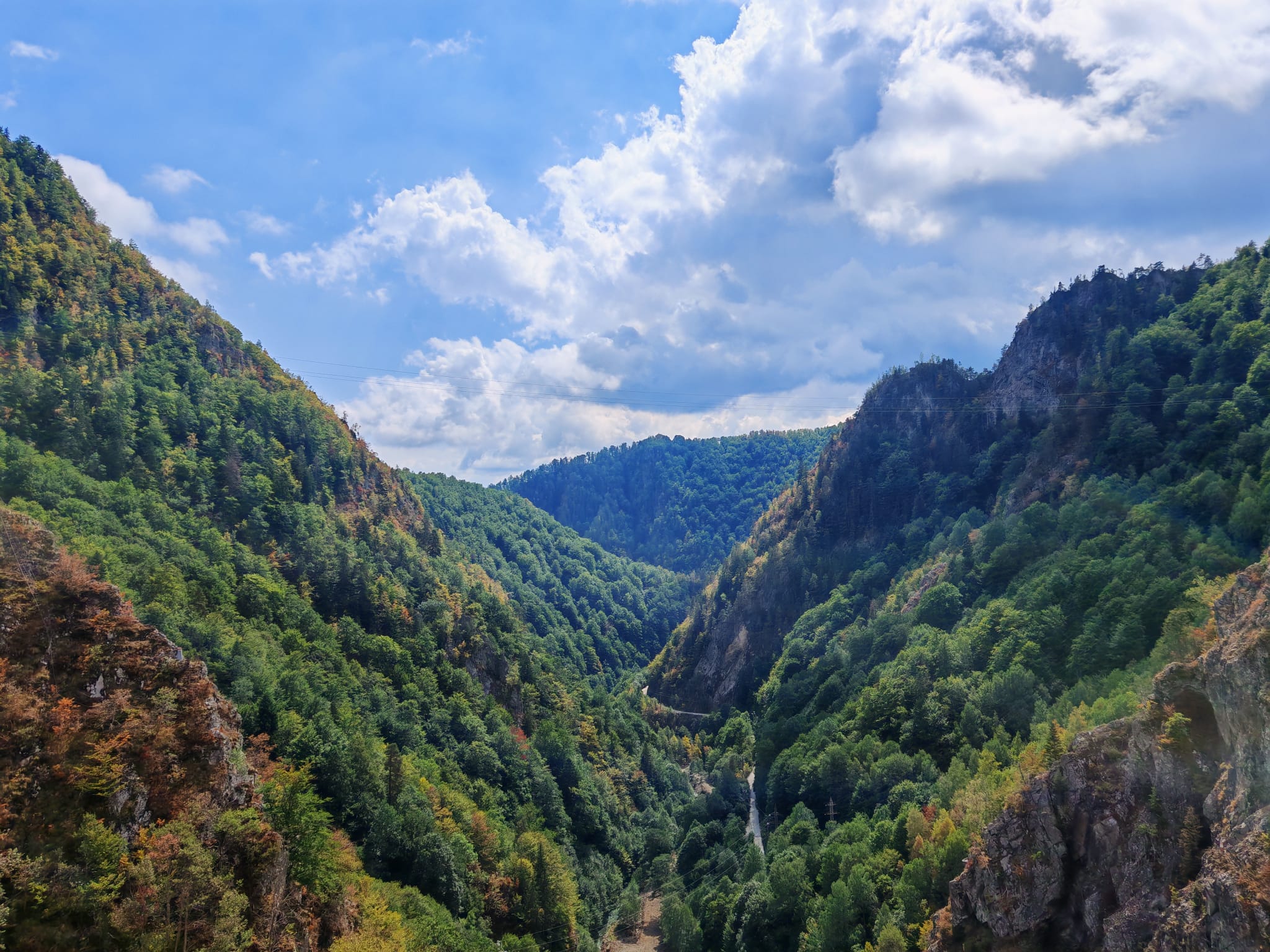
Romania became one of the longest and most spectacular parts of our journey. By this point we had already crossed Croatia, Bosnia and Herzegovina and Serbia, but the character of the riding was about to change completely. Ahead of us were the Southern Carpathians, famous mountain passes and several lesser-known roads that would prove every bit as memorable.
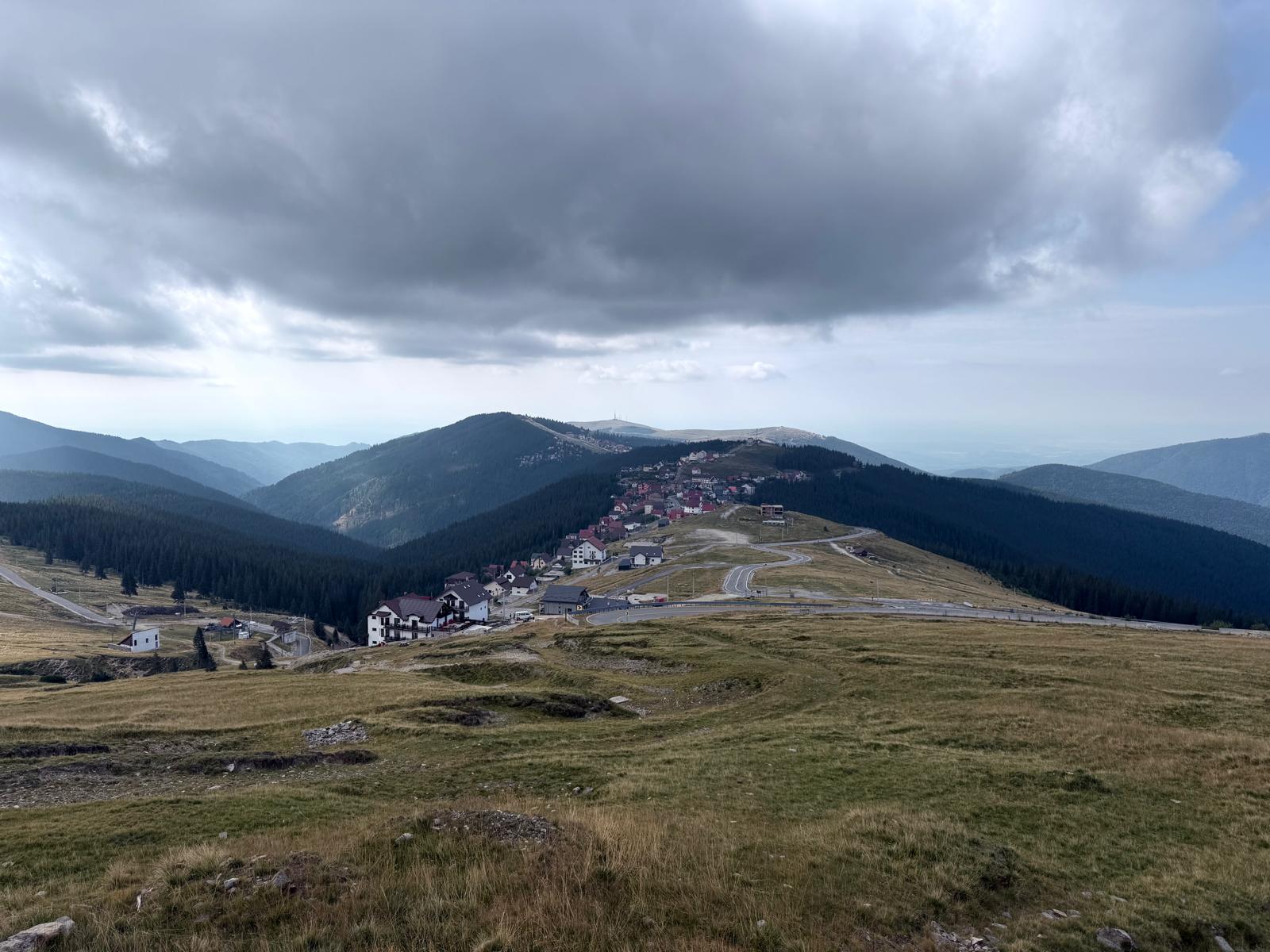
Leaving Ponoarele, we headed toward the Transalpina, one of Romania’s great high-altitude motorcycle roads. As the road climbed into the mountains, the landscape opened up around us: sweeping bends, steep slopes, wide views and the kind of constantly changing scenery that makes it difficult to ride very far without wanting to stop for another photograph.
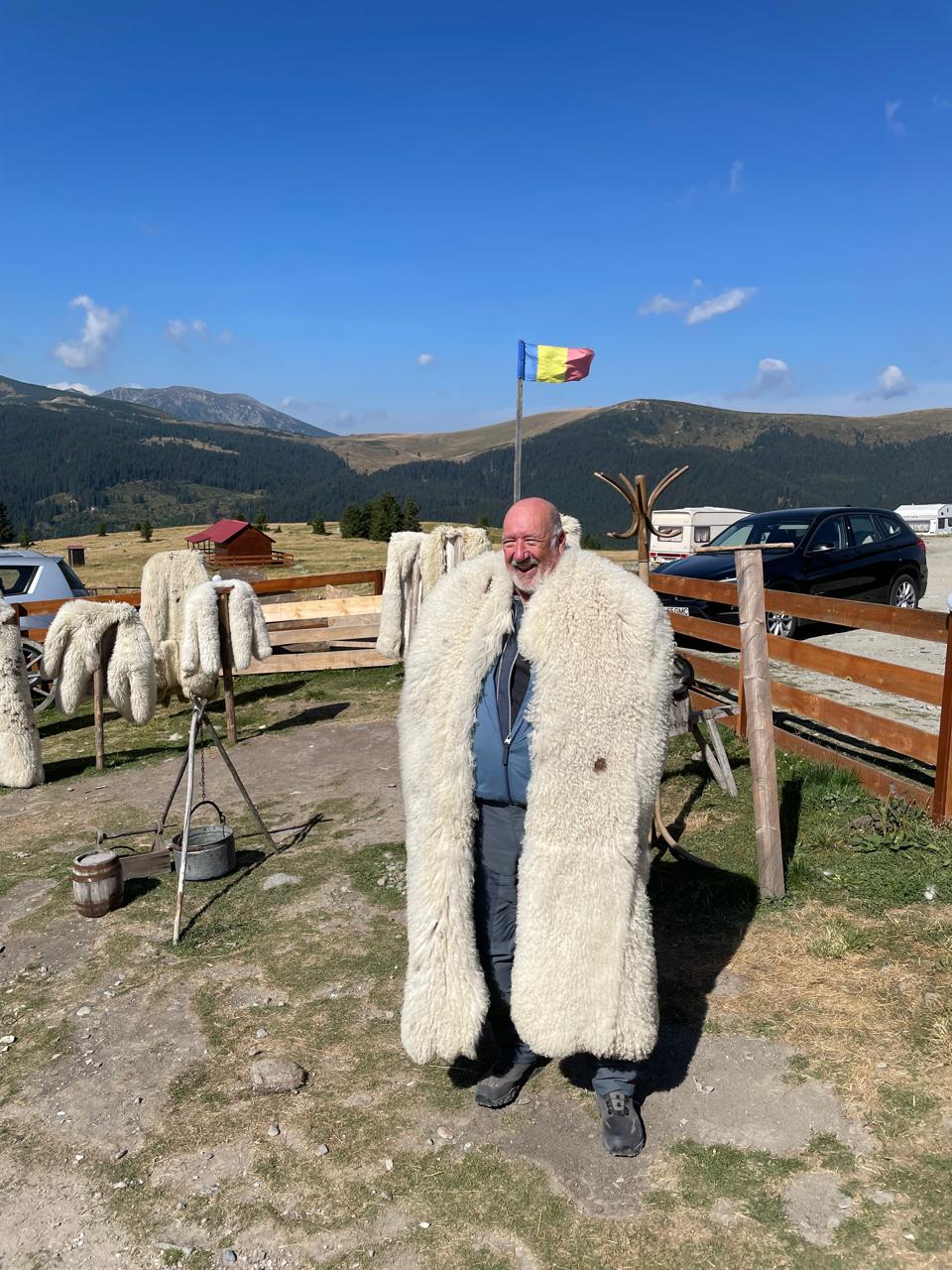
The Transalpina is not simply a road connecting two points on a map. It is an experience in itself. The higher we climbed, the cooler the air became and the more dramatic the surroundings. Small roadside stalls, viewpoints and groups of motorcycles appeared along the upper sections, but between them were long stretches where it was simply us, the mountains and the road.
Our original roadbook provided two possibilities for the second part of this riding day. After roughly 224 km, we were supposed to decide whether to take the shorter route toward Alba Iulia or continue on a much longer alternative through the mountains.
In reality, that decision had already been made the evening before.
Sitting together after dinner, we talked about the following day and what we wanted from this journey. The shorter route would certainly have been easier, but nobody had travelled this far to choose the easy option simply because it was shorter. We wanted to experience something exceptional. The decision was uncomplicated and unanimous: all seven riders chose the long route. One hundred percent.
And it turned out to be absolutely the right decision.
Instead of heading directly toward Alba Iulia, we continued onto the TransApuseana, DJ107I, a much less internationally known mountain route through western Romania. Compared with the famous Transalpina, the road felt considerably more remote. Traffic became lighter, villages smaller and the surroundings increasingly rural as the route wound through the mountains.
The long alternative turned the day into approximately 426 km of riding. It was demanding, especially after already spending hours on the Transalpina, but nobody regretted the choice. Quite the opposite. These are often the days that remain most clearly in your memory afterwards — not because they were the easiest, but because everyone made the same decision to keep going and find out what was waiting beyond the shorter route.
By the time we finally arrived in Alba Iulia, it had been a substantial day on the motorcycles. The priorities that evening were simple: park the bikes, check into the hotel, have dinner and get some rest. Because the following morning another major highlight of the entire tour was waiting for us.
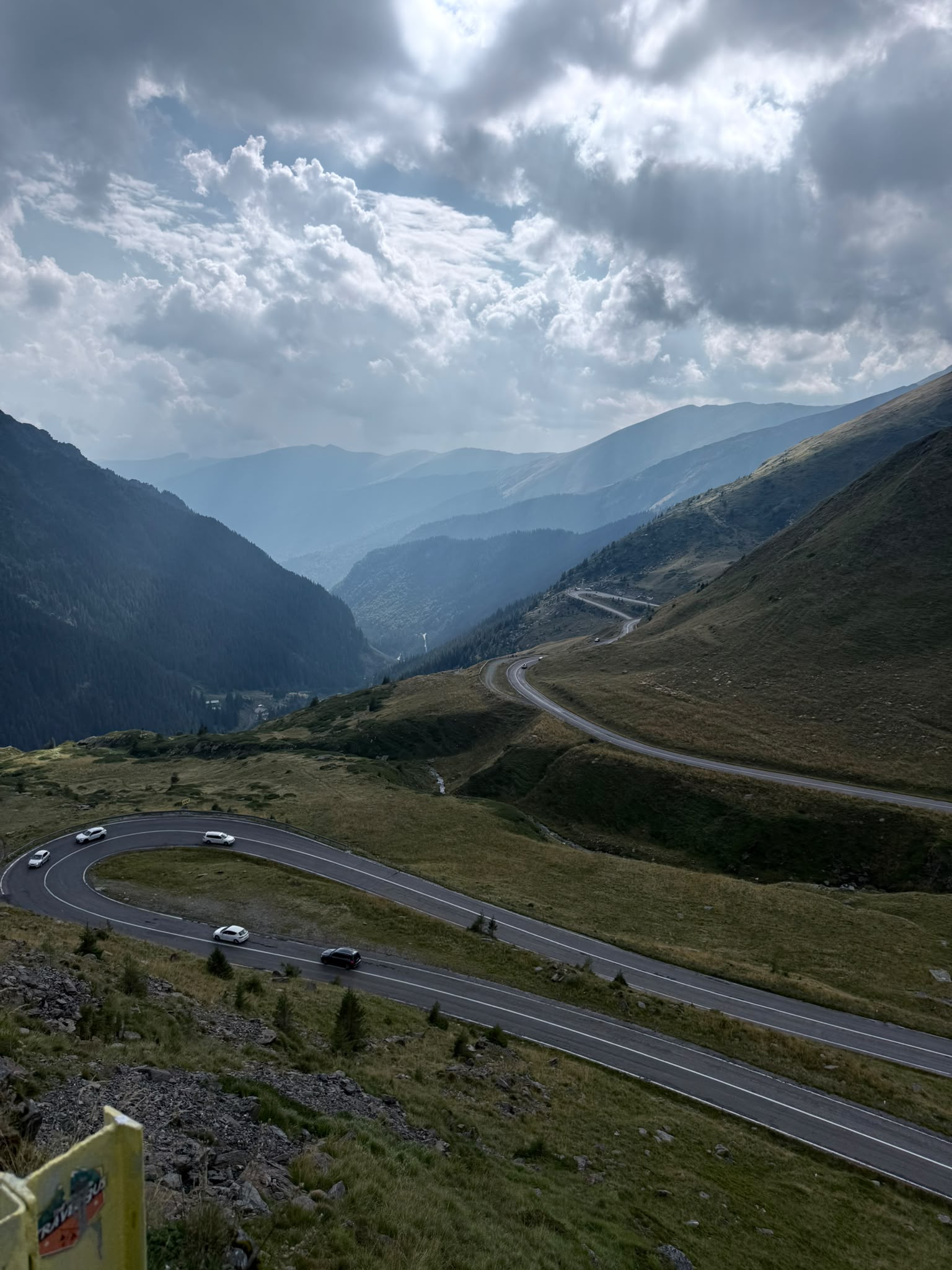
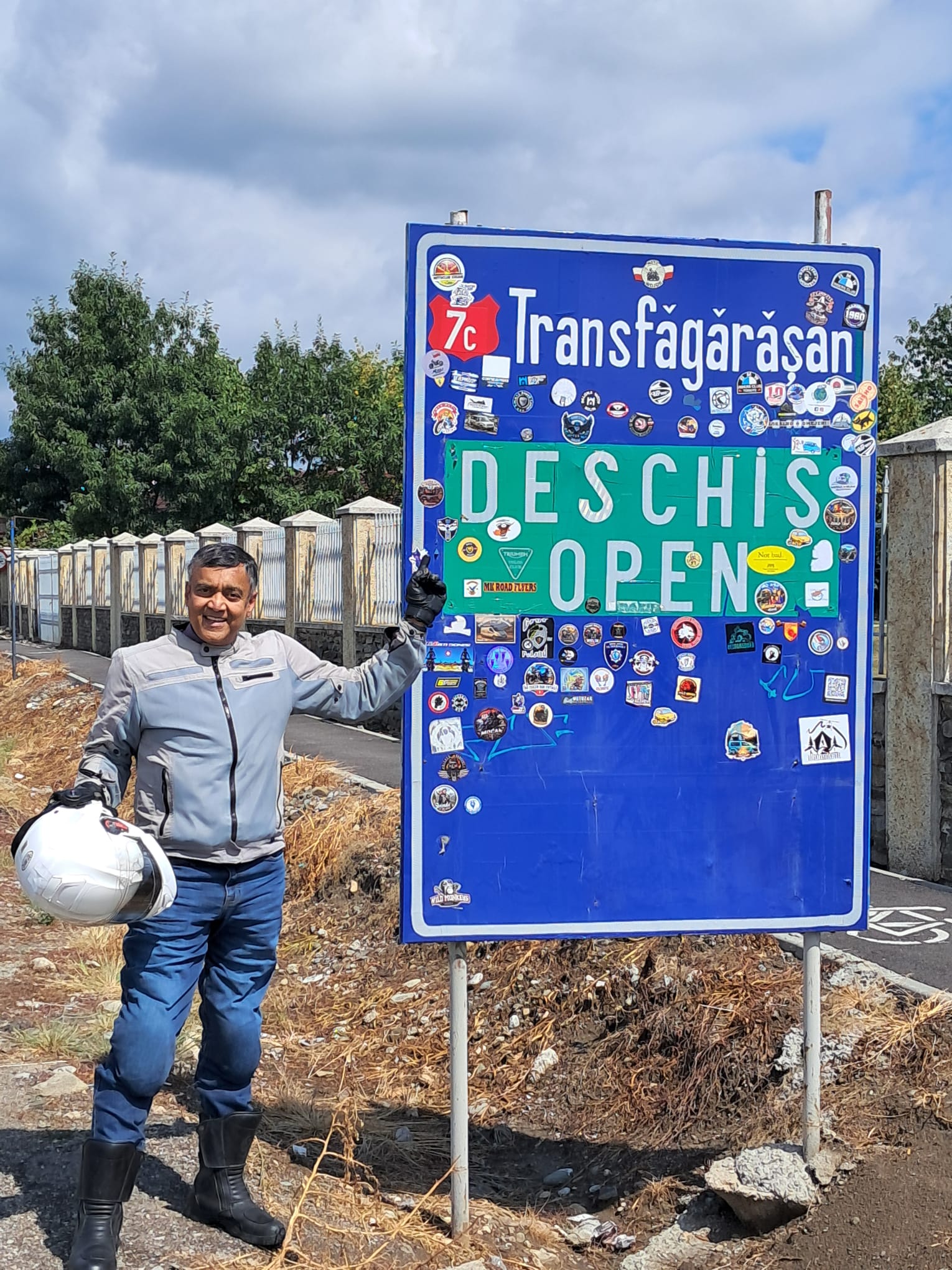
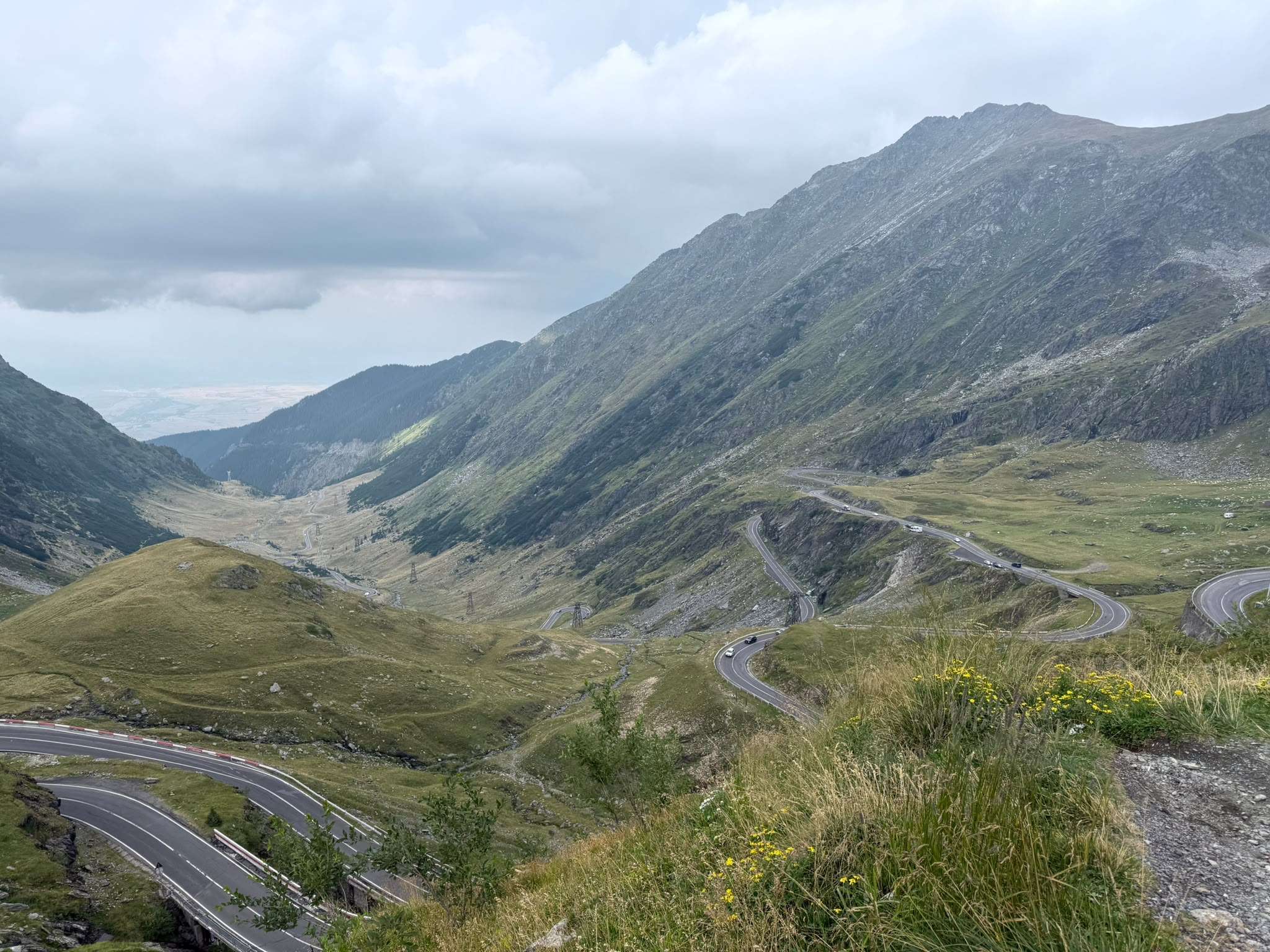
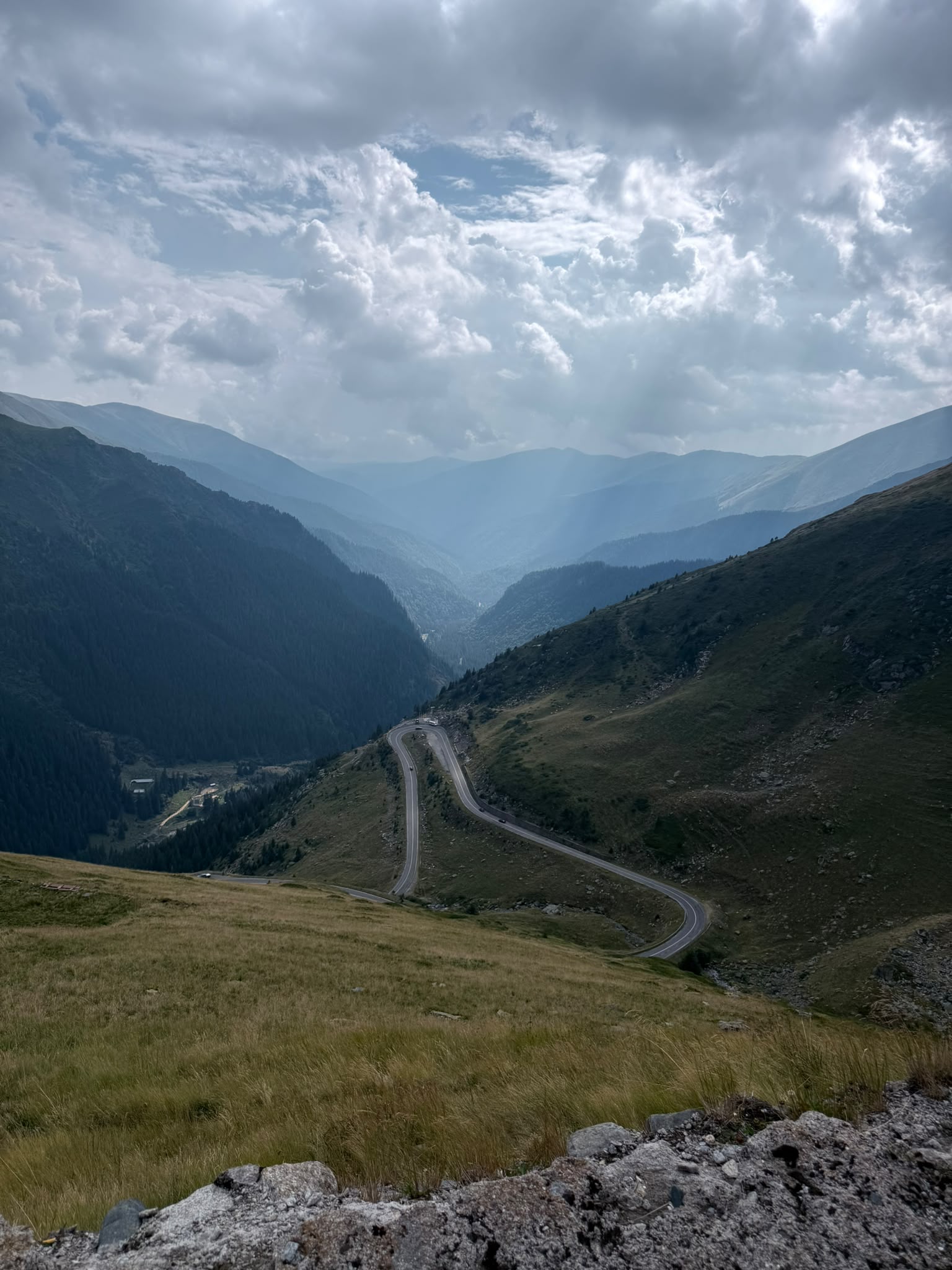
The Transfăgărășan is one of the most famous mountain roads in Europe, and on a motorcycle it fully deserves its reputation. The road cuts across the Făgăraș Mountains through a landscape that becomes increasingly dramatic with every kilometre. Long valleys gradually narrow, the mountains rise around the road and sequences of bends and hairpins climb toward the highest sections.
Photographs show the famous curves of the Transfăgărășan, but photographs cannot really explain what it feels like to ride through this landscape. The scale only becomes clear when you are actually there, looking back at the road winding across the mountains below you.
Our plan was also different from simply crossing the pass and continuing toward the next city. We wanted to stay in the mountains.
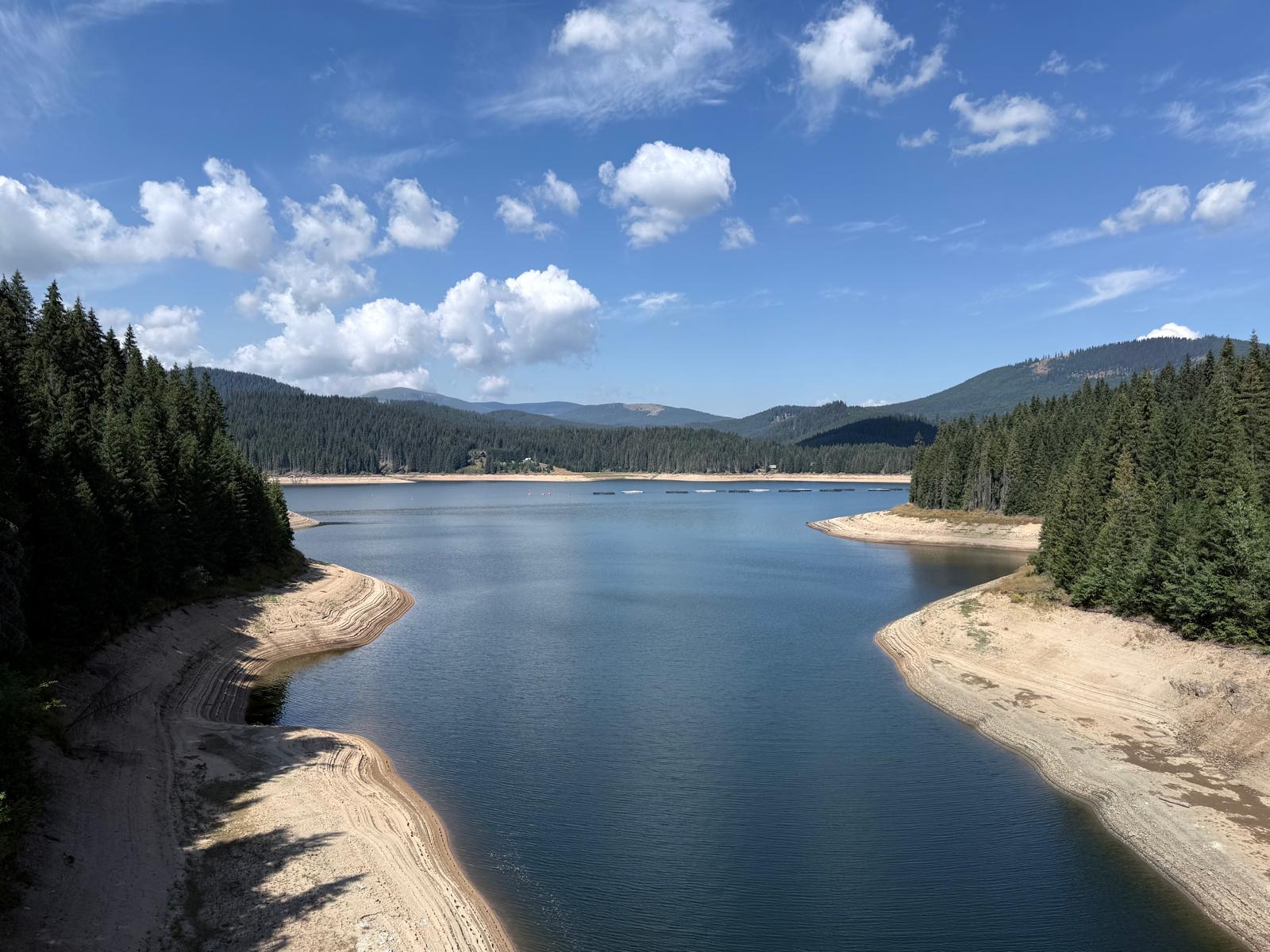
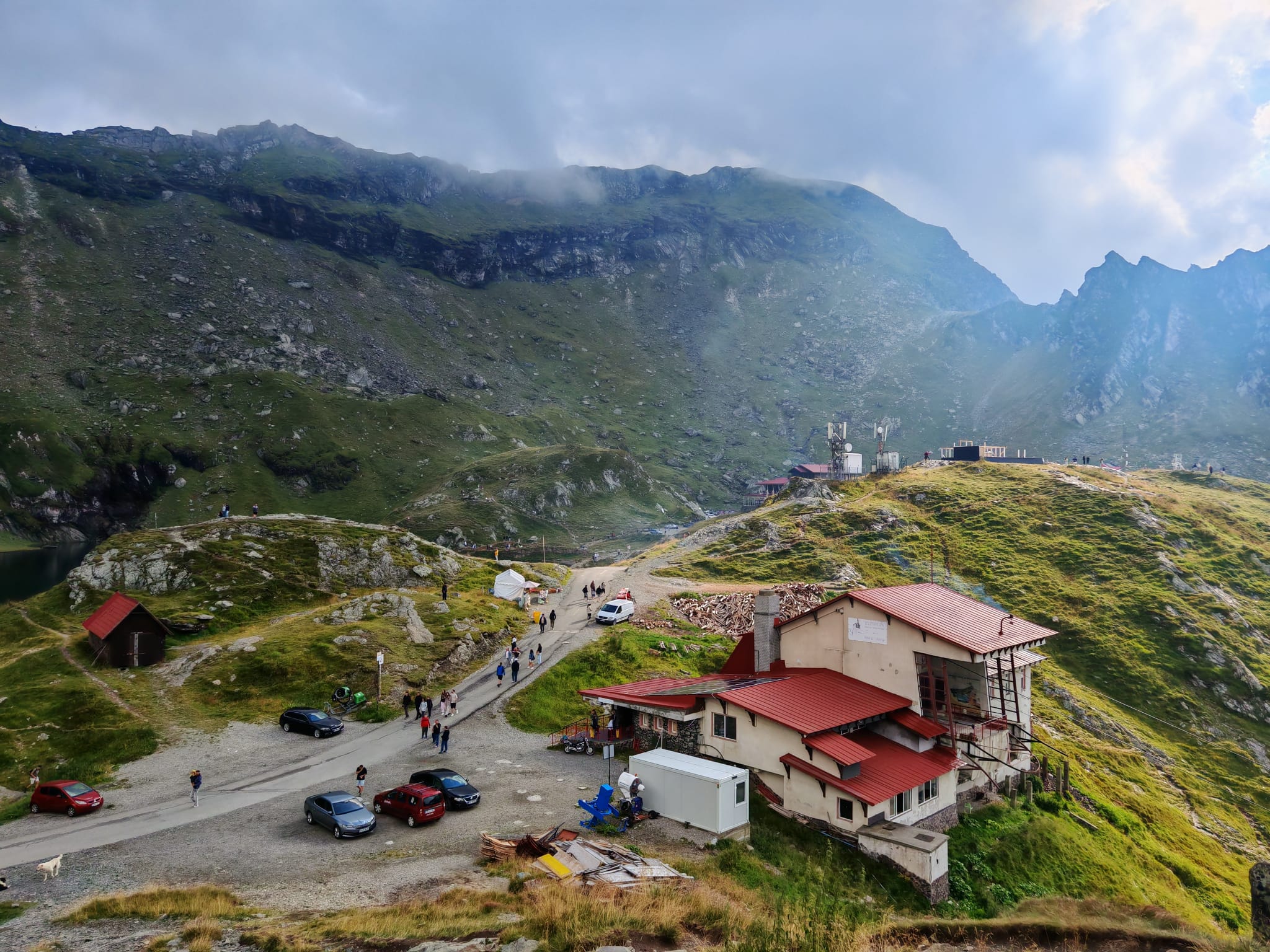
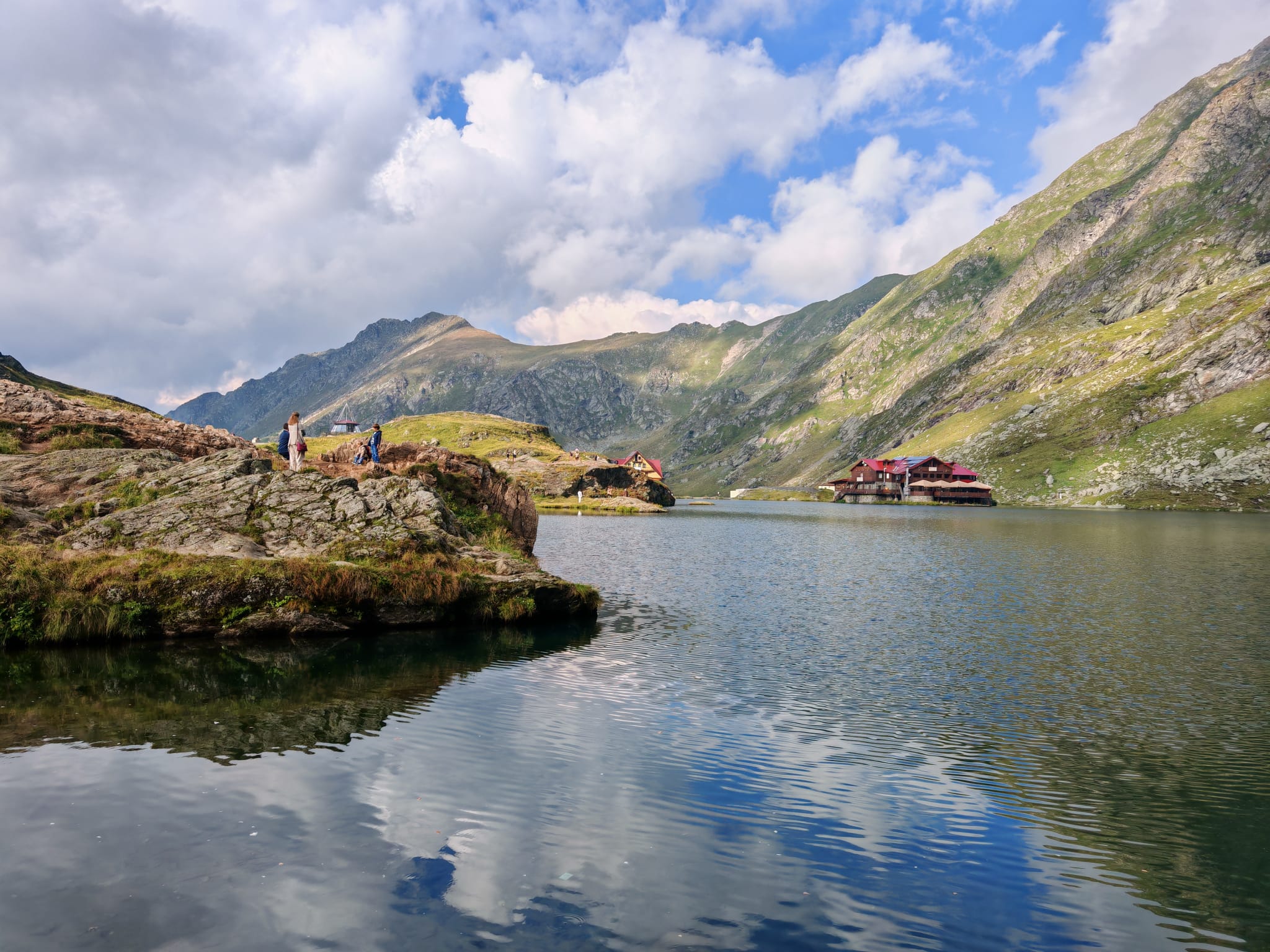
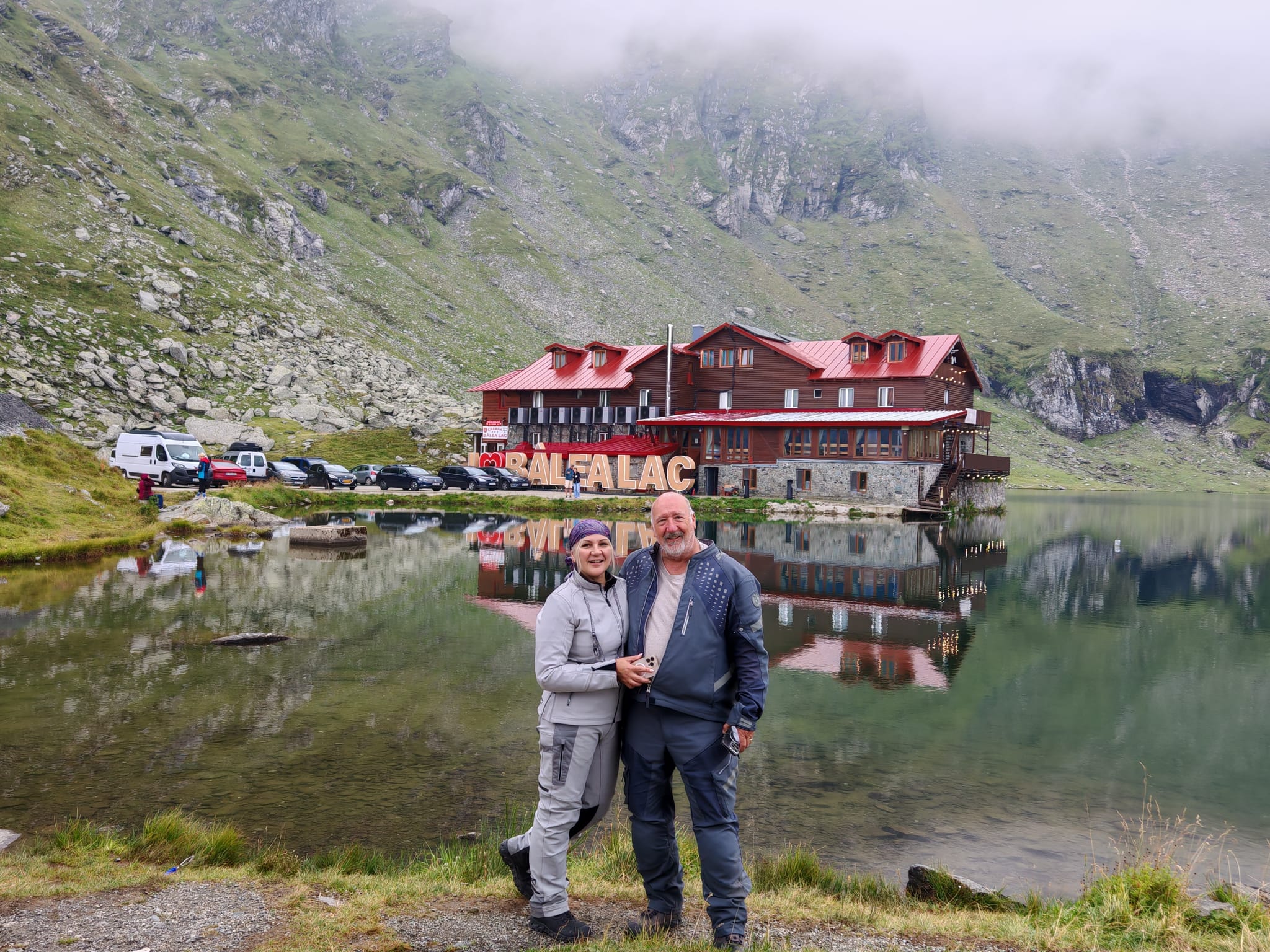
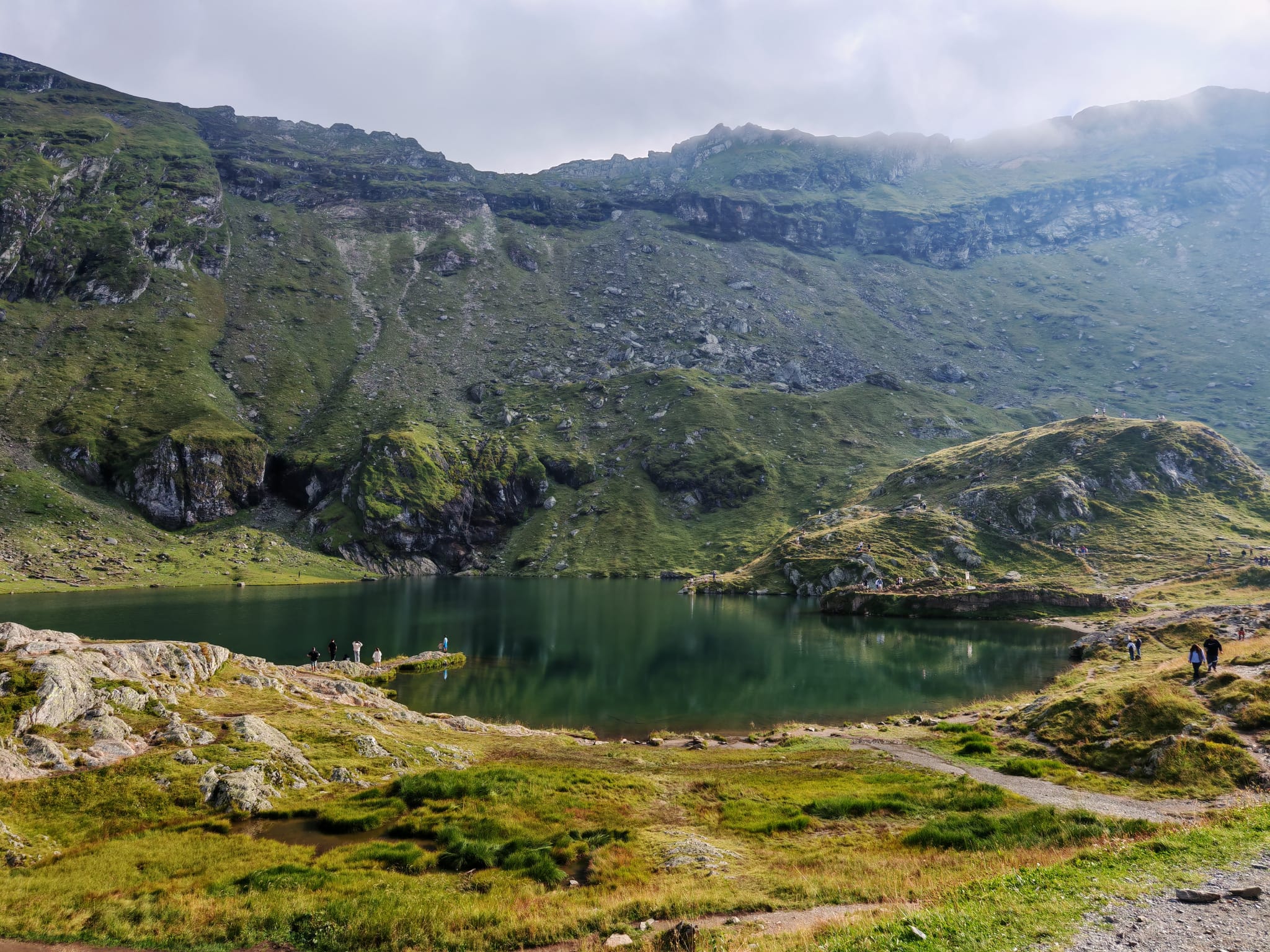
Our destination was Lake Bâlea, high in the Făgăraș Mountains, where we spent the night at Cabana Bâlea Lac.
That overnight stay gave us a completely different experience of the Transfăgărășan. Instead of riding straight back down into the valley, we parked the BMW GS motorcycles, took off the riding gear and stayed right there beside the lake, surrounded by the mountains we had spent the day riding through.
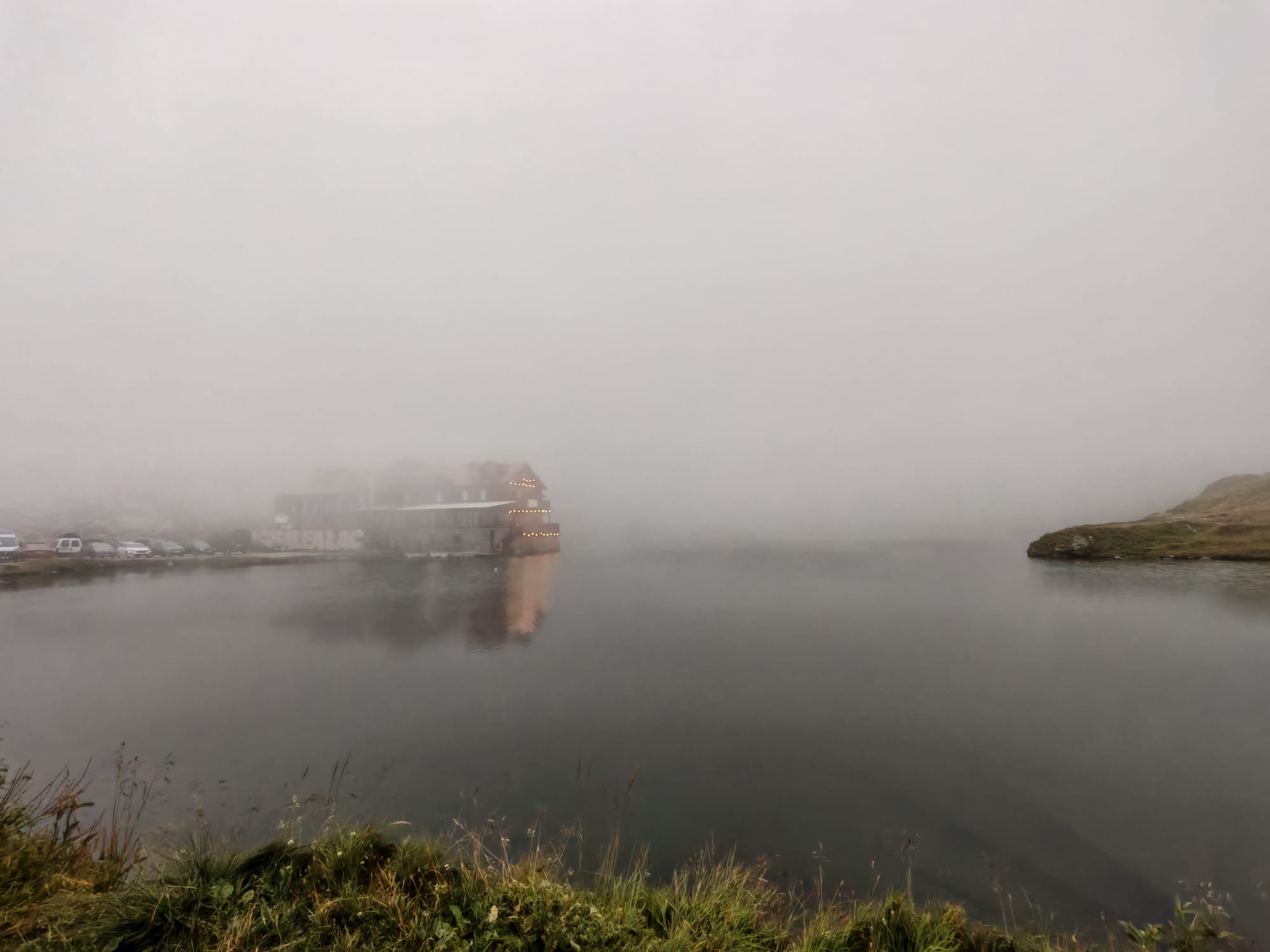
Lake Bâlea is spectacular in clear weather, but during our stay the mountains showed us another side as well. Dense fog repeatedly moved across the lake and the surrounding peaks, sometimes reducing visibility dramatically before opening up again just as quickly. It came and went throughout our time there, hiding the landscape one moment and revealing it again the next.
Far from spoiling the experience, the changing fog made the place even more atmospheric. At times the hotel, the lake and the nearby mountains seemed to disappear into the clouds, only to emerge again minutes later. It gave Lake Bâlea an almost mystical character and turned an already extraordinary overnight stop into one of those moments that photographs can only partly capture.
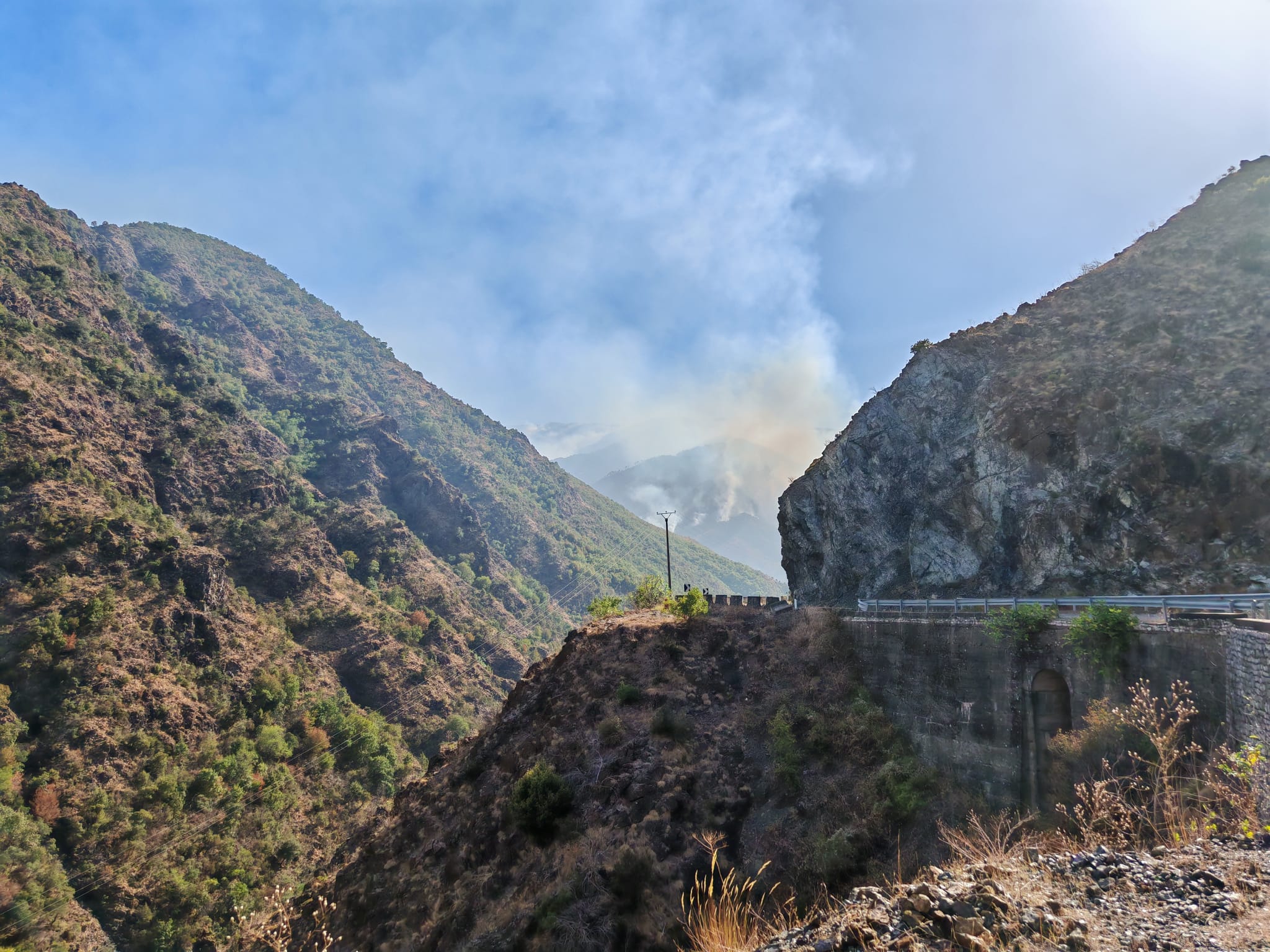
At around 2,000 metres above sea level, the temperature also reminded us how much conditions can change during a motorcycle tour through the Balkans and Carpathians. Only a few days earlier we had been riding in much warmer summer temperatures. Up here, even in August, the air was noticeably colder and mountain weather could change within minutes.
The following morning we continued from Lake Bâlea and stopped at Capra Waterfall, only a short ride away. The waterfall drops beside the mountain road and offered another natural reason to park the motorcycles for a while rather than simply chasing kilometres.
From there we continued through central Romania toward Bran, leaving the highest mountains behind and entering the wooded landscapes and villages of Transylvania. Our destination was close to Bran Castle, one of Romania’s best-known landmarks and internationally associated with the Dracula legend.
After seven consecutive riding days, it was time for our first proper rest day. But rather than spending the day sightseeing in Bran, we went to Brașov, where both the group and the motorcycles had their own programme.
Brașov gave us the chance to experience a completely different side of Romania. We explored the historic old town, walked through its streets and squares and had time to take in the local atmosphere without watching the clock or thinking about the next border crossing. After so many days on the motorcycles, simply having time to walk around, sit down for a coffee and experience everyday life in a Romanian city was a welcome change.
Later, we took the cable car up the mountain above Brașov and visited the restaurant at the top, with panoramic views over the city and the surrounding Transylvanian landscape. Looking down over Brașov from above was another memorable moment of the tour — this time without helmets, riding gear or another few hundred kilometres still ahead of us.
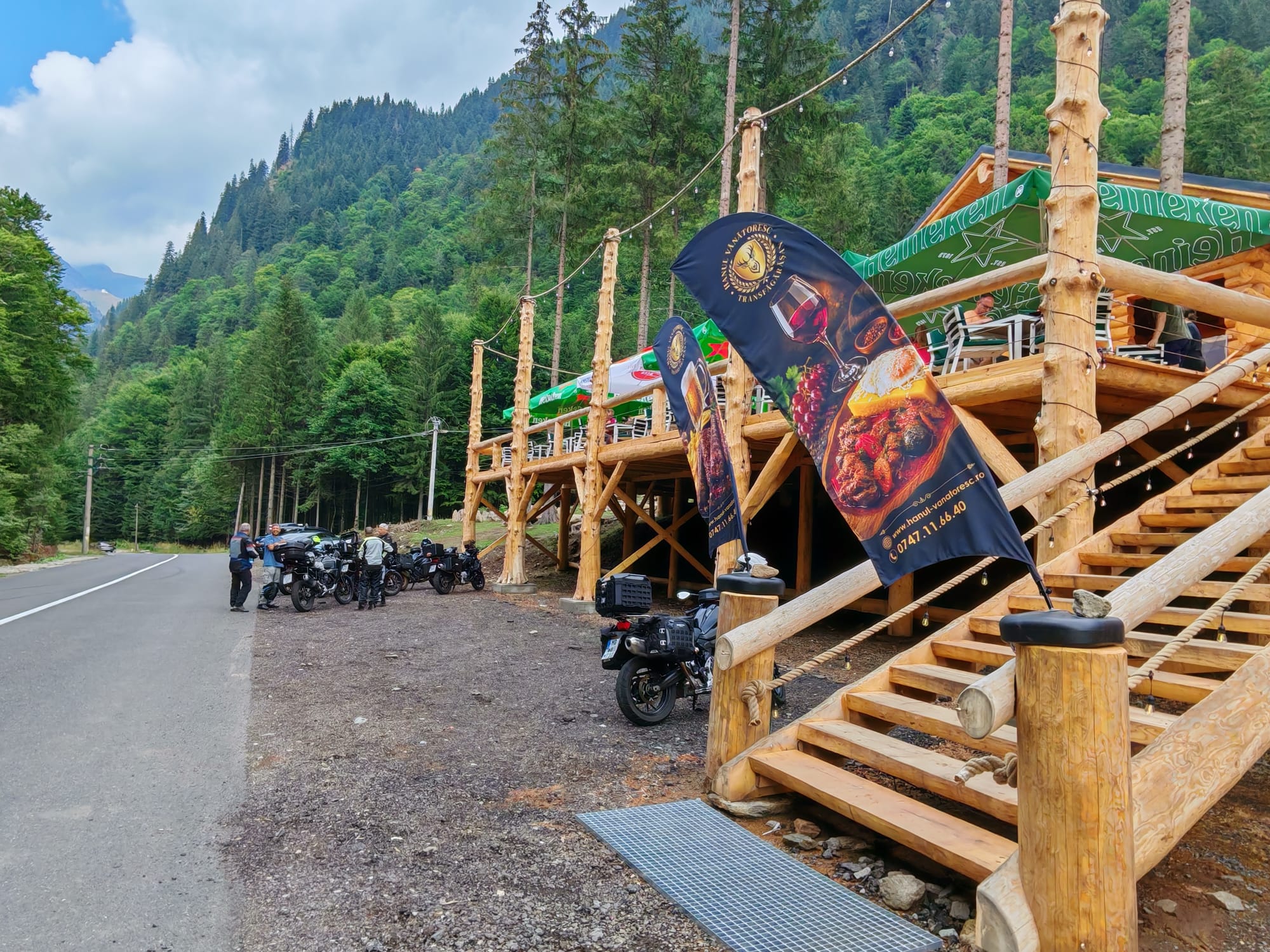
The rest day also provided the ideal opportunity to take care of something much less spectacular, but essential on a journey of this length: the motorcycles themselves. Three bikes needed fresh tyres before we continued toward North Macedonia, Albania and Montenegro, where further demanding mountain roads were waiting for us.
This was not something we left until the last minute. The required tyres, including the correct sizes for the individual BMW GS models, had already been ordered and reserved before the tour began with a trusted motorcycle partner in Brașov whom we know and regularly work with. The workshop knew our schedule, the tyres were waiting for us and the fitting had been arranged to coincide with the group’s rest day.
That kind of preparation is an important part of organising a guided motorcycle tour through several countries. A tyre change sounds simple until a group is thousands of kilometres into a journey and the correct tyres suddenly have to be found in another country. Having reliable contacts and established partners along the route means that maintenance can be planned in advance instead of becoming an unexpected problem during the tour.
Most importantly, the riders did not have to spend their rest day searching for workshops, checking tyre availability or organising appointments. While the group enjoyed Brașov’s old town, local life and the views from the mountain above the city, the necessary motorcycle maintenance was taken care of in the background.
By the end of the day, both riders and motorcycles were ready to continue. The group had enjoyed a genuine break from riding, the bikes that needed new tyres were prepared for the next stages, and everyone could focus completely on the journey ahead.
That is one of the less visible parts of a professionally organised motorcycle tour, but also one of the most important. The riders should be able to concentrate on the roads, the landscapes and the experience. Our job is to make sure that everything else is already organised when it is needed.
By the time we left Transylvania, Romania had given us the TransSemenic, Transalpina, TransApuseana and Transfăgărășan, a night high in the clouds at Lake Bâlea, the historic atmosphere of Brașov and some of the finest riding of the entire journey.
But we were only around halfway through the tour.
The route was now turning south again — through Serbia and North Macedonia, toward Lake Ohrid, Albania and the Albanian Alps.
From Serbia to Albania: Skopje, Lake Ohrid, Galičica National Park and the Albanian Alps
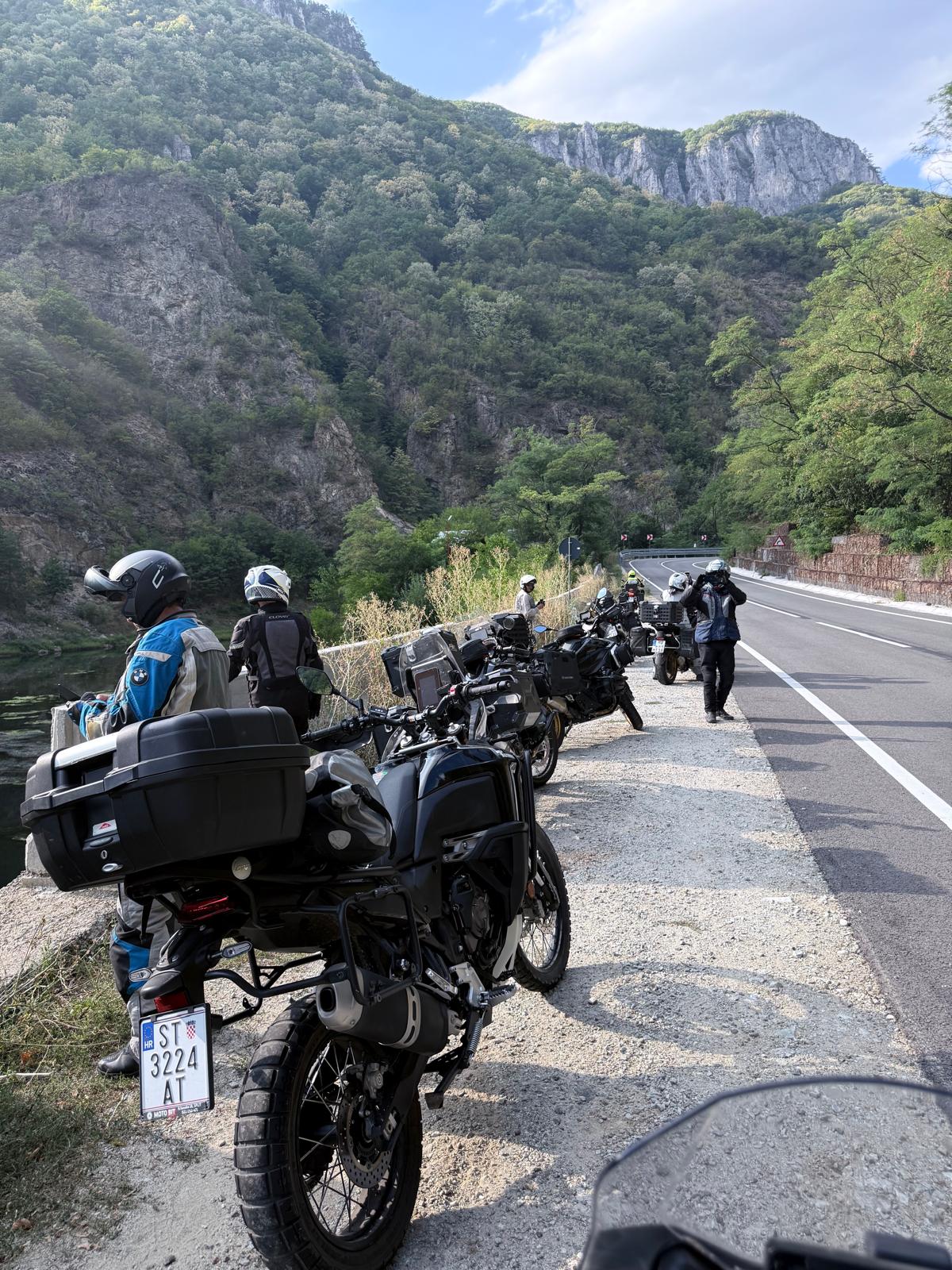
Leaving Transylvania, the journey turned south again. Romania had given us some of the greatest mountain roads of the tour, but the character of the journey was about to change once more. Ahead of us were Serbia, North Macedonia and finally Albania — with very different landscapes, roads and experiences waiting in each country.
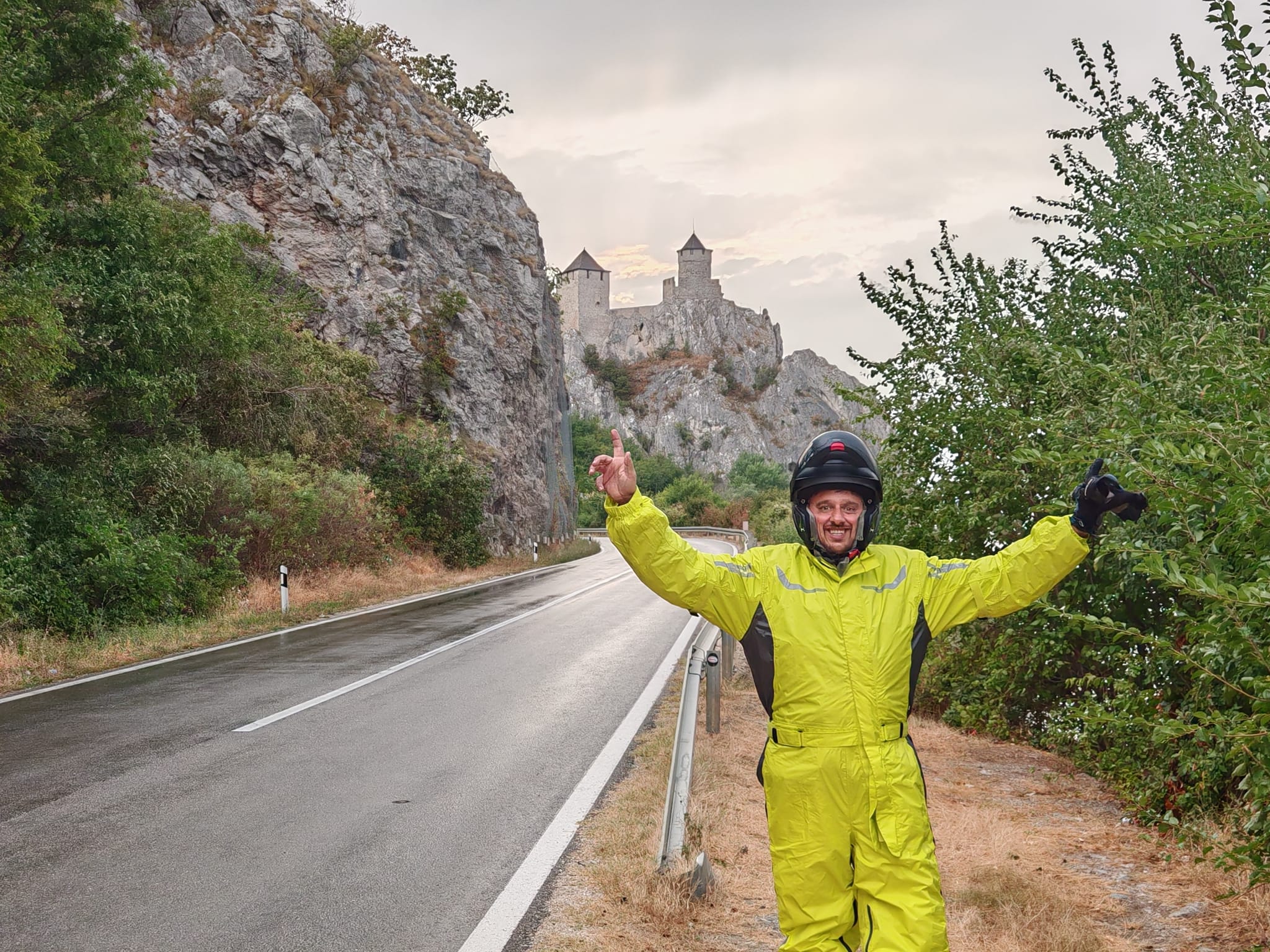
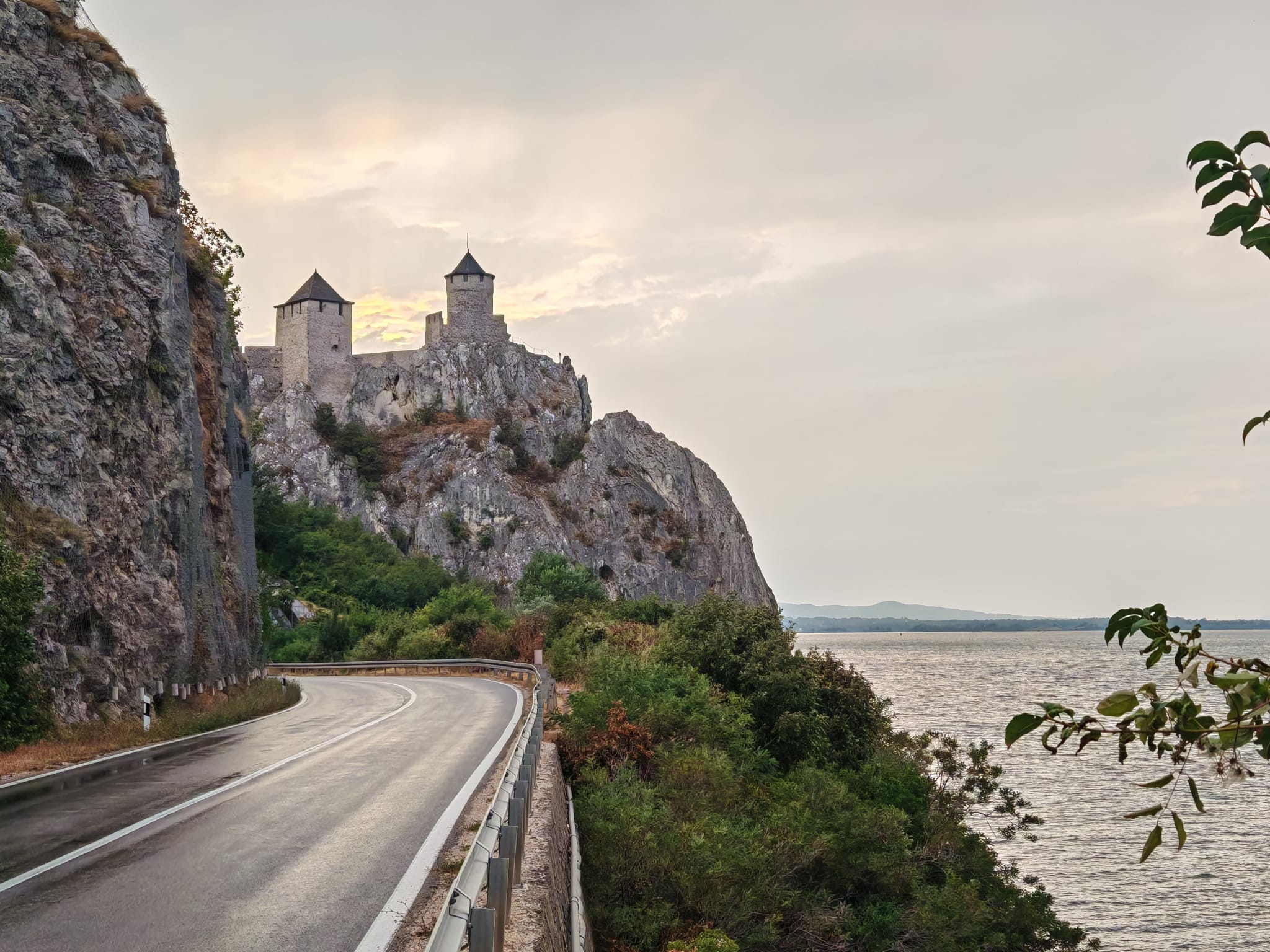
The first stage took us back across the Romania–Serbia border and toward the Danube. One of the highlights along the way was Golubac Fortress, standing directly above the river at the entrance to the Đerdap Gorge. After several days dominated by the Carpathian Mountains, the huge expanse of the Danube created a completely different setting and gave us another reason to stop rather than simply ride past.
We spent the night near the Danube before continuing south through Serbia. This was a longer transitional section of the tour, taking us away from the Romanian mountains and steadily toward North Macedonia. Our next overnight stop was Vranje, in southern Serbia, positioning us perfectly for the border crossing the following morning.
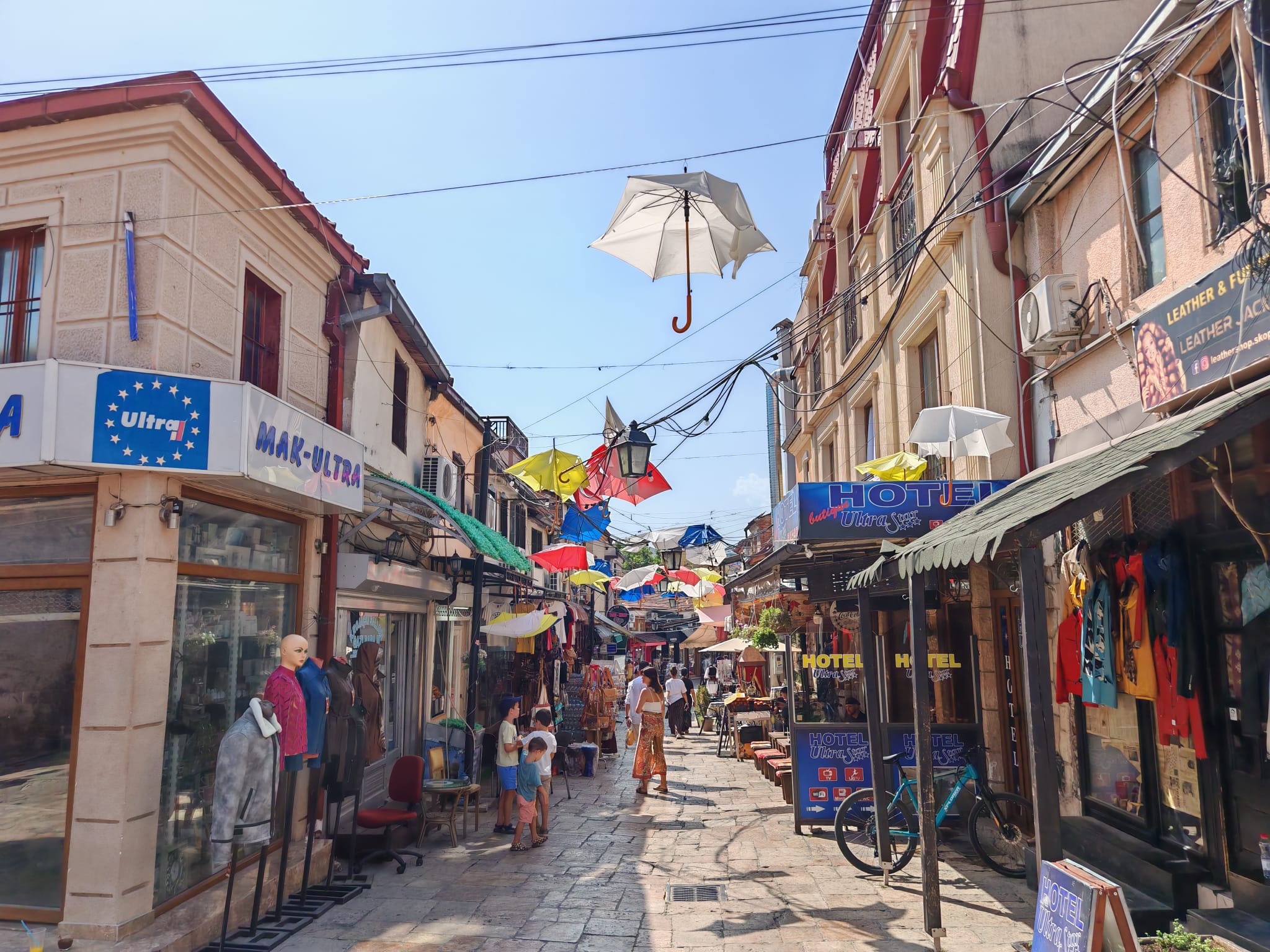
Once in North Macedonia, our first major stop was Skopje. We parked the motorcycles close to the historic centre and walked into the Old Bazaar, one of the places where the cultural change along this journey becomes immediately noticeable. Cafés, restaurants, small shops and narrow streets gave us time for lunch and a break before getting back on the bikes.
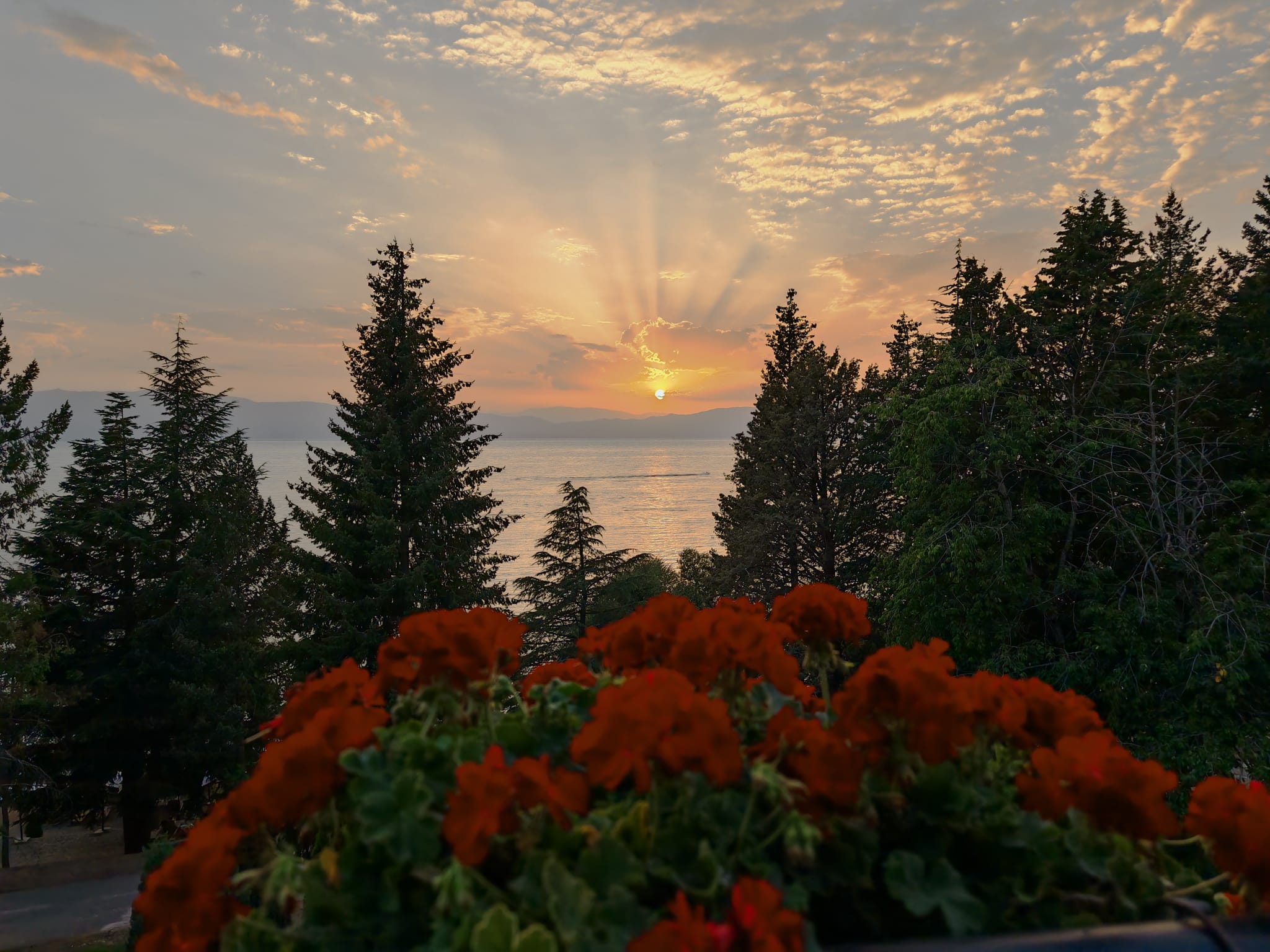
From Skopje we continued south-west toward Lake Ohrid. By the time we reached the lake, the scenery had changed again completely. Mountains surround an enormous body of deep blue water, and our hotel was directly in the Lake Ohrid area — a perfect location for the next part of the route.
The following morning became one of the great scenic surprises of the tour.
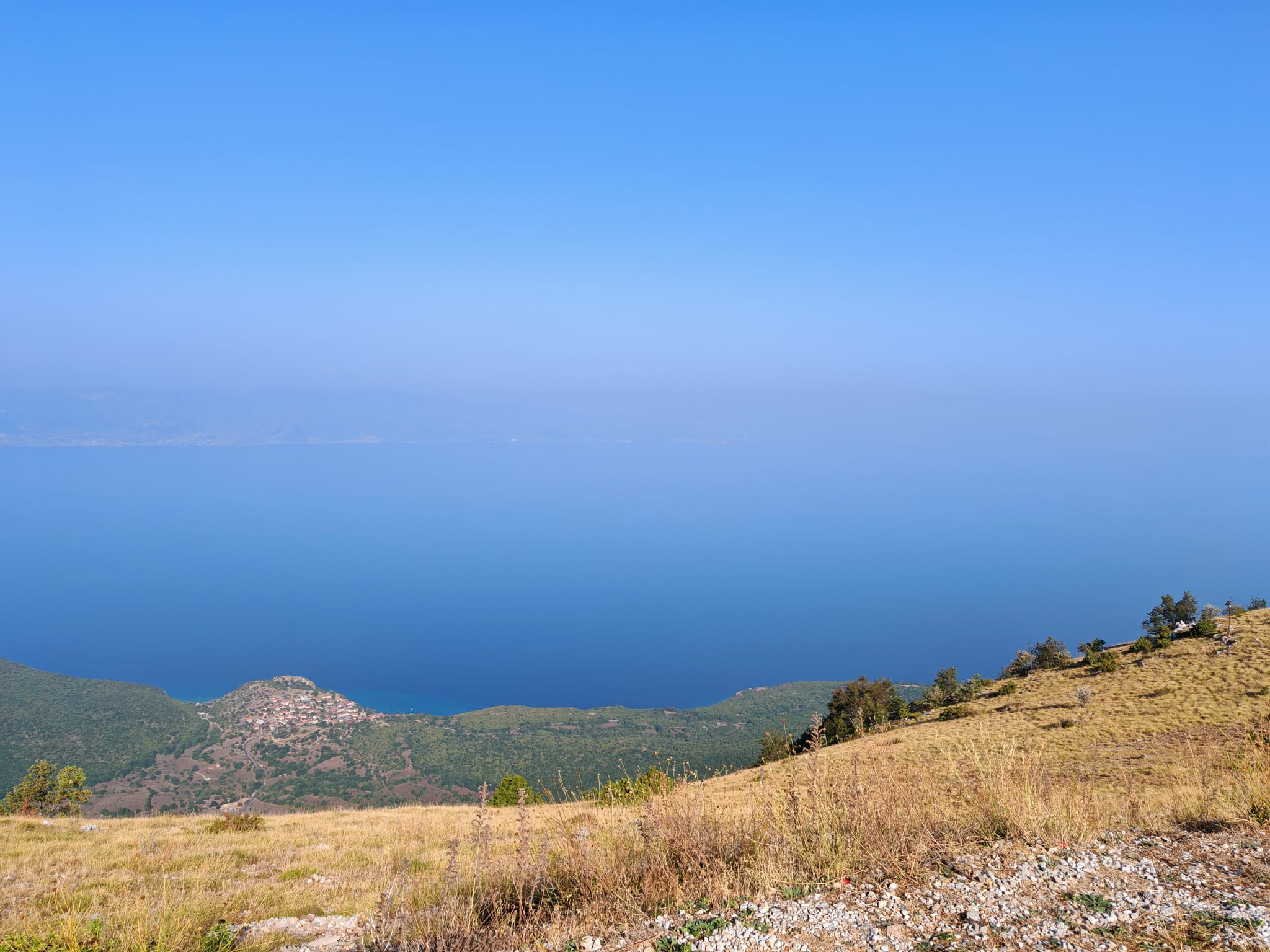
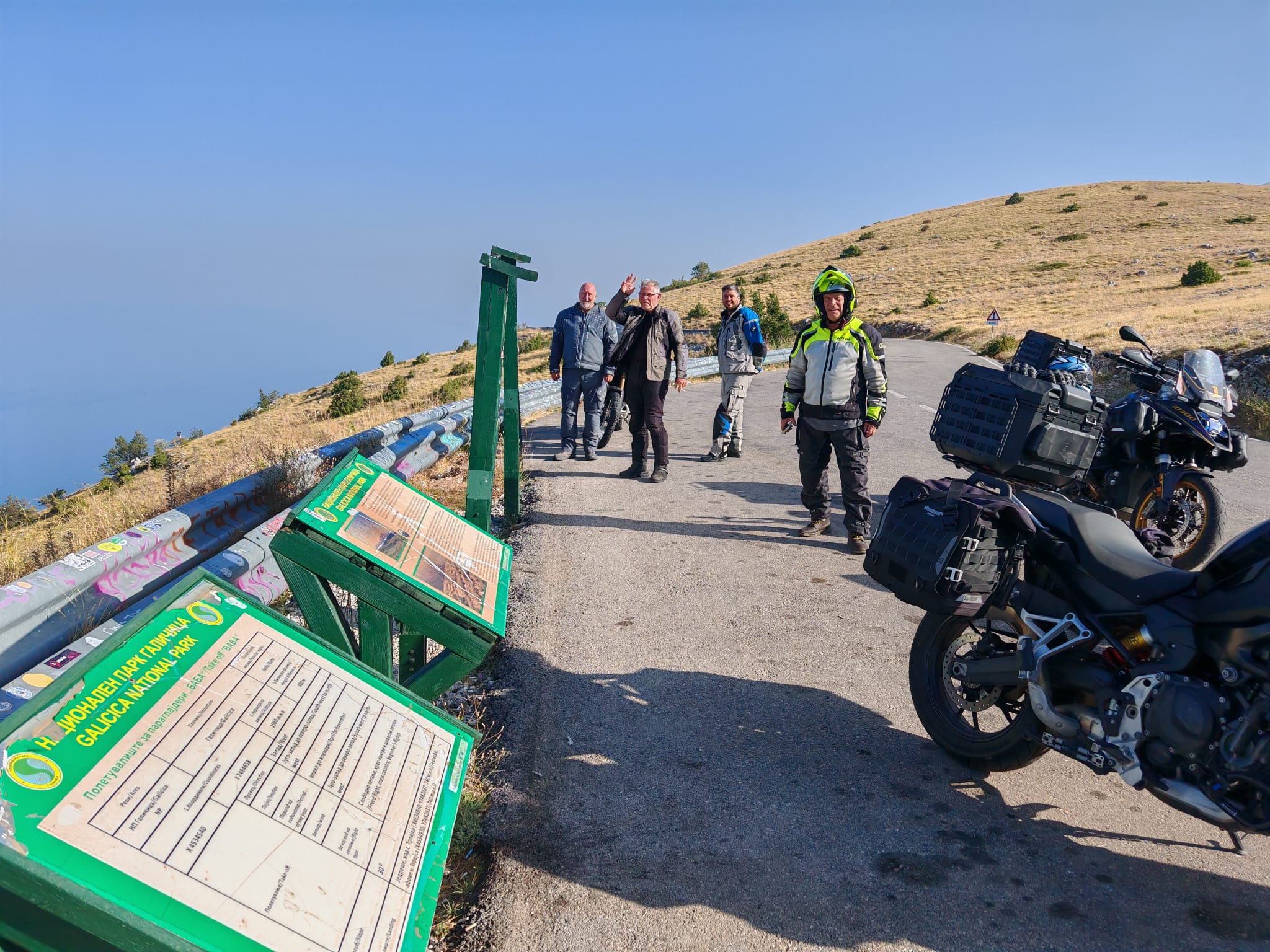
Instead of simply taking the quickest road toward the Albanian border, we rode into Galičica National Park, climbing high above Lake Ohrid. The mountain massif rises between Lake Ohrid and Lake Prespa, and as the road gained altitude the view behind us became increasingly spectacular.
Then came the viewpoint.
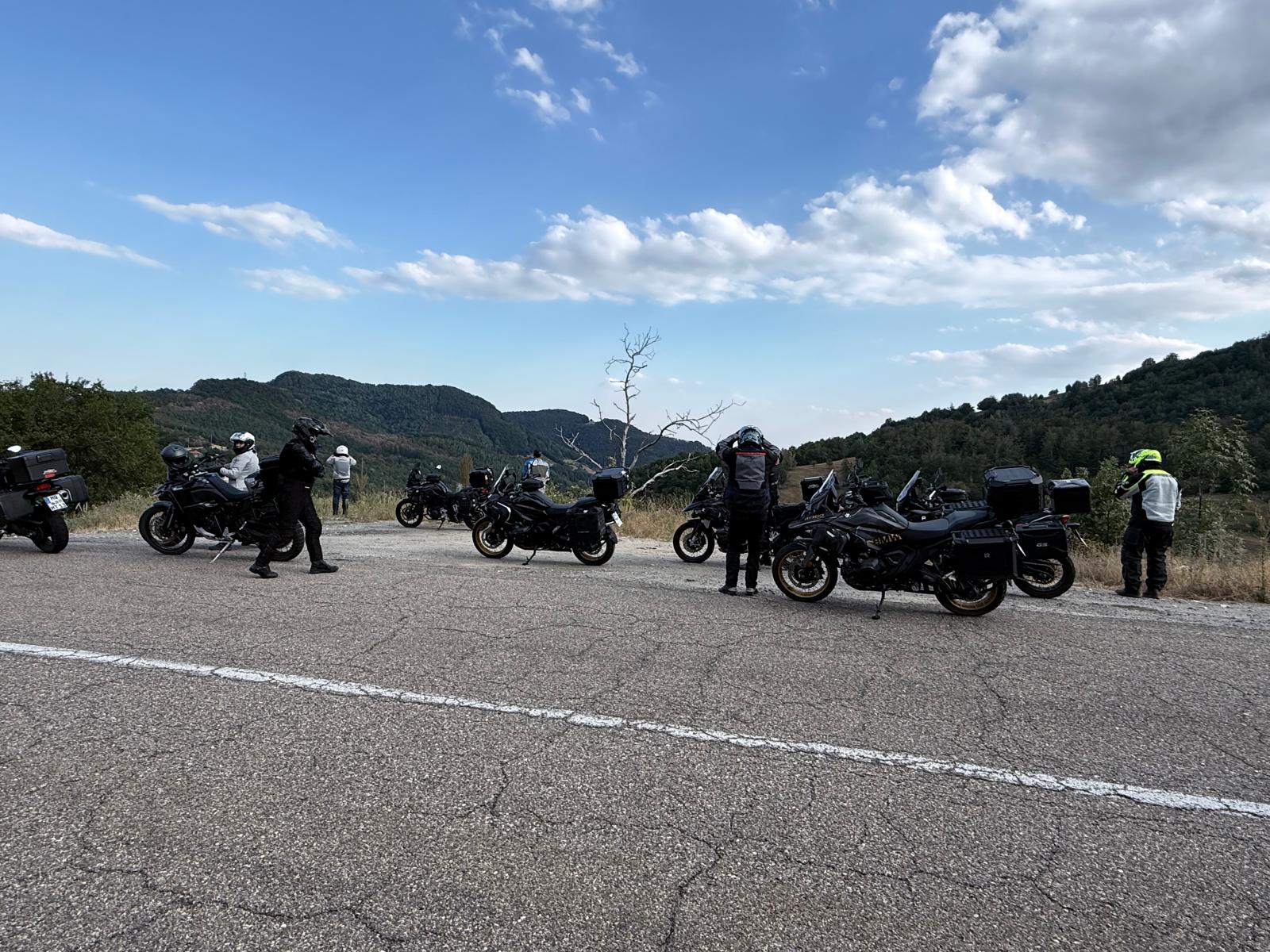
Far below us lay Lake Ohrid, framed by mountains and stretching away toward the horizon. From high above, the scale of the lake suddenly became completely different from what we had experienced at water level the evening before. It was one of those places where everyone stopped, switched off the engines and simply looked.
For a motorcycle tour, this is exactly why taking the direct road is not always the best option. The route through Galičica National Park added more than just kilometres. It gave us one of the most impressive panoramic views of the entire journey and turned the ride toward Albania into a highlight in its own right.
From the mountains above Lake Ohrid we continued toward the border and crossed from North Macedonia into Albania. No repeated border crossings and no unnecessary complications — just one crossing into the country that gave this tour its name.
Our first Albanian destination was Shëngjin, on the Adriatic coast. After the high mountains and cooler air around Lake Ohrid, we were suddenly back at sea level and in much warmer temperatures. Albania had begun with another complete change of scenery.
But Shëngjin was only the introduction.
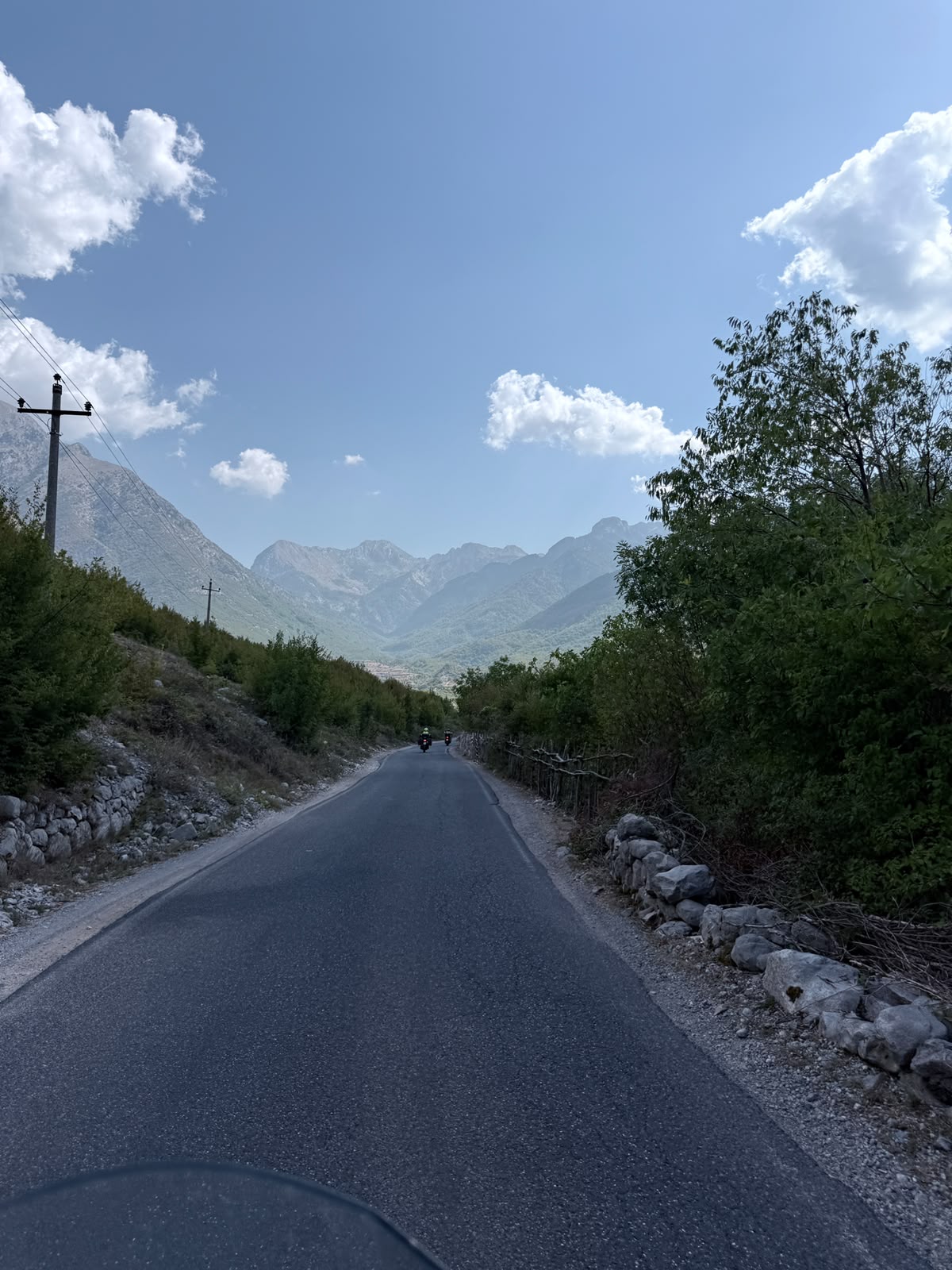
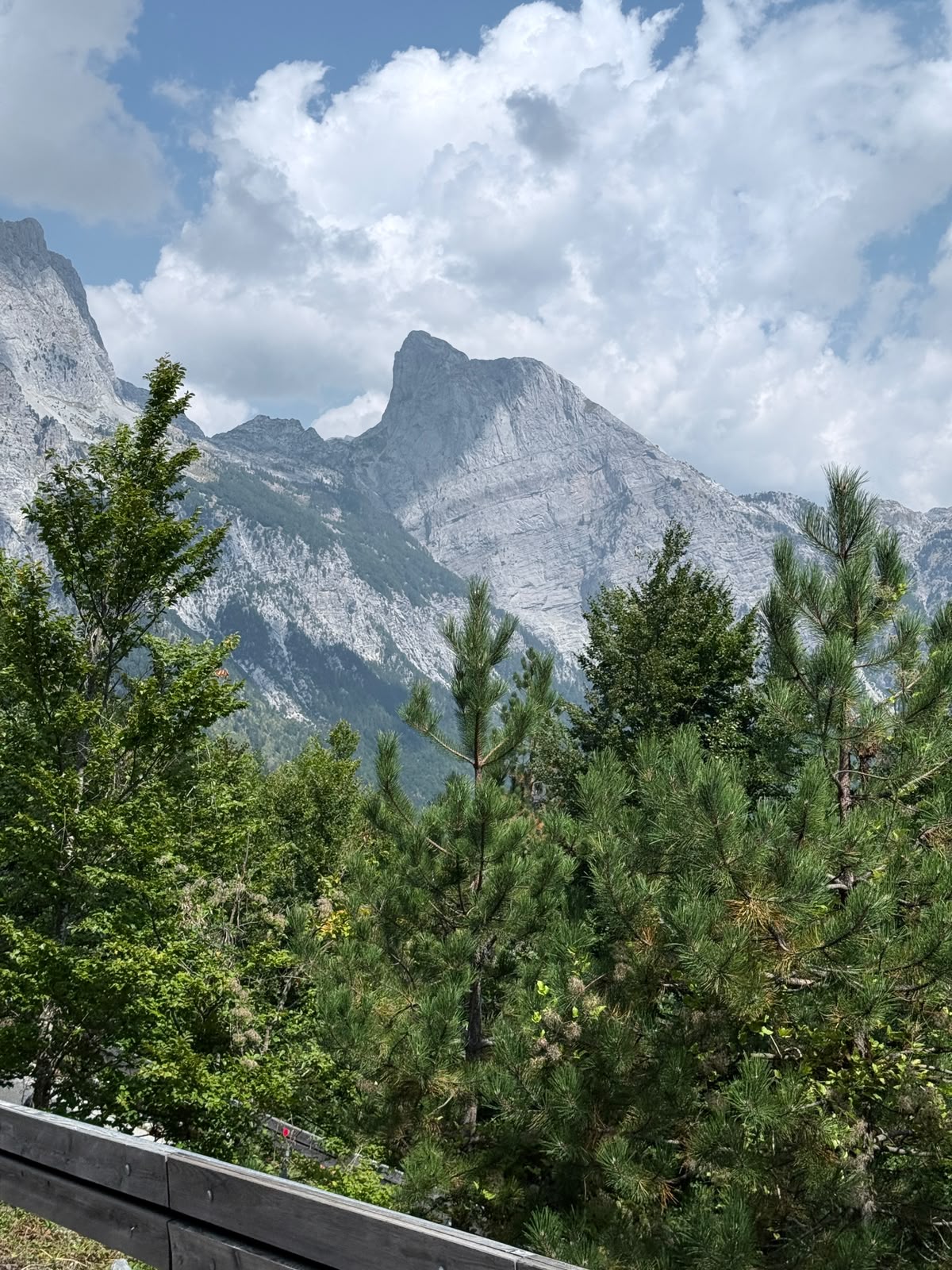
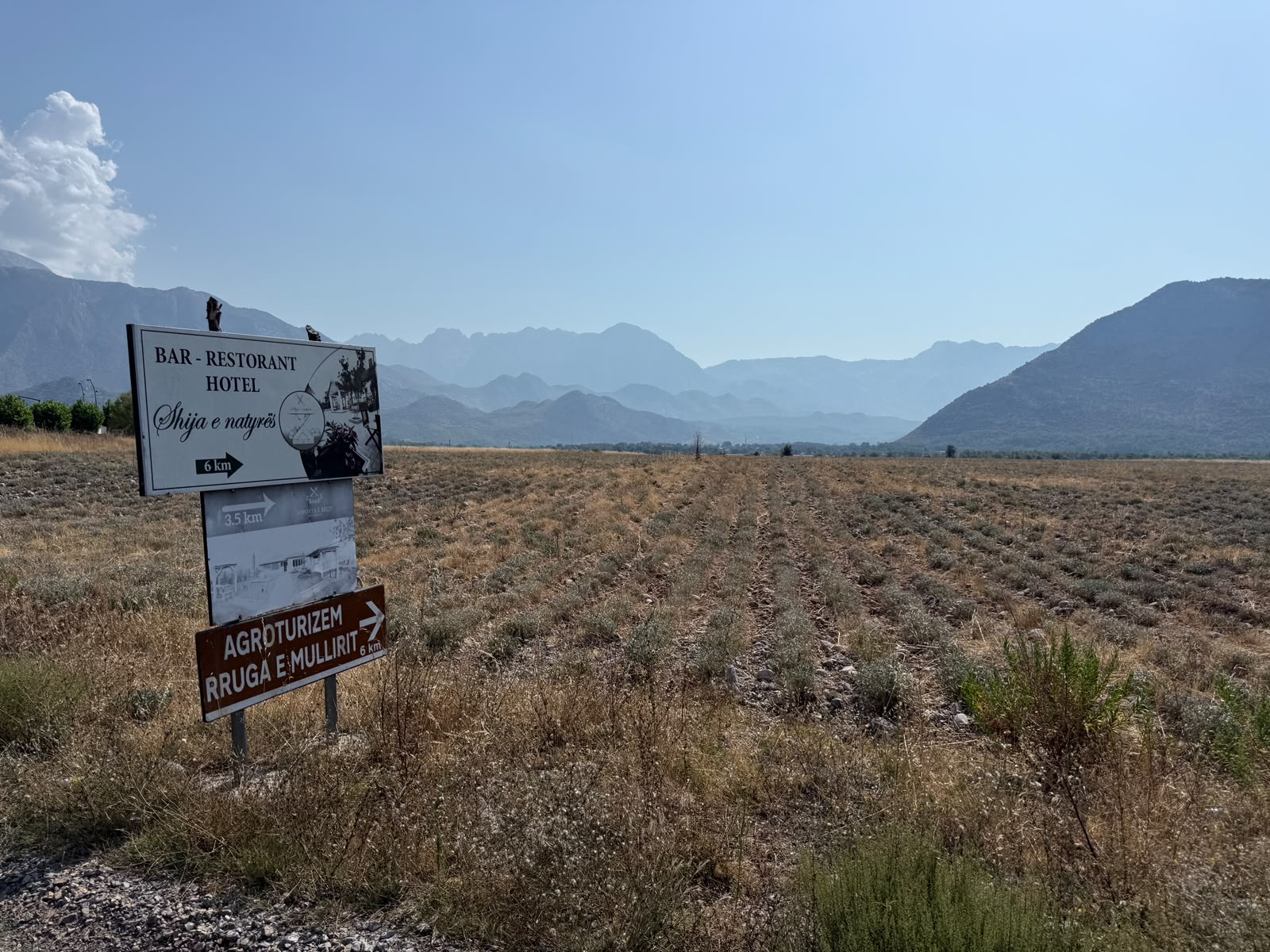
The following morning we left the coast early and headed north toward the Albanian Alps and Theth. This was one of the days we had all been waiting for. The roads became smaller, the mountains steeper and the surroundings increasingly remote as we moved away from the coastal plain and deeper into northern Albania.
The route into Theth Valley is not an off-road route, but sections can be considerably rougher than the smooth mountain passes we had ridden in Romania. Depending on construction and road conditions, good asphalt can be followed by broken surfaces, gravel or unfinished sections before returning to pavement again. It is a public road used by local traffic, but on a fully loaded BMW GS it demands considerably more concentration than an ordinary touring road.
And the effort is worth it.
As we climbed deeper into the Albanian Alps, enormous limestone mountains rose around us and the valleys became increasingly dramatic. Traffic became sparse, villages smaller and the feeling of being far away from the major tourist routes became stronger with every kilometre.
Theth is not memorable because of one single corner, viewpoint or attraction. It is the entire approach: the mountains, the narrow roads, the changing surfaces and the feeling that the landscape keeps becoming bigger the further you ride into it.
This was exactly the kind of day for which we had adapted the standard tour itinerary for this particular group. It was longer, more demanding and less predictable than taking the easy road — but after the unanimous decision we had already made in Romania to choose the extraordinary whenever we had the opportunity, nobody wanted it any other way.
After exploring the Theth region, we continued toward the Albania–Montenegro border. Before the day was over, one final spectacular landscape was still waiting for us.
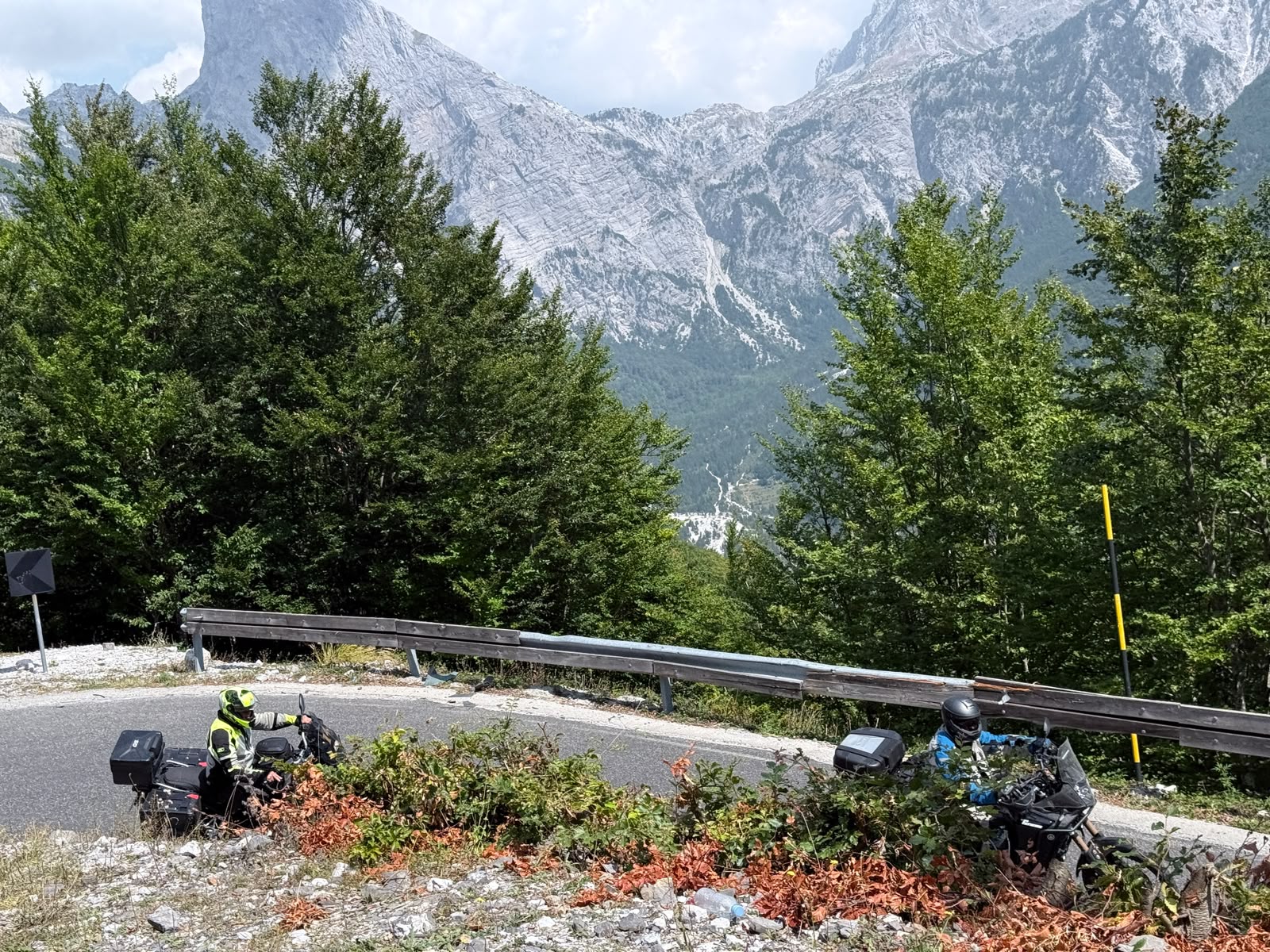
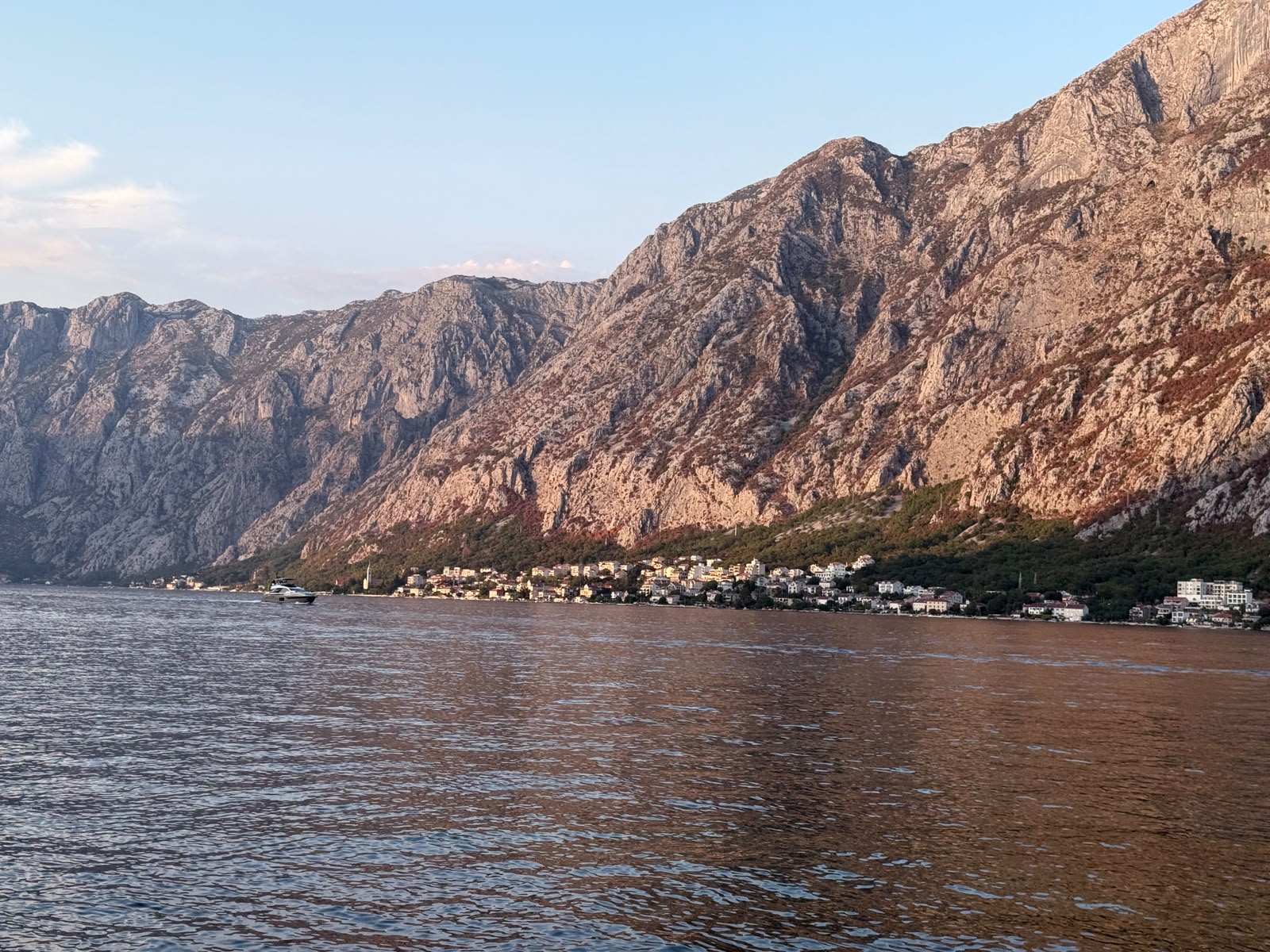
Descending through Montenegro, the mountains eventually opened and revealed the Bay of Kotor far below. After a day that had begun near the Albanian coast, taken us deep into the Albanian Alps and through Theth, standing high above the Bay of Kotor felt almost like arriving in another world.
It had been a long and demanding riding day — but also one of the days that best represented what this tour was about: not simply connecting countries, but deliberately choosing roads and places that made the journey worth remembering.
Montenegro by Motorcycle: Bay of Kotor, Ostrog Monastery, Tara Canyon, Durmitor and Piva Canyon
Crossing from Albania into Montenegro did not mean the end of the mountains. Quite the opposite. One of the most spectacular arrivals of the entire tour was still waiting for us.
Our route climbed high above the Bay of Kotor to one of the classic panoramic viewpoints overlooking the bay. From up there, the entire landscape opened beneath us: the deep blue water, the mountains rising almost directly from the shoreline and the settlements scattered around the bay far below. After the long and demanding ride through Theth and the Albanian Alps, it was an extraordinary place to stop, switch off the engines and simply take in the view.
But looking down at the Bay of Kotor was only the beginning.
From the viewpoint we descended toward the water on a spectacular series of serpentine bends, losing altitude turn after turn until we finally reached the bay itself. Few approaches to an overnight destination could have provided a greater contrast: only a short time earlier we had been high in the mountains looking down at the water; now the BMW GS motorcycles were parked almost at sea level beside it.
Our hotel was located directly on the waterfront on the opposite side of the bay from Kotor. And for the evening, the motorcycles stayed exactly where they were.
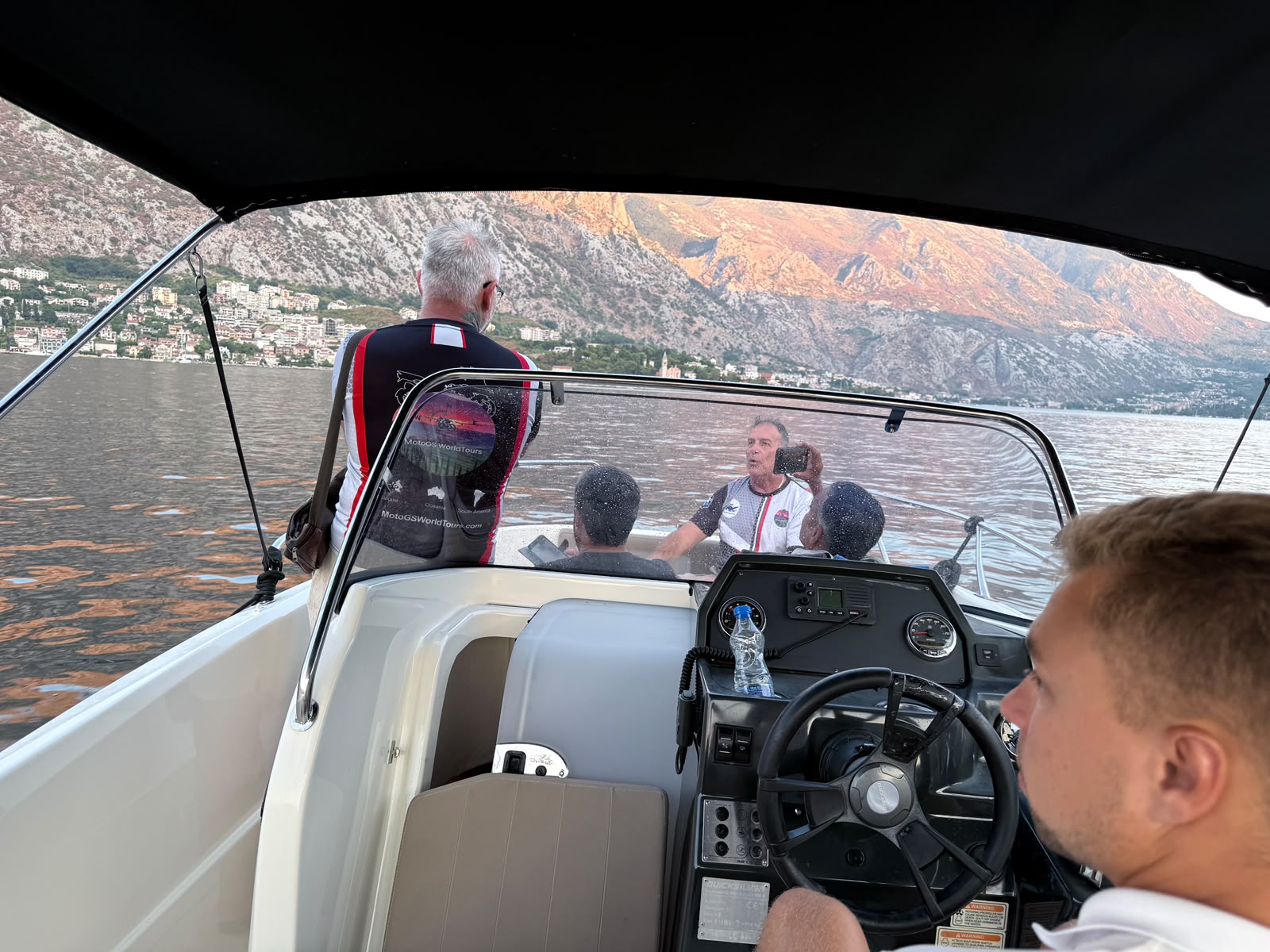
Instead of riding around the bay, we took a water taxi across to Kotor. Arriving by boat gave us a completely different perspective of the mountains surrounding the bay and was also the perfect way to reach the historic centre without worrying about traffic or parking.
The Old Town of Kotor is one of those places that simply has to be experienced when travelling through Montenegro. Hidden behind massive old city walls and pressed between the waterfront and the steep mountain slopes and fortifications rising above it, the narrow streets, stone buildings, small squares and restaurants create an atmosphere completely different from anything we had experienced during the riding days.
We spent the evening walking through the old town before sitting down together for dinner inside the historic walls. After a long day that had started in Albania, taken us through the Albanian Alps and finished with the descent into one of the most beautiful bays in the Adriatic, there was no better place to end it.
Later that evening, the water taxi took us back across the bay to our hotel directly beside the water. No motorcycles, no riding gear and no need to think about the next turn for a few hours — just the lights of the Bay of Kotor reflecting on the water.
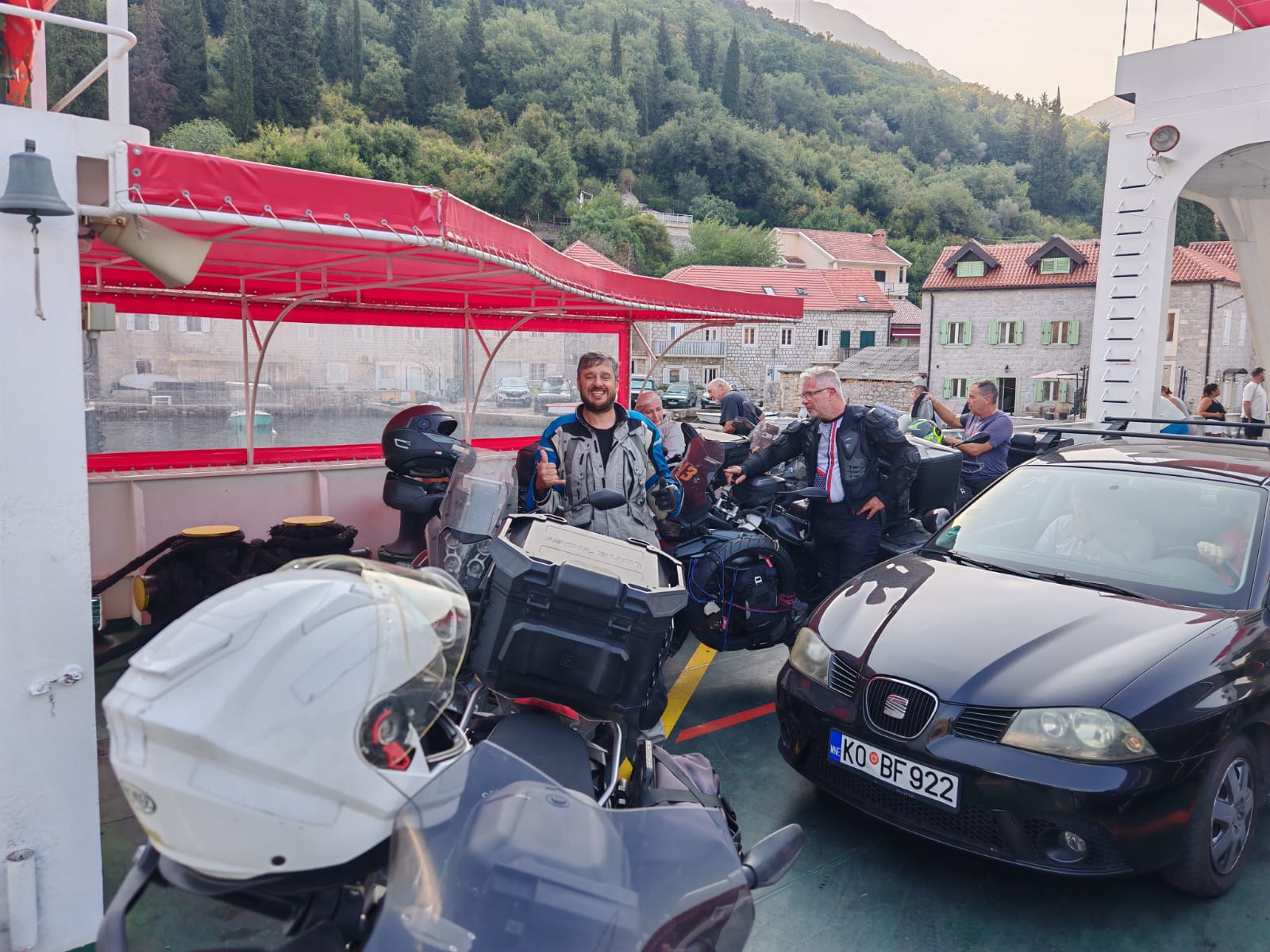
The following morning, our route turned inland toward Ostrog Monastery. To continue the journey, however, we first had to reach the opposite side of the Bay of Kotor. There are two ways to do that: follow the entire bay by road, which can easily take one and a half to two hours in heavy traffic, or take the nearby ferry across the water. We chose the ferry. Within minutes, the BMW GS motorcycles were on board, the engines were switched off and we were crossing the bay before continuing our journey from the opposite shore. It was not only the faster option, but also a far more memorable way to start the day.
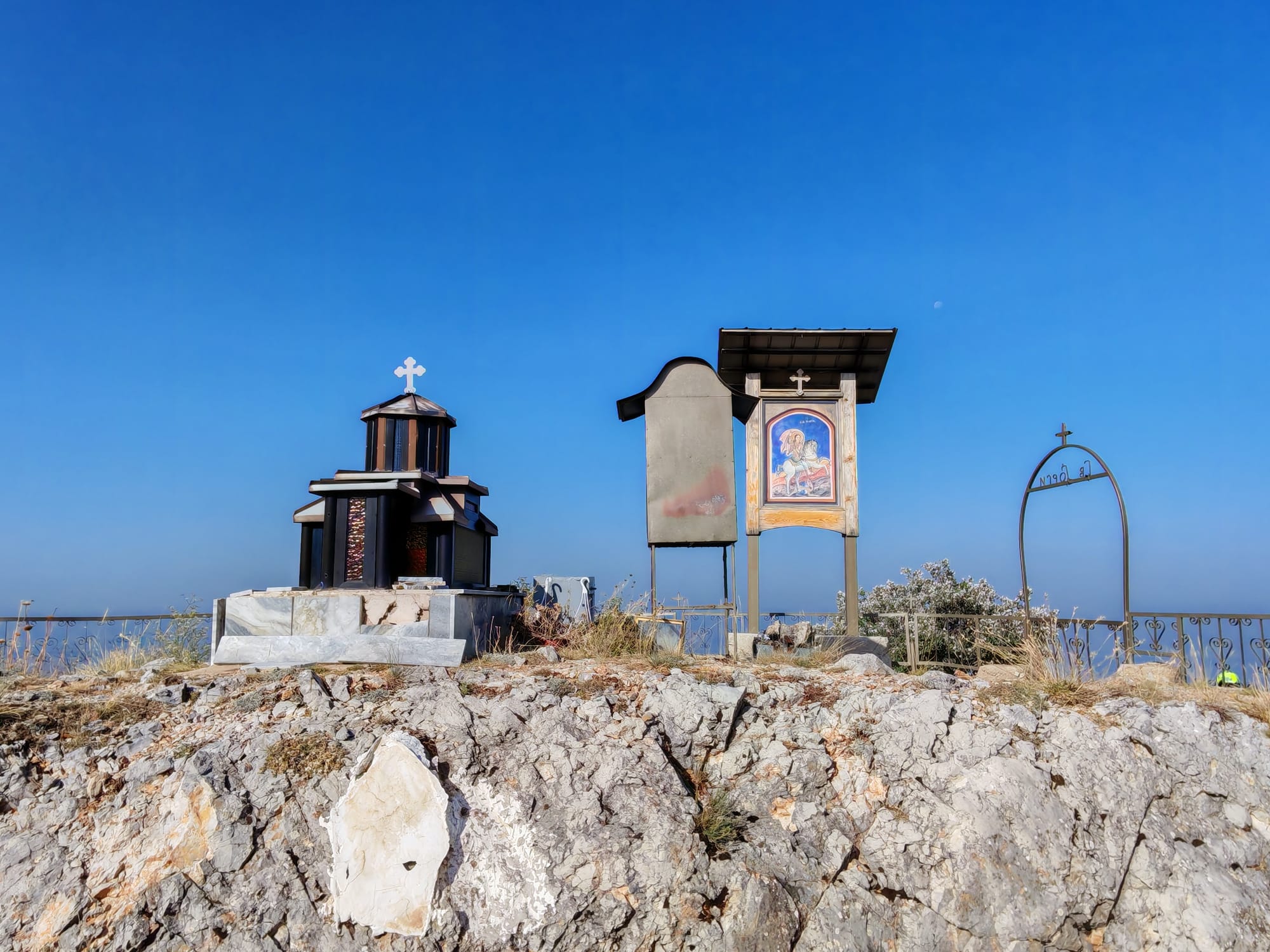
From there, we left the coast behind and rode inland toward Ostrog Monastery, dramatically built into a near-vertical rock face high above the surrounding valley. The ride itself already felt like a complete change from the Bay of Kotor, and Ostrog added another remarkable dimension to the journey. This was not simply a photo stop beside the road. We parked the motorcycles and took time to experience one of Montenegro’s most extraordinary places before continuing north toward the Tara region.
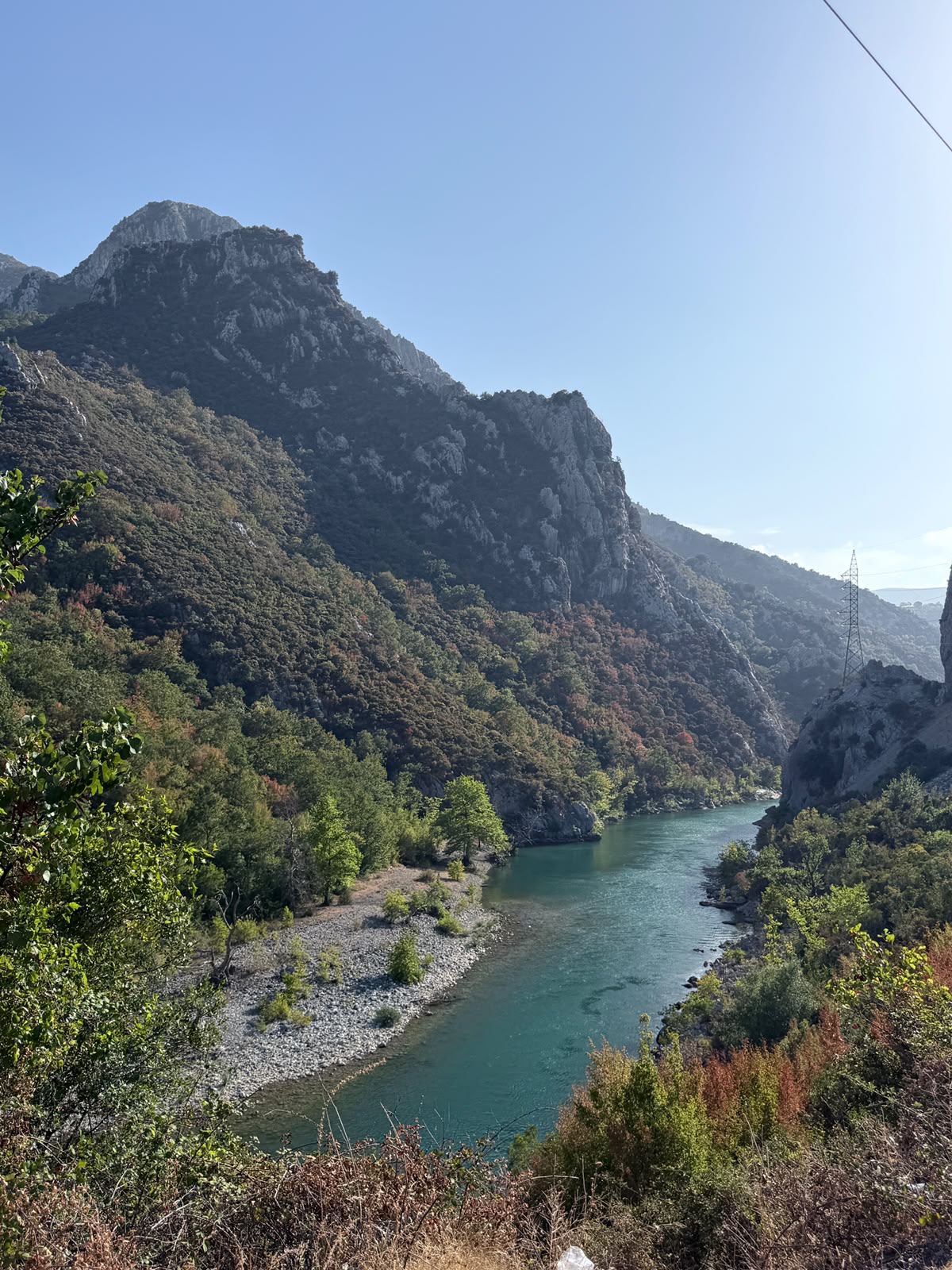
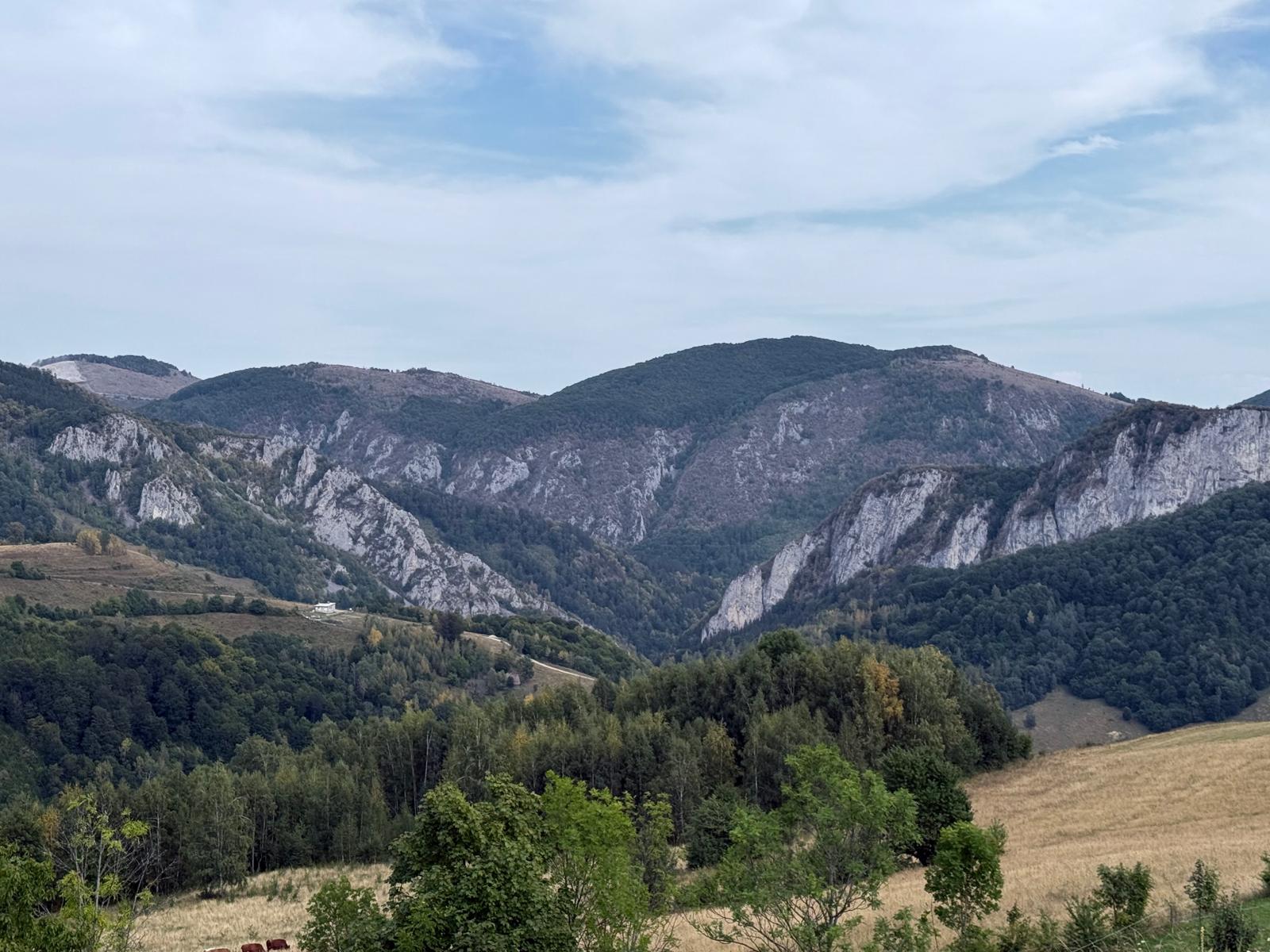
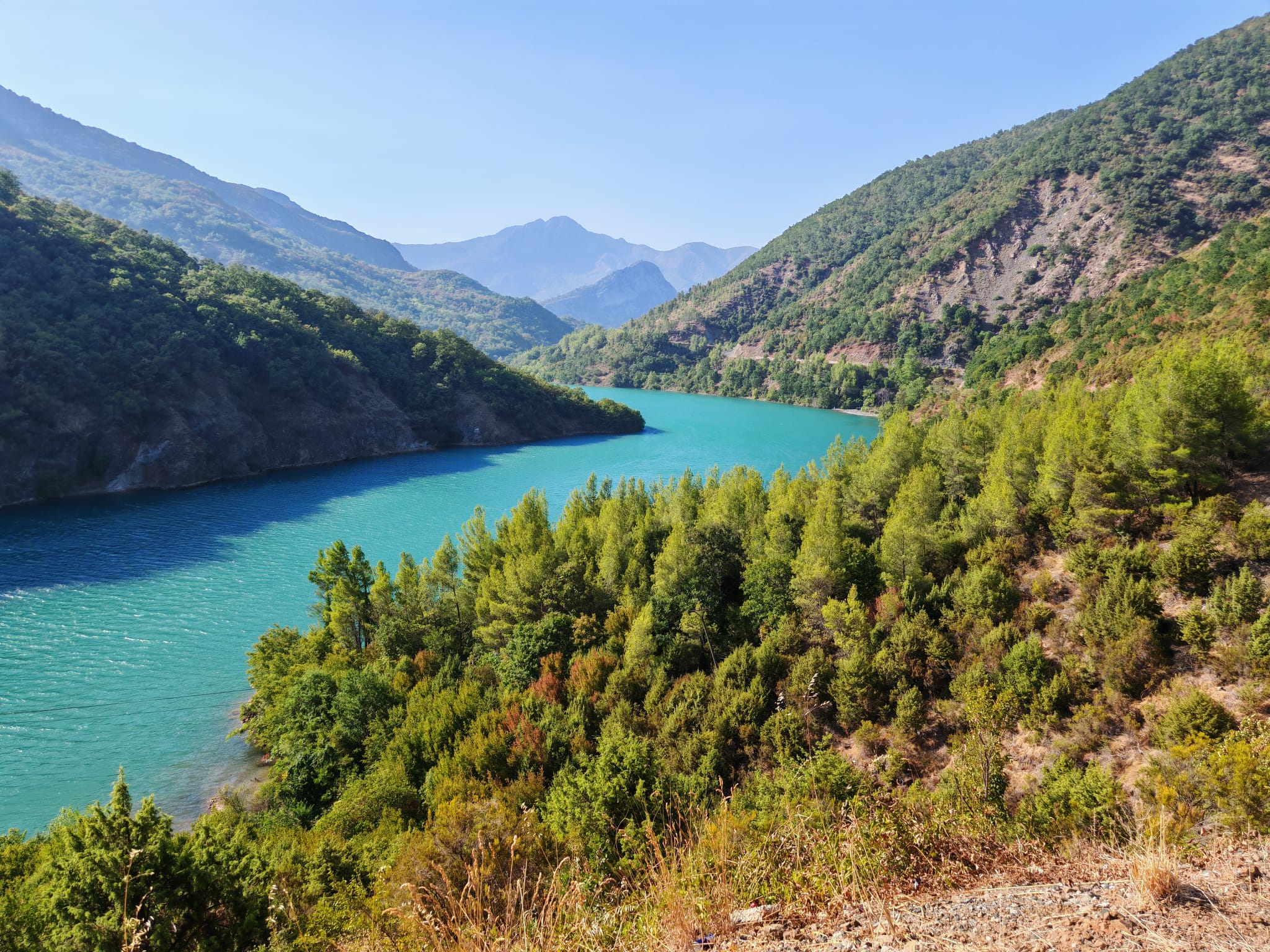
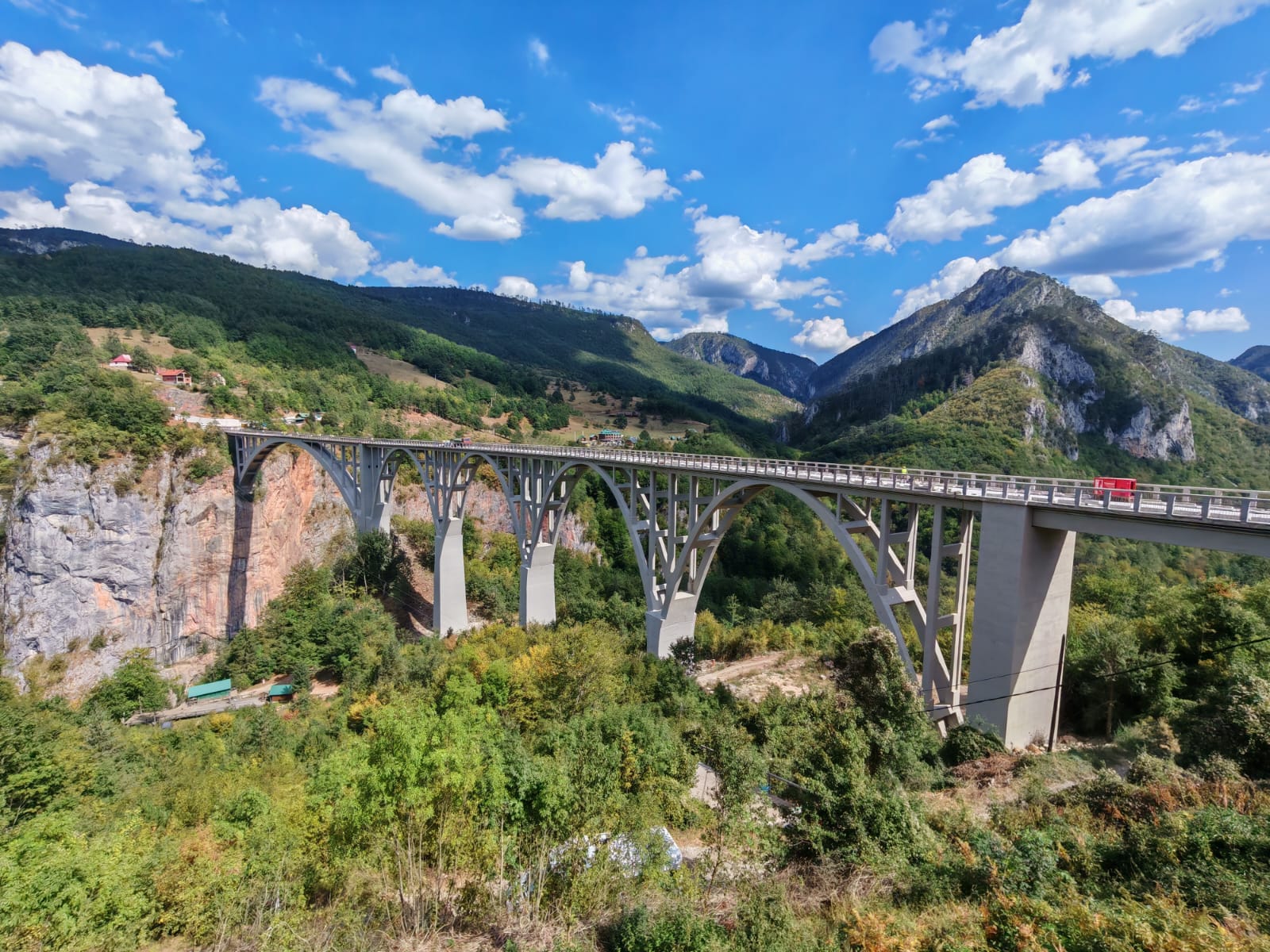
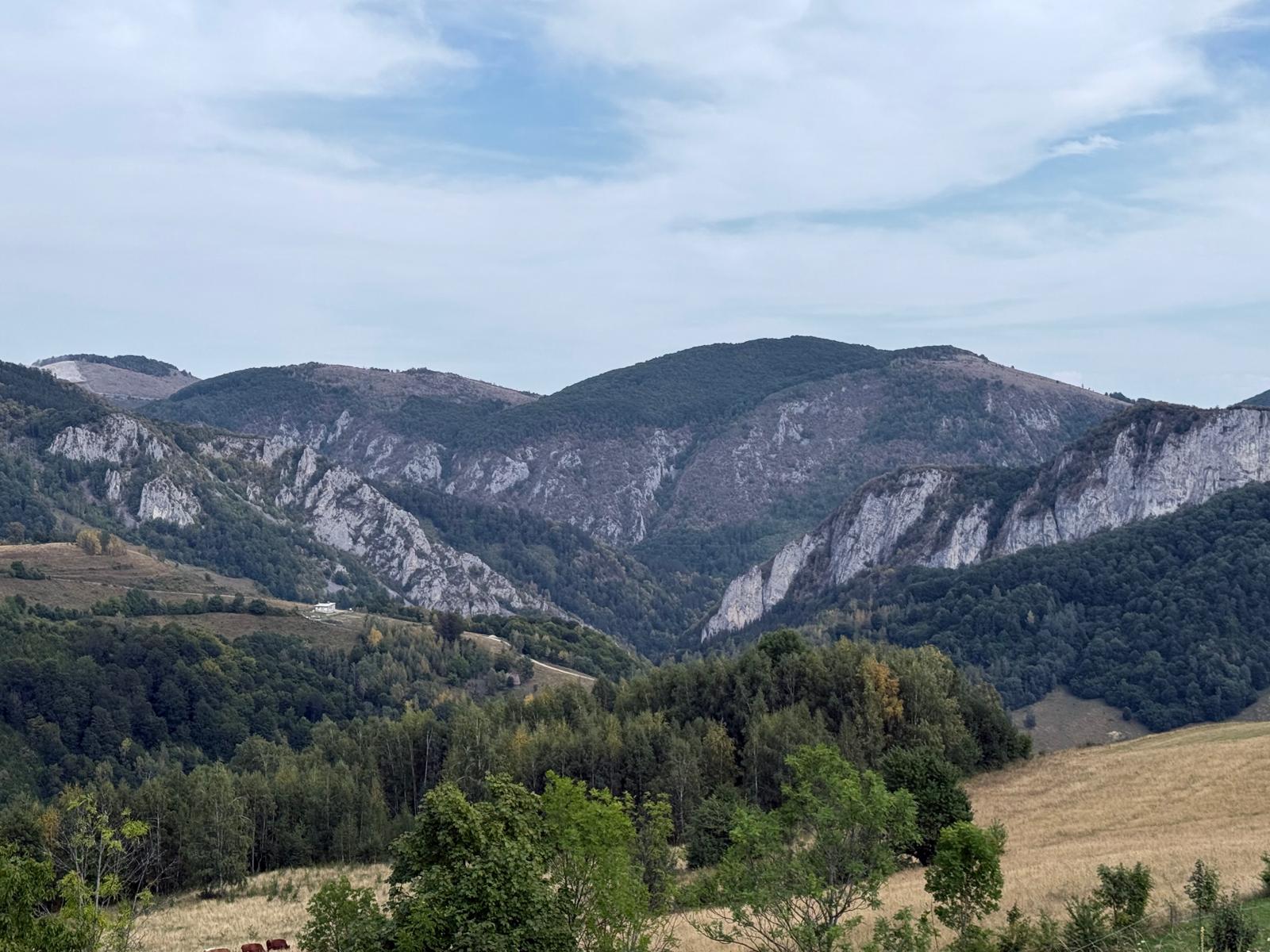
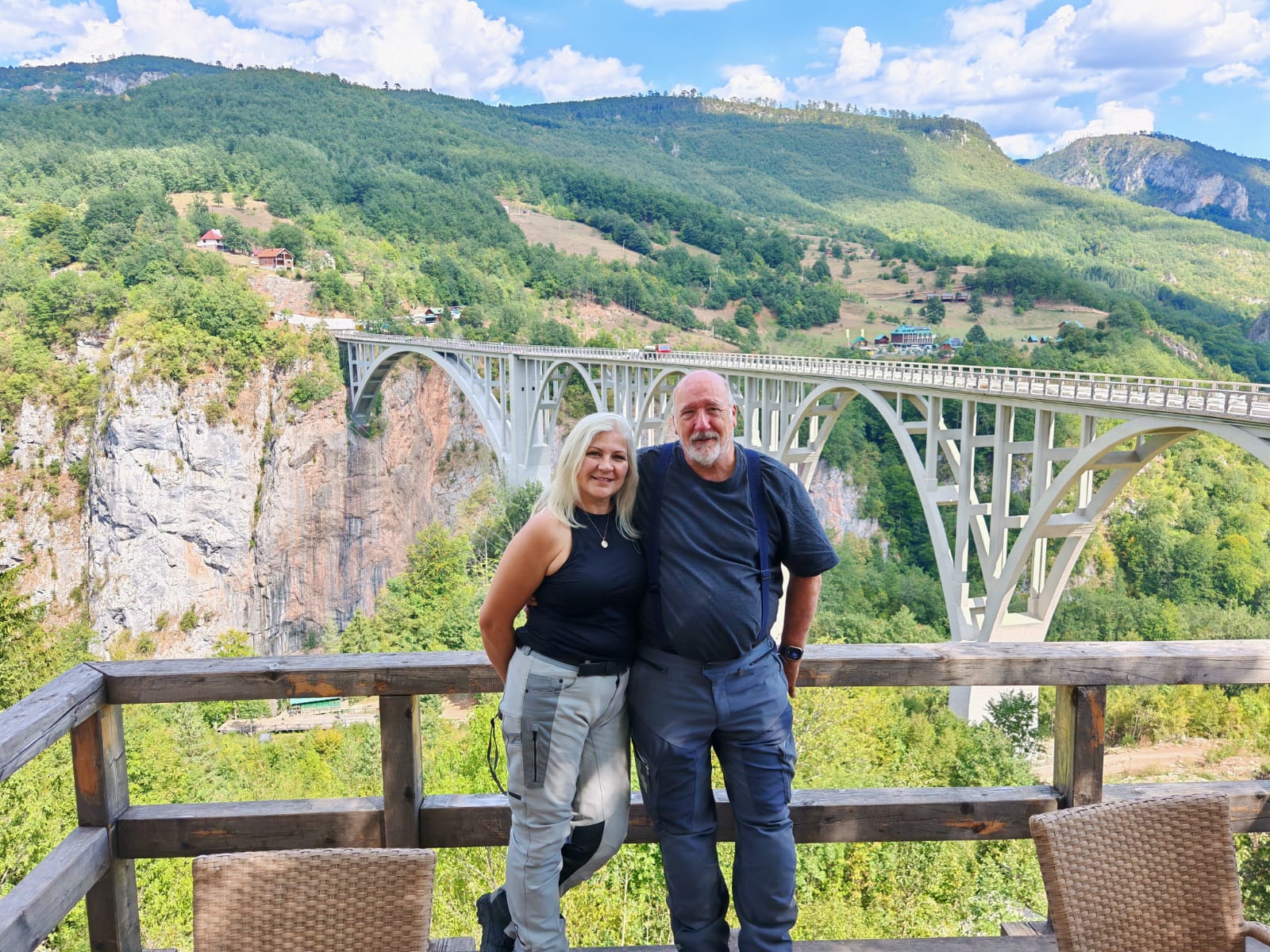
From Ostrog, the route led deeper into the interior toward the Tara River and Tara Bridge. The landscape became increasingly wild as we approached northern Montenegro: higher mountains, dense forests and the enormous Tara Canyon cutting through the region.
But once again, we were not satisfied with simply standing on the bridge, looking down into the canyon and continuing to the next hotel.
Our destination was deep inside the Tara Canyon itself.
The road descended further and further toward the river, away from towns, traffic and everyday civilisation. The deeper we travelled into the canyon, the more isolated everything became. Mountains and forest surrounded us, the Tara River ran below and eventually there was little left around us except nature and the narrow road leading deeper into the valley.
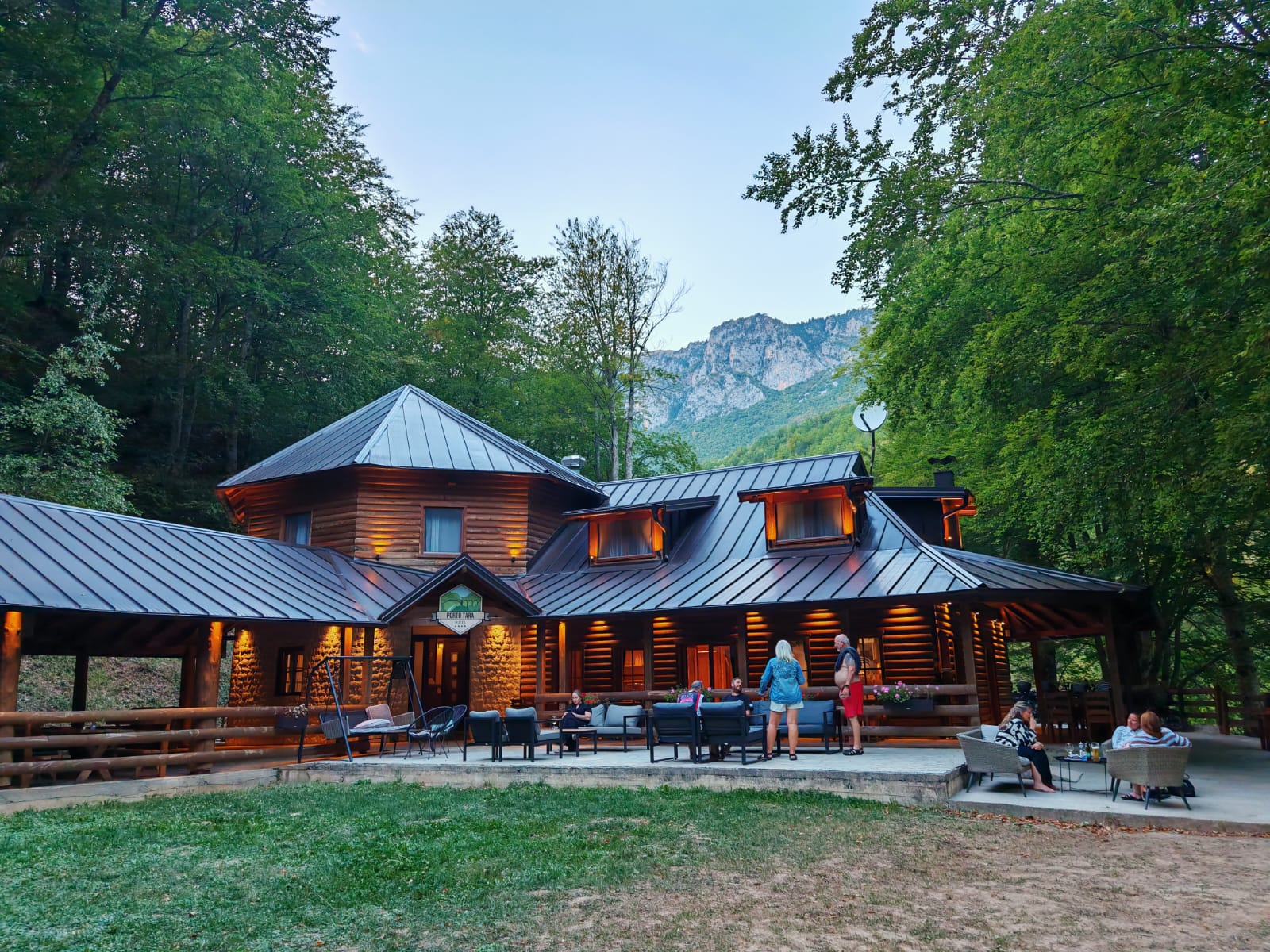
At the end of that road was Porto Tara, our home for the next two nights.
“In the middle of nowhere” describes the location rather well — and that was precisely the reason for choosing it. There were no busy streets, no city centre and no tourist programme waiting outside the hotel. We were deep in the canyon, surrounded by mountains, forest and the river.
After so many kilometres through seven countries, that isolation was not a disadvantage. It was part of the experience.
We deliberately stayed two nights because the following day the motorcycles remained parked. This time, our adventure would take place on the water.
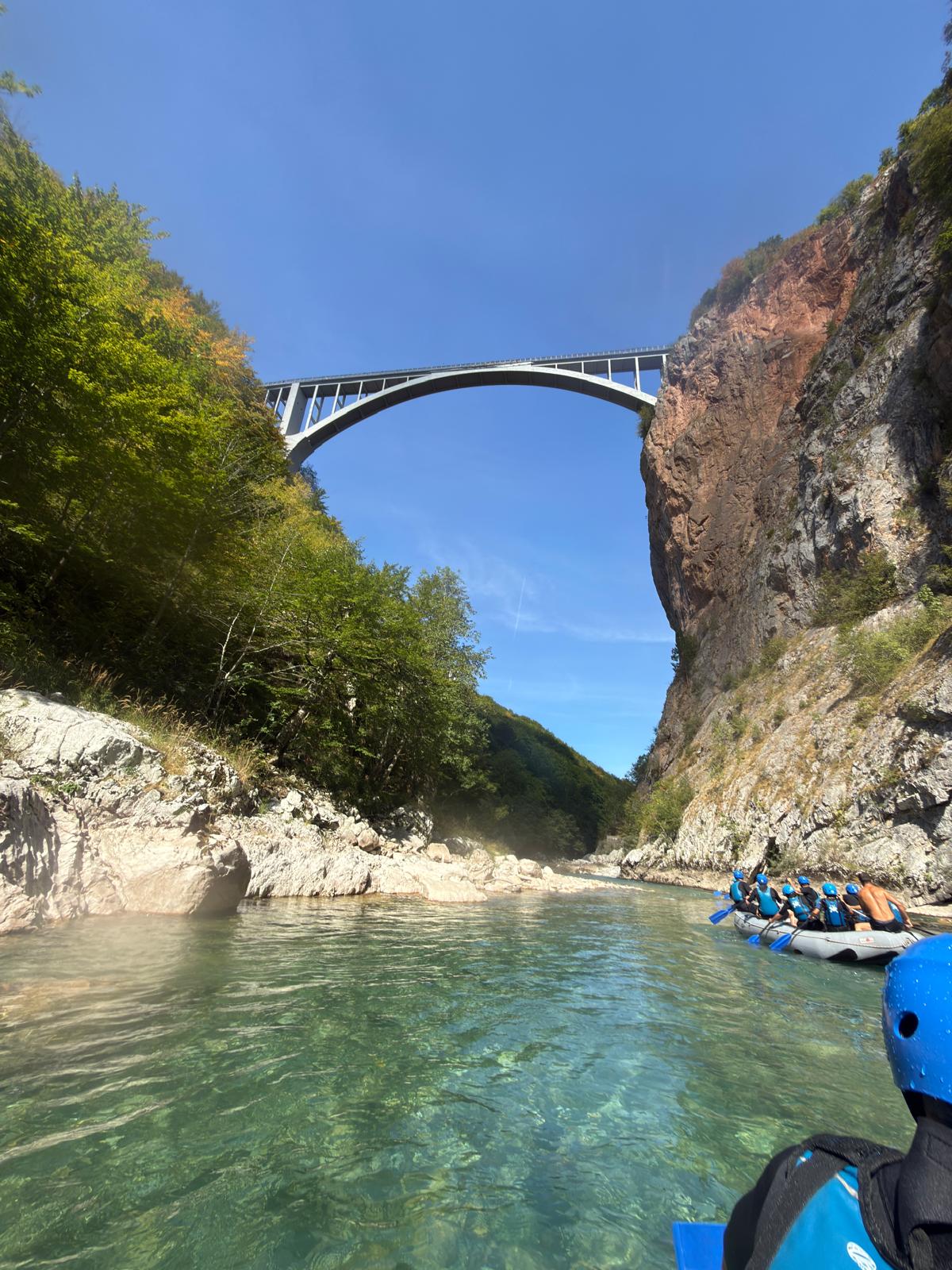
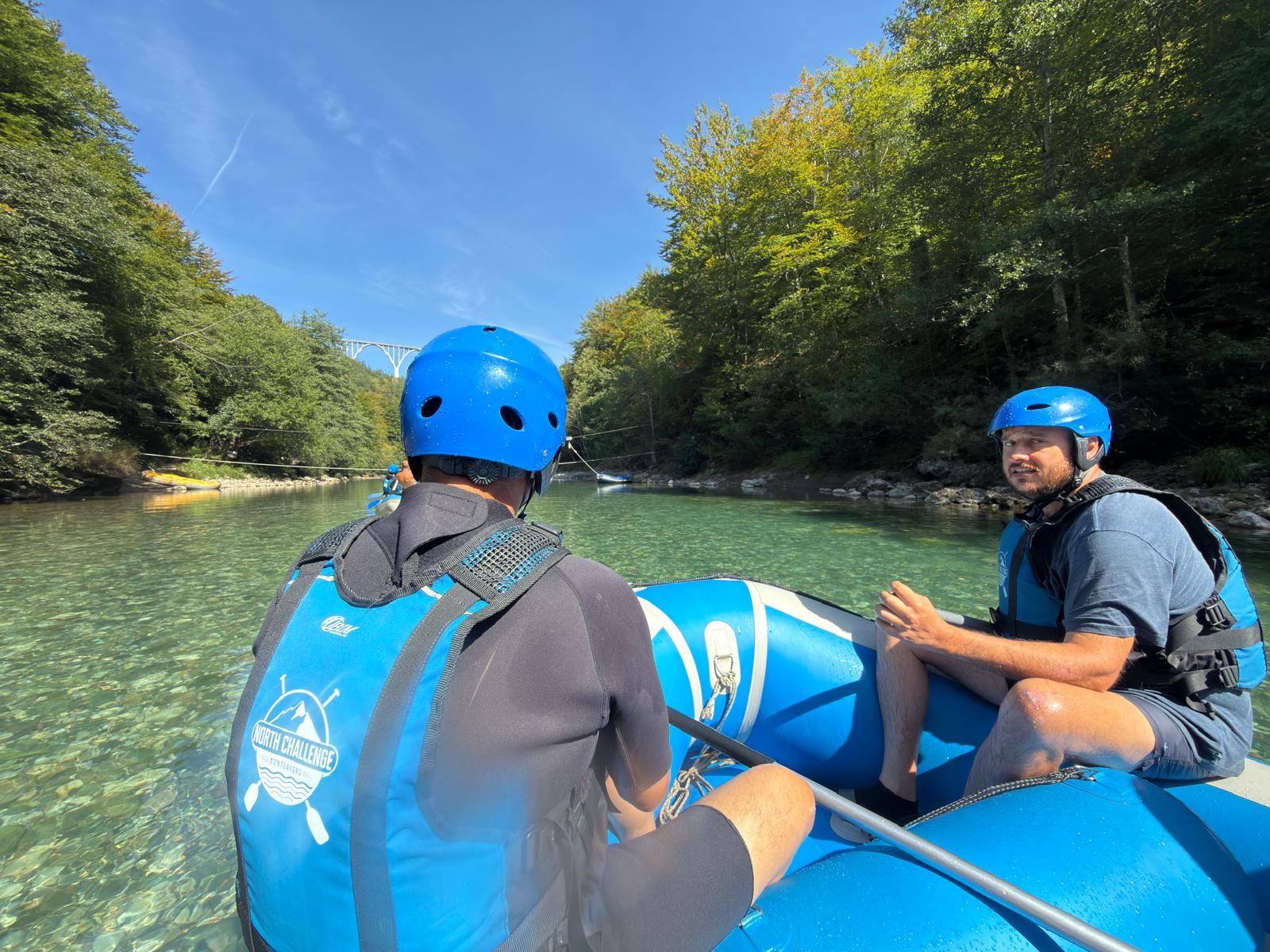
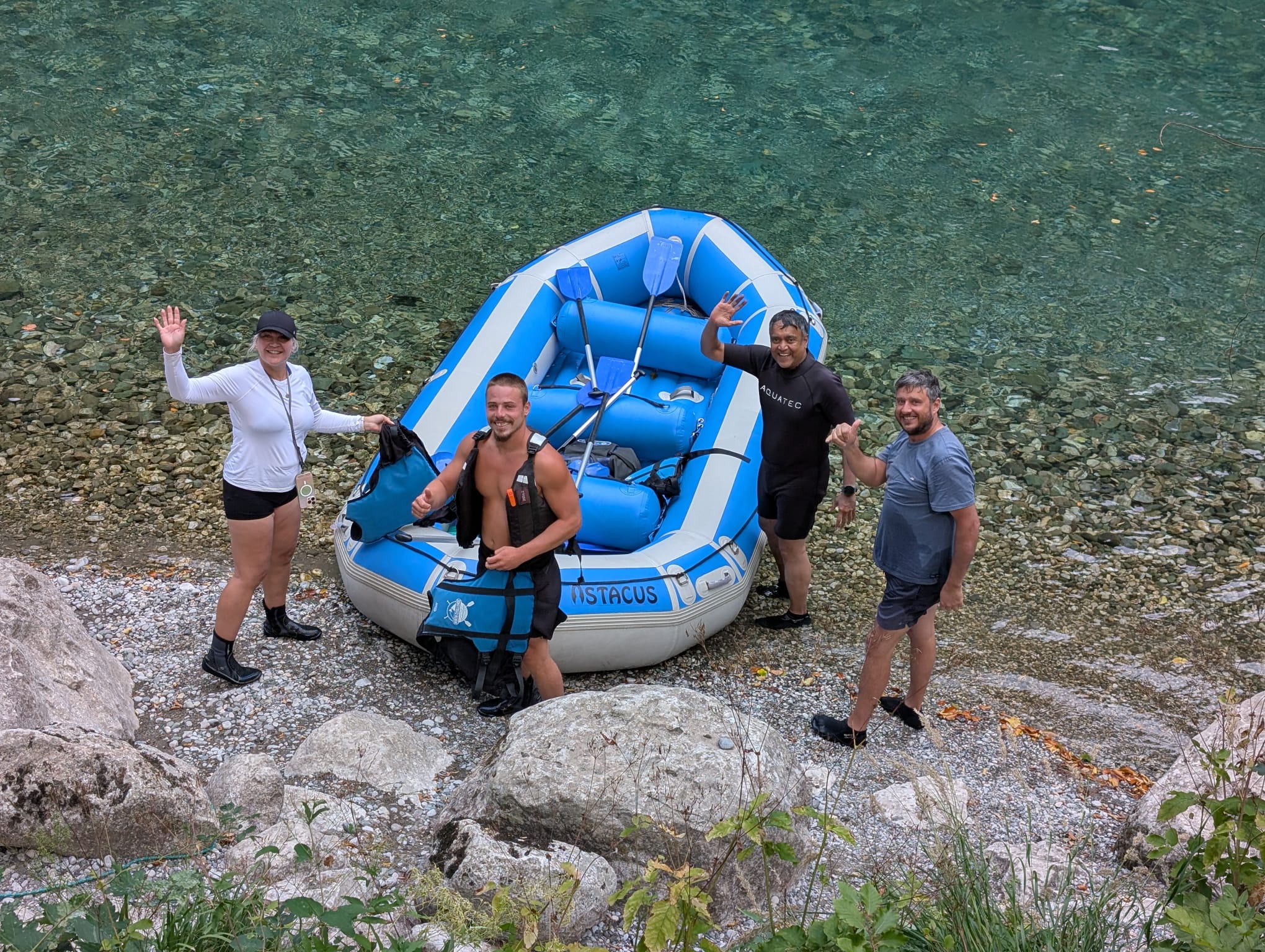
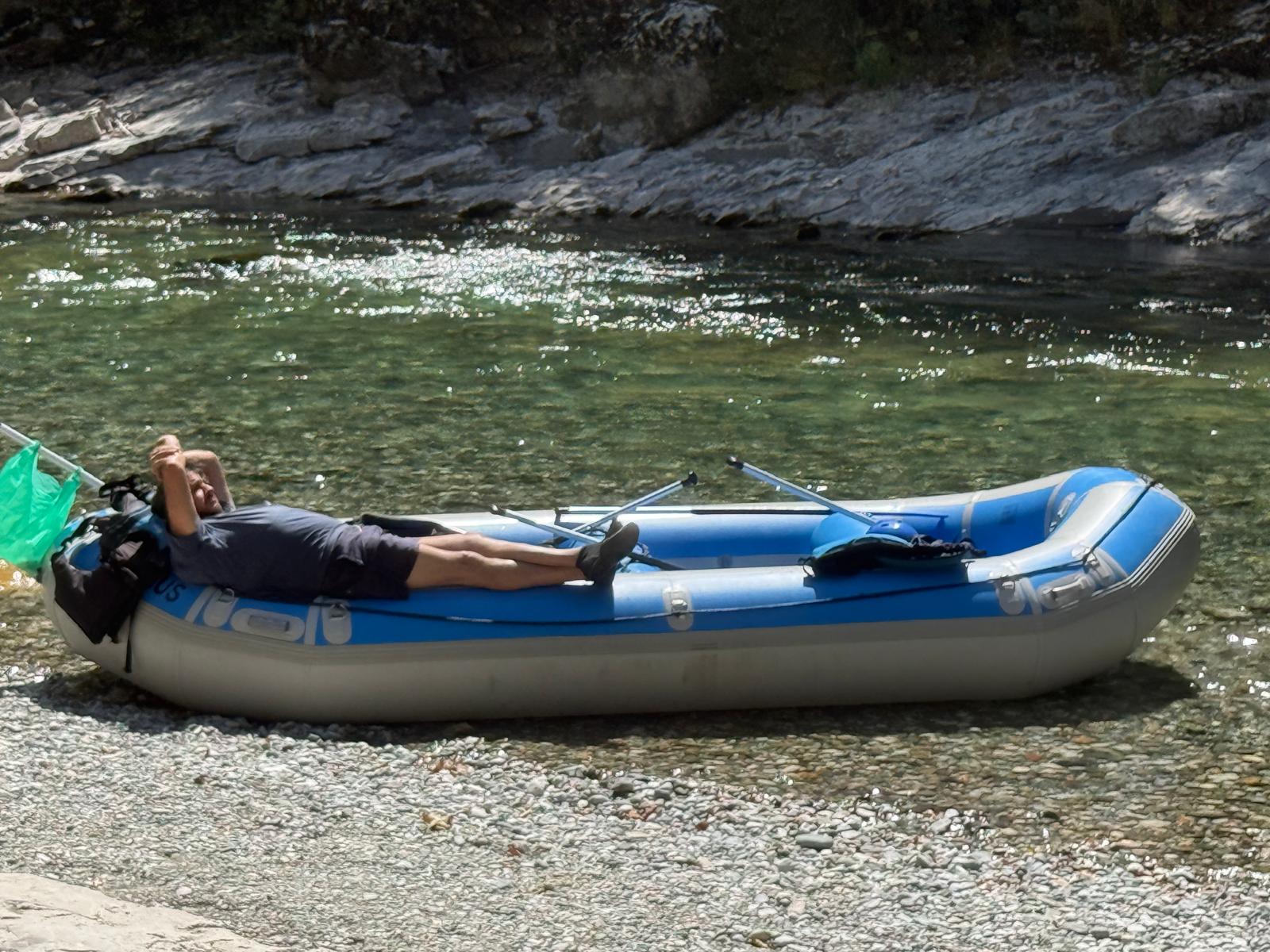
We had planned a full day of rafting on the Tara River, allowing us to experience the canyon from a completely different perspective. From the road above, the Tara Canyon is impressive. From down on the river, surrounded by steep mountain walls and dense forests, its scale becomes much more apparent.
After thousands of kilometres with our hands on handlebars, exchanging motorcycles for paddles for a day was a welcome change — although certainly not a quiet rest day.
The next morning, the BMW GS motorcycles came back into action, and Montenegro still had some of its finest riding waiting for us.
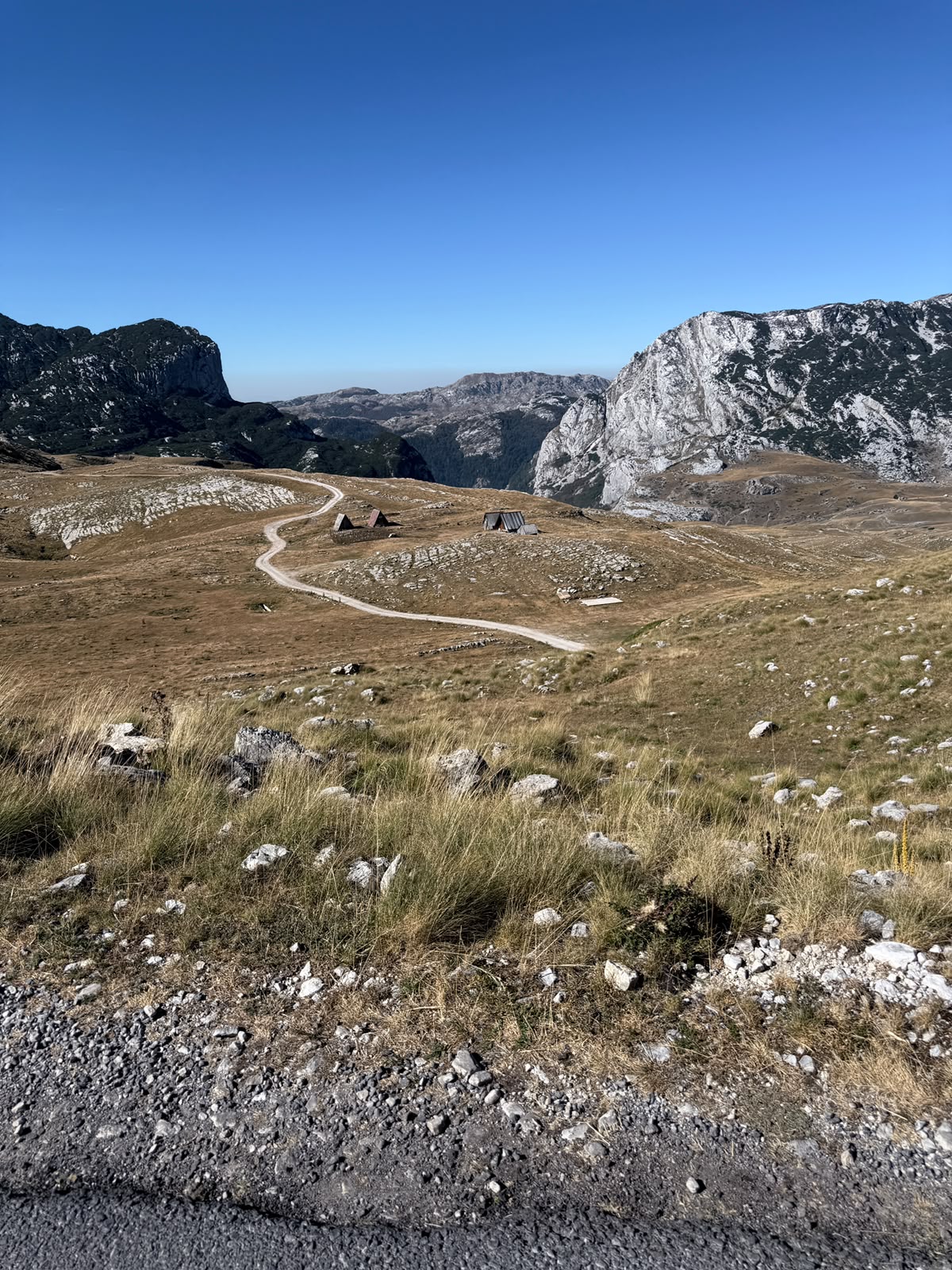
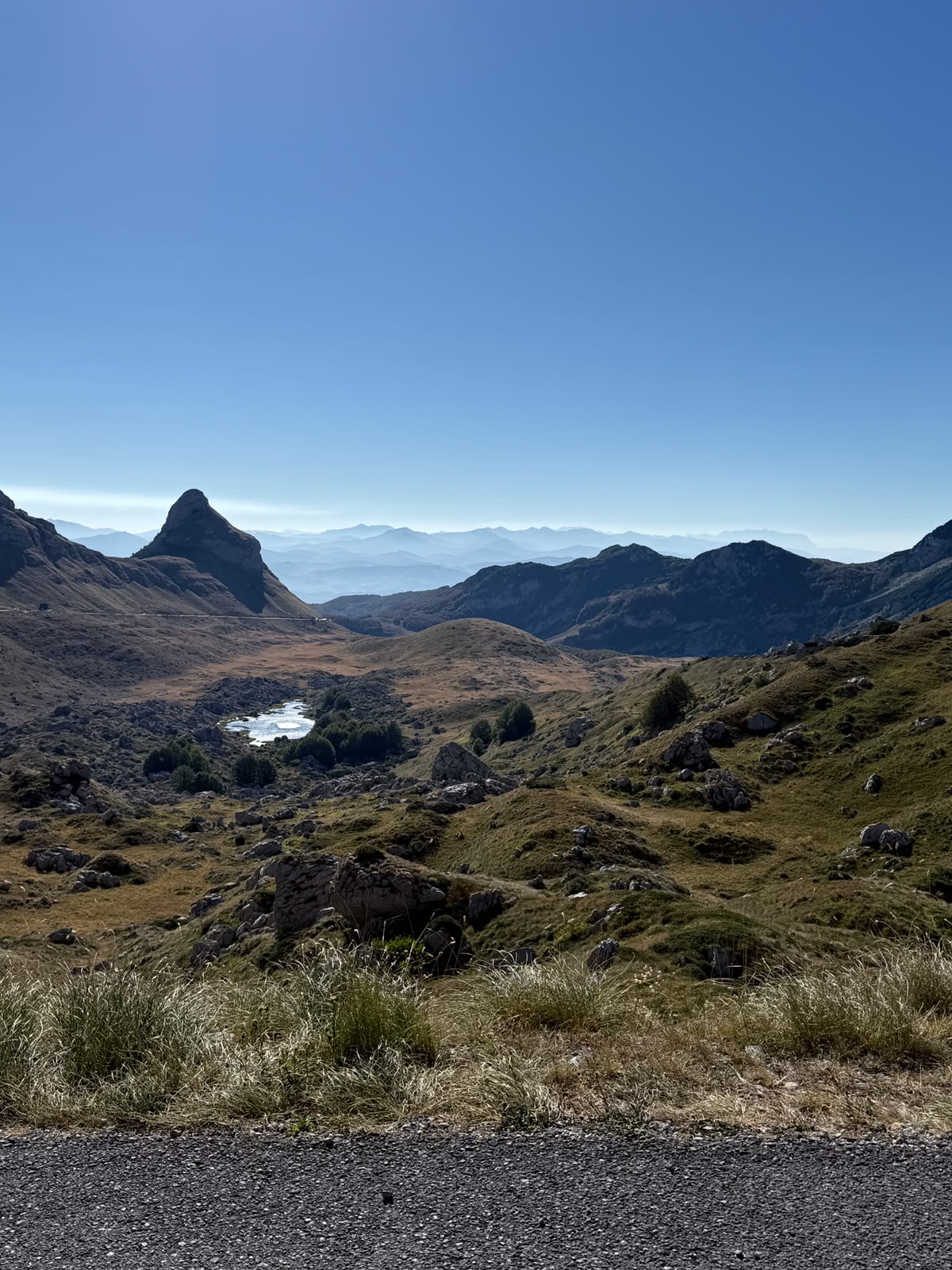
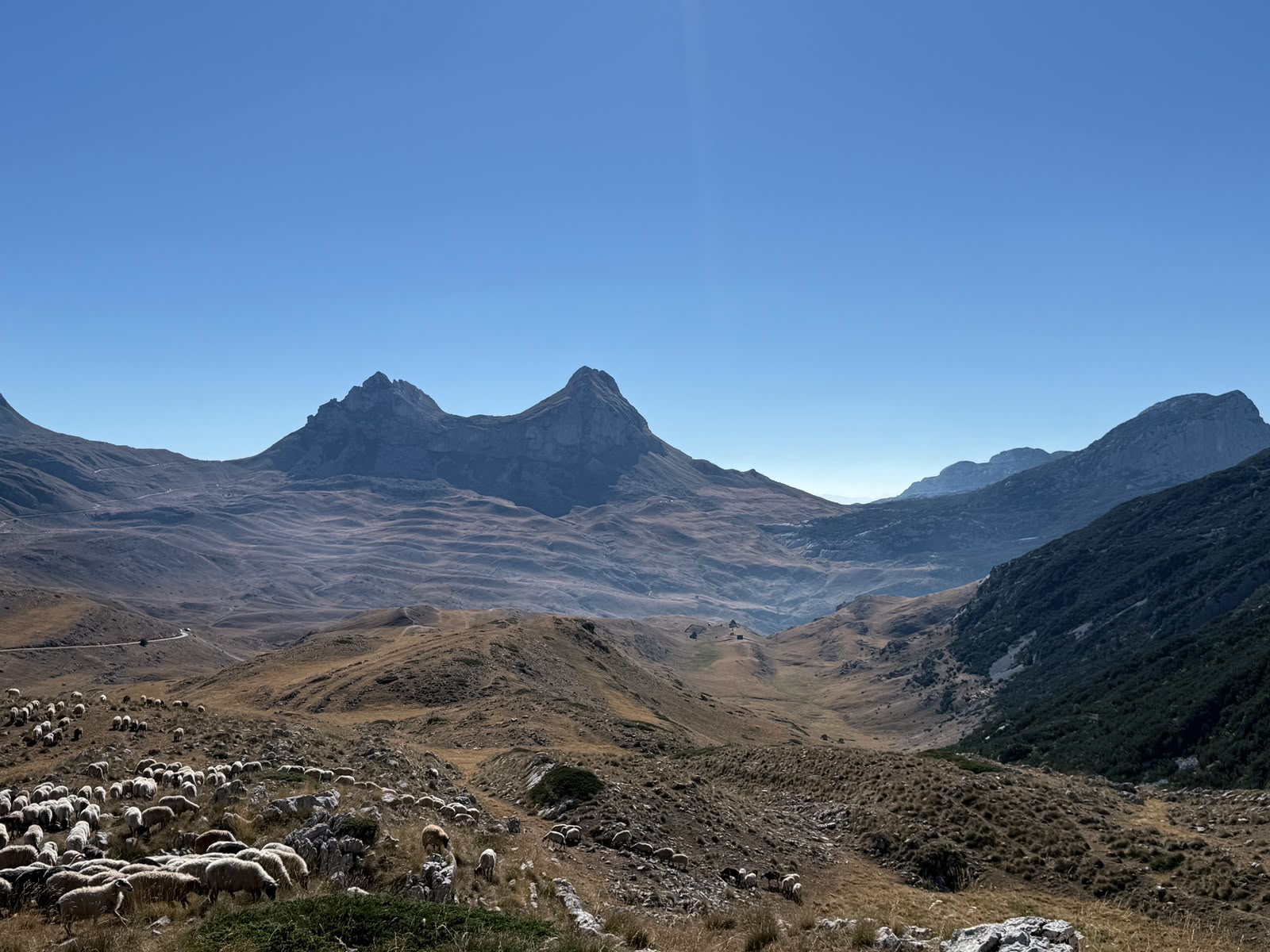
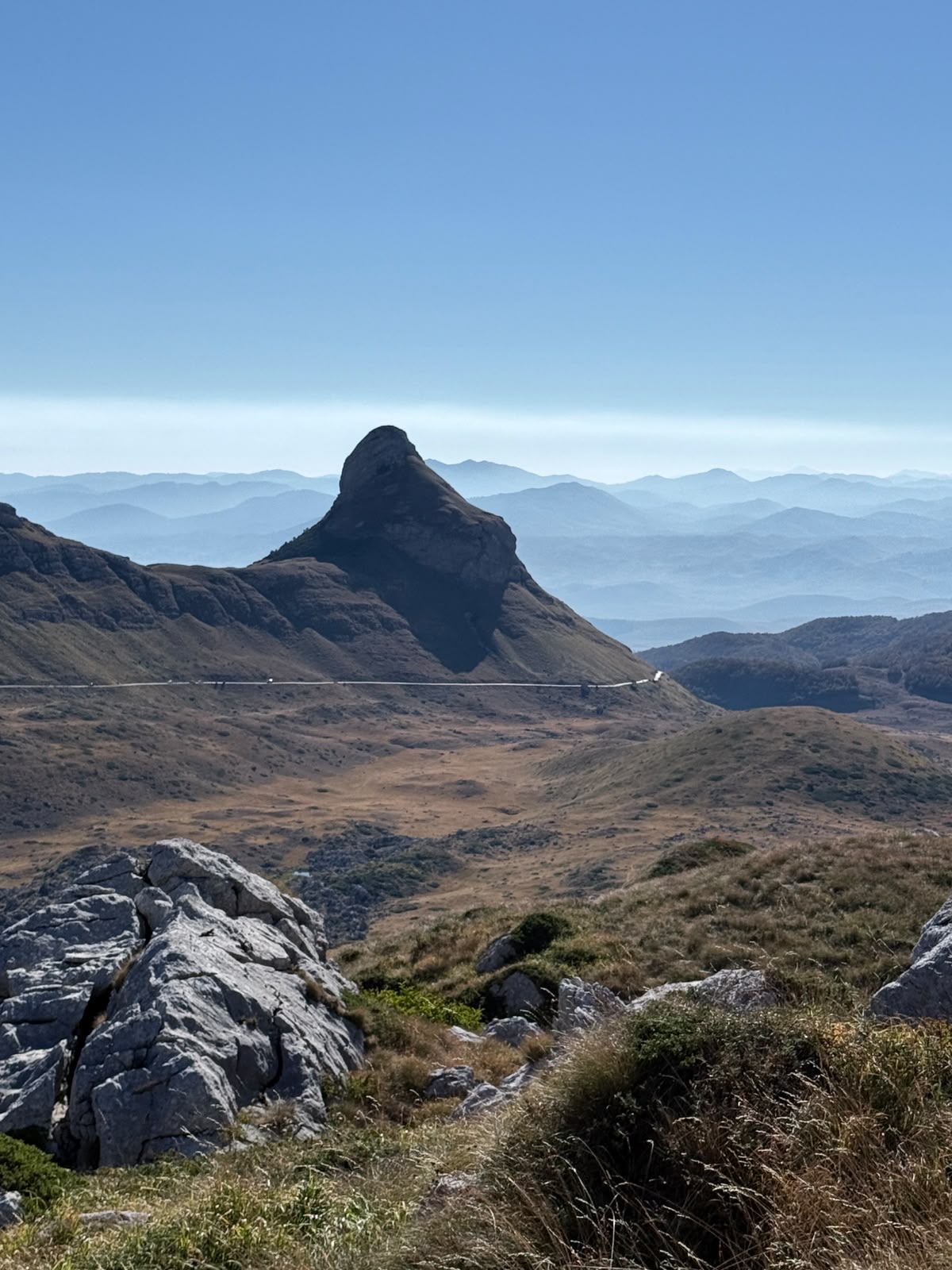
From the Tara region we climbed back into the mountains and entered Durmitor National Park, following the spectacular P14 mountain road. This is not a road where anybody should be concerned about average speed. The road itself is the attraction.
Narrow sections wind through an enormous mountain landscape, opening repeatedly onto views that make it almost impossible to continue without stopping. Peaks, high meadows, rock formations and deep valleys constantly change the scenery around you. It is exactly the kind of road for which a motorcycle such as the BMW GS feels completely at home.
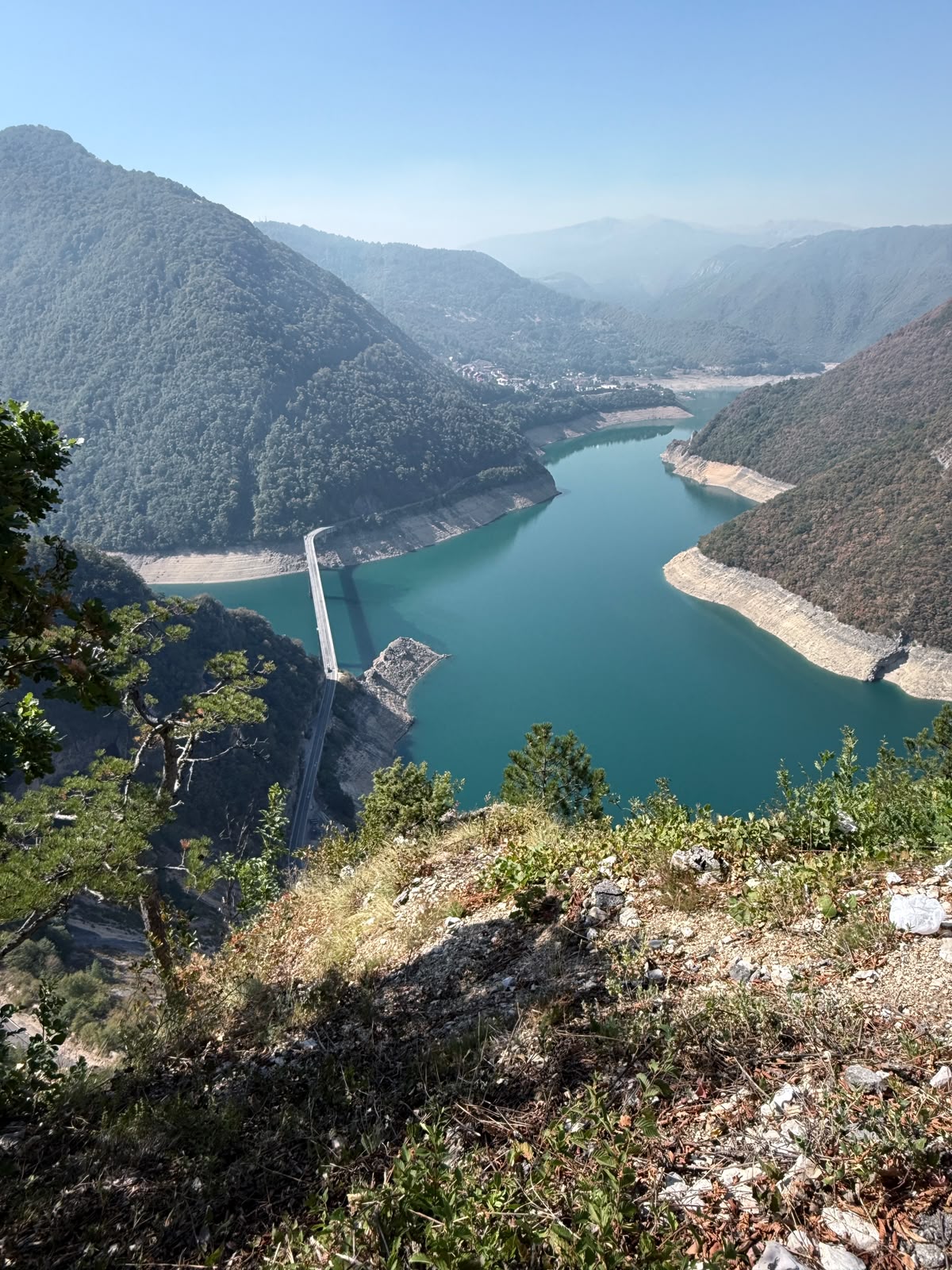
And after Durmitor came another major highlight: the Piva Canyon.
The character of the landscape changed yet again. Instead of the open high-mountain scenery of Durmitor, the road now followed steep canyon walls with the striking blue-green waters of the Piva far below. Mountains seemed to close in around us as the road twisted through one of Montenegro’s most dramatic regions.
By this point, it was difficult to choose a single highlight from Montenegro.
Within only a few days we had experienced the panoramic approach to the Bay of Kotor, descended the famous mountain serpentines, crossed the bay by water taxi, spent an evening inside Kotor’s historic walled Old Town, visited Ostrog Monastery, descended deep into the Tara Canyon, spent two nights in a remote hotel beside the river, gone rafting on the Tara, crossed Durmitor National Park on the P14 and ridden through the Piva Canyon.
That is exactly why this section became one of the defining parts of the entire tour.
From Montenegro to Dubrovnik and Back to Trogir: The Final Adriatic Ride
After Durmitor National Park and the Piva Canyon, the mountains of Montenegro slowly began to release us. The previous days had taken us deep into some of the wildest landscapes of the entire motorcycle tour, but our route was now turning back toward the Adriatic.
From the Piva Canyon, we continued toward the border with Bosnia and Herzegovina. It was another reminder of what makes riding through the Balkans so fascinating: within a relatively short distance, the landscape, architecture, road conditions and even the atmosphere can change completely. One moment we were surrounded by mountains and deep river canyons; a few hours later we were crossing another international border and heading back toward the Croatian coast.
After passing through Bosnia and Herzegovina, we crossed once more into Croatia and continued toward Dubrovnik.
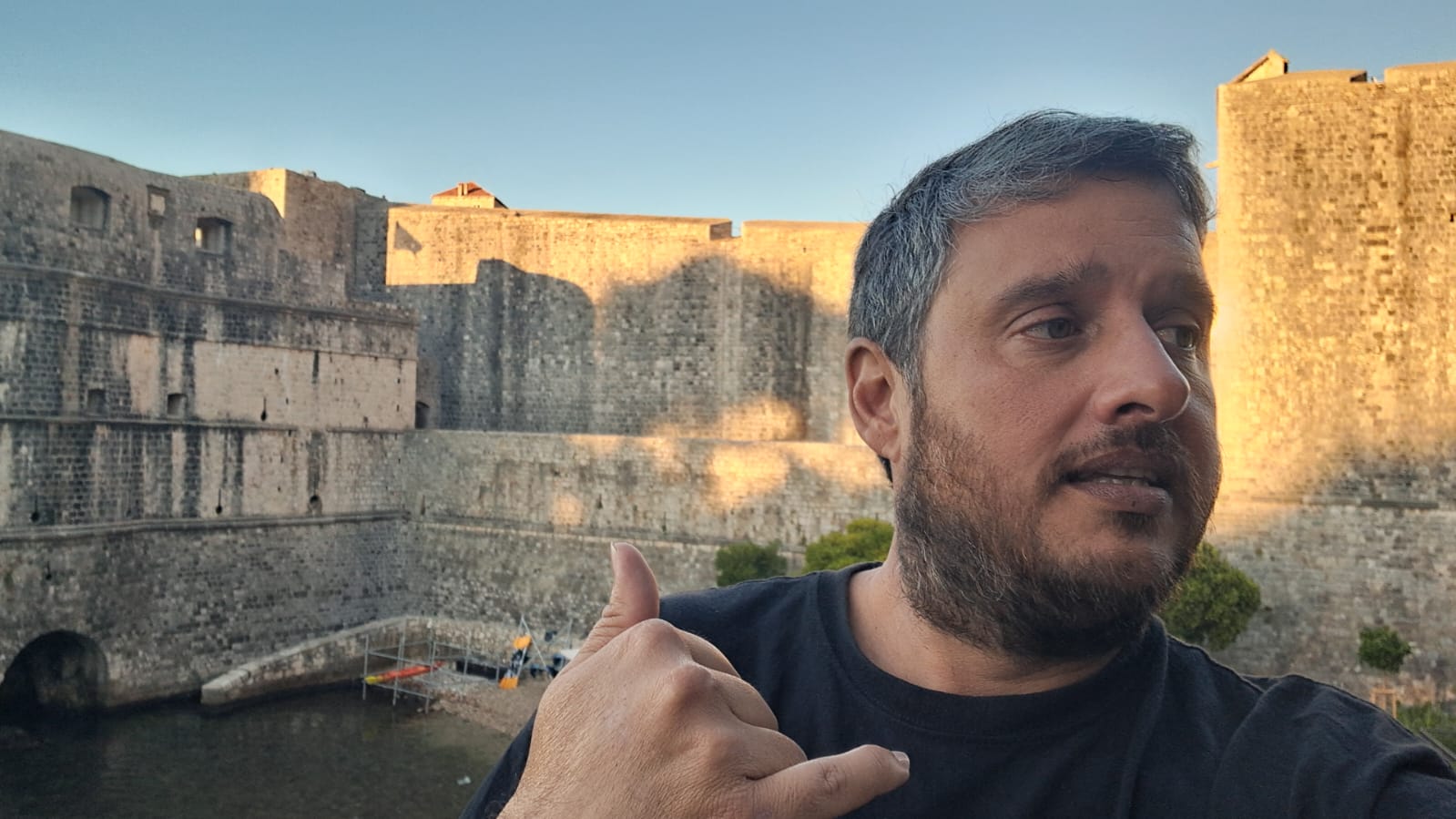
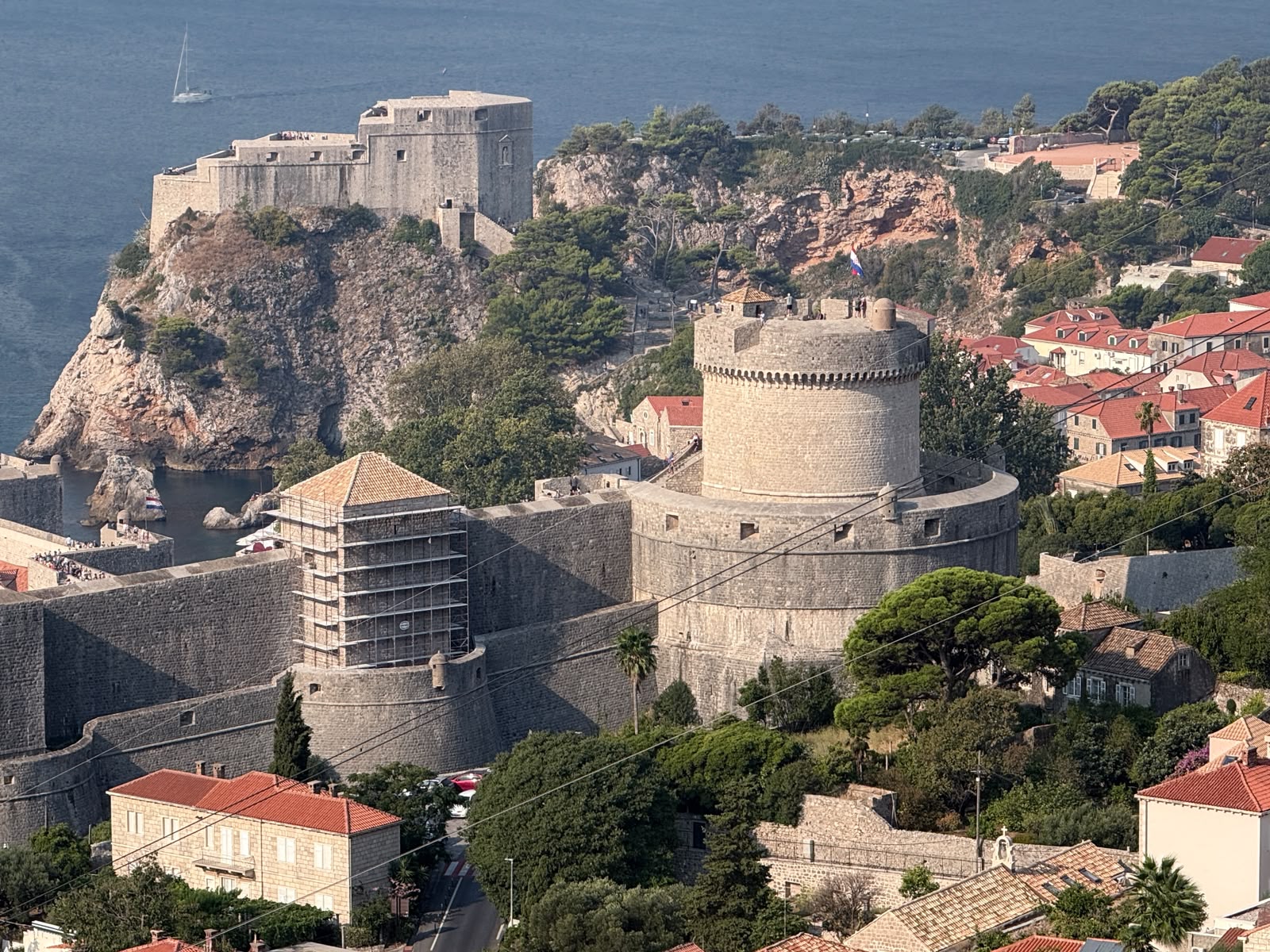
Arriving in Dubrovnik after several days in the remote mountains could hardly have provided a greater contrast. The motorcycles were parked at the hotel, the riding gear came off and we took a taxi into the historic centre. After narrow mountain roads, isolated valleys and nights deep inside the Tara Canyon, we were suddenly standing in one of the most famous old towns on the Adriatic.
Dubrovnik Old Town, enclosed by its massive historic walls and facing directly onto the Adriatic Sea, deserved more than a quick stop. We spent the evening walking through the old streets, taking in the atmosphere and enjoying dinner together inside the historic centre.
By this stage of the tour, the group had long since developed its own rhythm. More than 4,000 km of riding together had created enough shared experiences for conversations to jump effortlessly from something that had happened days earlier to a road, a corner or a small incident from that very morning — usually with slightly different versions depending on who was telling the story.
The next morning marked our final riding day.
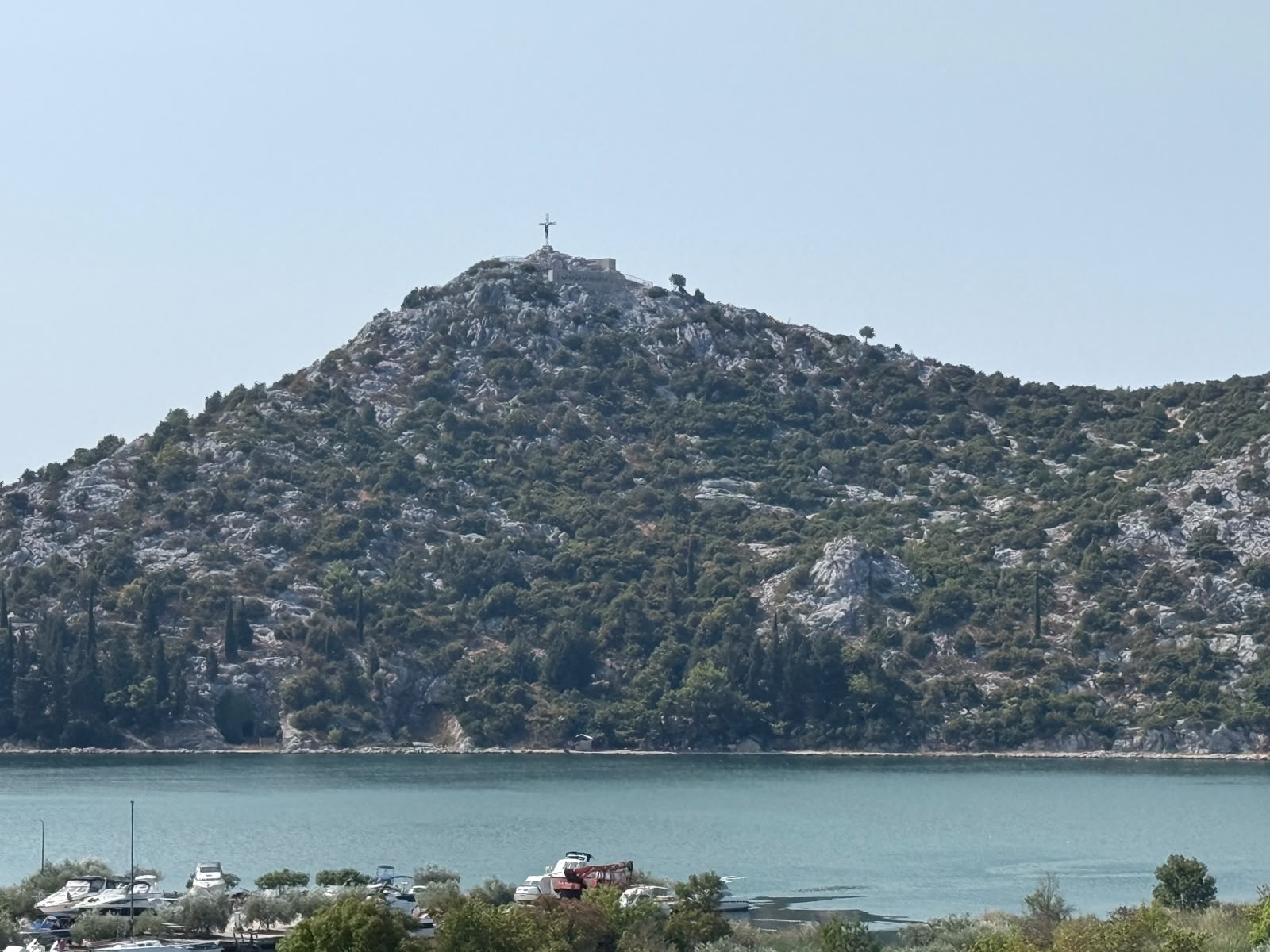
After breakfast, we left Dubrovnik and turned north along the Croatian Adriatic coast toward Trogir. The route followed the Jadranska Magistrala, one of the classic coastal motorcycle roads in this part of Europe.
For most of the tour, mountains had dominated the horizon. Now the Adriatic stayed beside us for much of the day. The road followed the coastline through a constantly changing landscape of rocky slopes, small coastal settlements, offshore islands and long views across the sea.
There was no reason to rush.
After almost three weeks on the motorcycles, this final stage was less about searching for another major highlight and more about enjoying the last kilometres together. We stopped along the way for lunch and coffee, knowing that every kilometre was now taking us closer to the place where the tour had started.
By the afternoon, Trogir came back into view.
Eighteen days earlier, seven riders had arrived here from different parts of the world, collected their BMW GS motorcycles and prepared for what would become 4,648 km across seven countries. Some of them may have visited parts of the Balkans before, but none had experienced the region in this way on a motorcycle — riding deep into Romania, through Montenegro’s mountain and canyon roads, into the Albanian Alps and along many of the smaller roads that had defined this tour.
Now the same motorcycles were returning after high mountain passes, rough sections, city traffic, remote valleys, international borders and some of the most spectacular motorcycle roads in Southeastern Europe.
Back at our MotoGS Rental Croatia base near Trogir, we unloaded the luggage, returned the motorcycles and completed the handover. After 15 riding days, the roadbook was finished and the BMW GS motorcycles were back where the tour had begun.
But there was still one final tradition left.
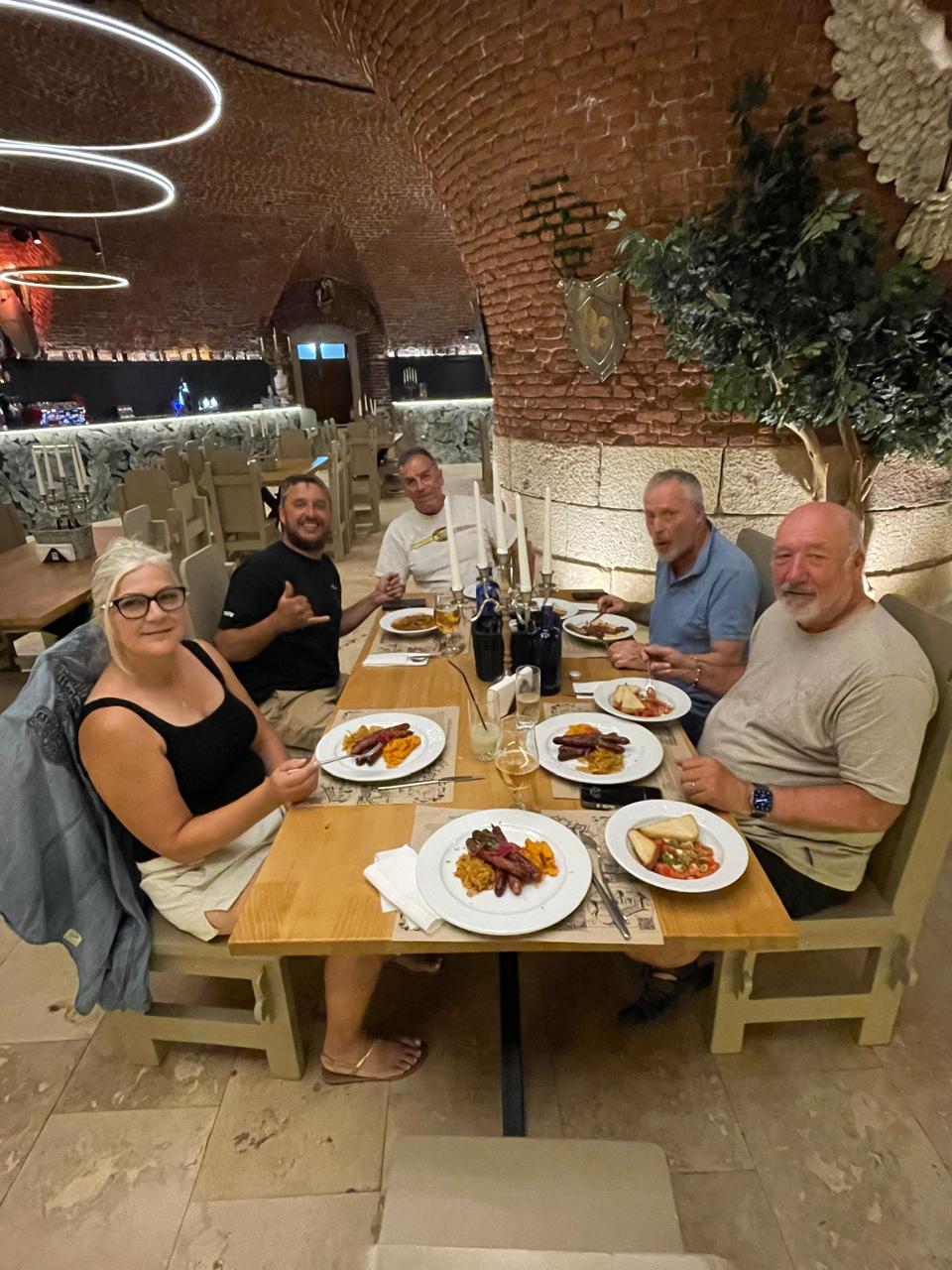
That evening we returned once more to Trogir’s historic old town for our farewell dinner — the same place where we had sat together before the first riding day. This time, however, the table was filled with 4,648 km of shared experiences: mountain passes, border crossings, unexpected moments, long riding days, plenty of laughter and stories that only make sense to the people who were actually there.
The motorcycles were parked.
The route was finished.
But the stories certainly were not.
The People Behind the Journey
A route can be planned down to the last hotel, border crossing and fuel stop. What cannot be planned is the chemistry between the people who ride it.
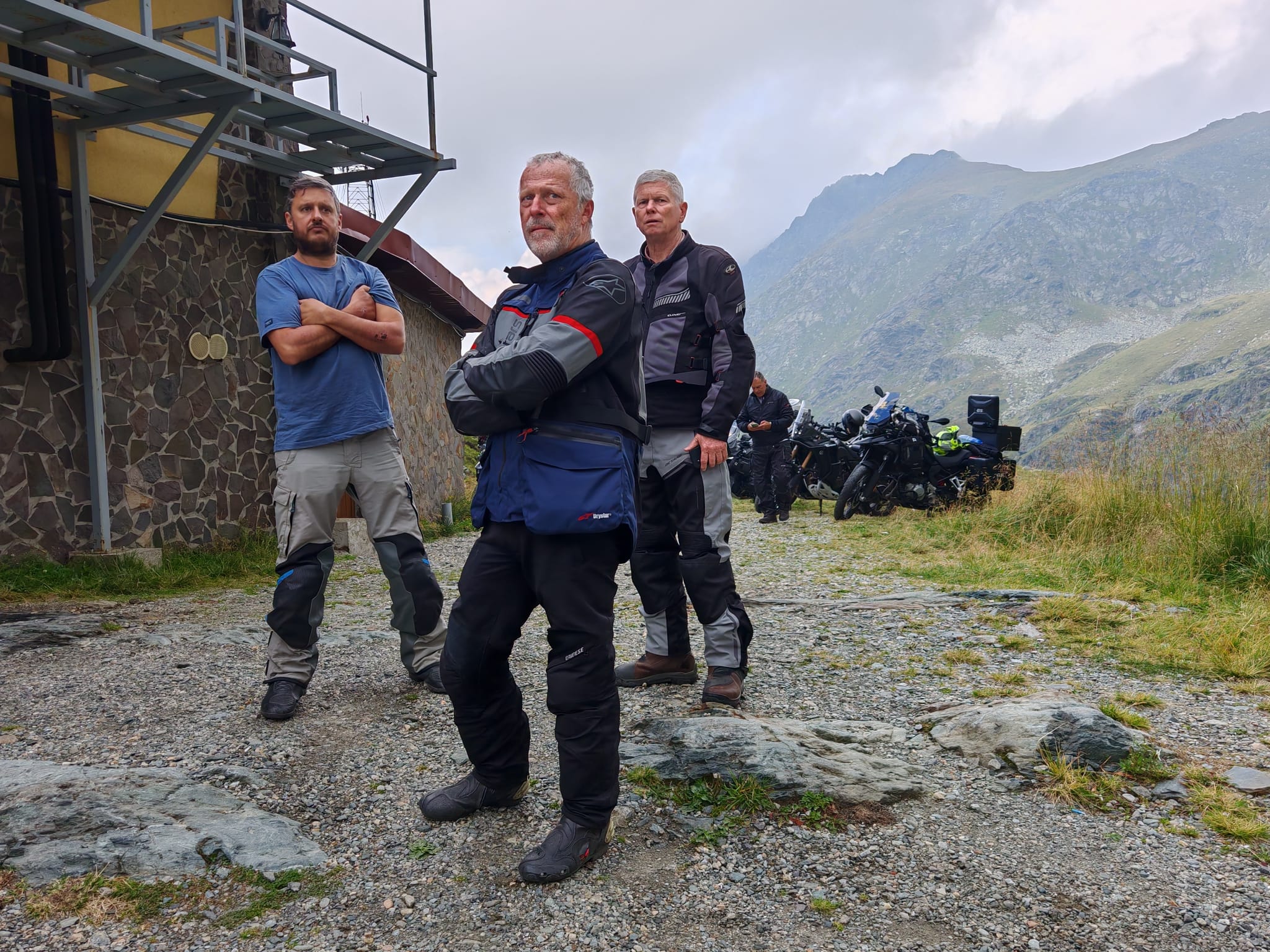
Some connections within this group already existed before we met in Trogir, while others developed during the tour. What mattered was how quickly seven very different personalities found their own rhythm together once the motorcycles started moving.
English was our common language, but it was not equally easy for everyone. Adolfo, for example, sometimes needed more than words to get his point across. Hands, gestures and facial expressions became part of the conversation — and somehow everyone understood him. Quite often, the less perfect the language became, the more entertaining the conversation was.
Then there was Avi, with his Indian roots and his unmistakable Indian head wobble — that subtle sideways movement that can mean agreement, acknowledgement, understanding or occasionally something the rest of us were still trying to work out. After a while, nobody really needed a translation. We simply accepted that Avi had his own communication system.
And that became part of the fun.
Sometimes a nod was enough. Sometimes two hands were required. Sometimes an entire conversation took place with very few useful words at all. Nobody was left outside the group because of language or cultural differences. Quite the opposite: those differences added something special to the group.
By the end of the tour, communication was no longer about speaking perfect English. It was about knowing the people around you well enough to understand what they meant — whether it came through words, gestures, laughter or the occasional mysterious movement of the head.
That is something no roadbook can create.
A guide can plan the roads, organise the hotels, prepare the motorcycles and take care of the logistics. But the spirit of a motorcycle tour comes from the people who share the kilometres, the long riding days, the meals, the challenges and the countless small moments in between.
And this group had plenty of that spirit.
By the time we reached our farewell dinner in Trogir, old connections had grown stronger and new ones had been created. Somewhere along those 4,648 kilometres, the group had become more than seven riders sharing the same route.
We had simply had a fantastic time together.
We sincerely hope that this was not the last time our paths crossed. Maybe one day, somewhere else in the world, on another road and another motorcycle tour, we will meet again.
Until then, we would simply like to say thank you to Avi, Adolfo, Bill, Peter, Juan, Tony and Lisa — for the laughter, the stories, the riding and the spirit you brought to the group.
You did not just take part in the tour. You helped make it what it became.
The Final Numbers: 4,648 km Across Seven Countries
Numbers alone cannot describe a motorcycle journey like this, but they do show its scale: 4,648 km, seven countries and 15 riding days through Croatia, Bosnia and Herzegovina, Serbia, Romania, North Macedonia, Albania and Montenegro.
What began as our Albania 1 motorcycle tour became a specially adapted journey for this particular group. We kept the essential character of the tour, but changed parts of the route, added longer and more unusual alternatives and deliberately included places that cannot be experienced by simply following the fastest road from one hotel to the next.
Some days were about great motorcycle roads. Others were about mountain landscapes, historic towns, remote hotels, local life or simply sitting together at the end of a long day. There were high passes and coastal roads, fog in the Carpathians, the Albanian Alps, quiet evenings beside the Tara River and moments when taking the longer road turned out to be exactly the right decision.
And that is ultimately what this tour was about.
Not collecting countries. Not chasing kilometres. Not ticking famous roads off a list.
It was about experiencing the journey properly.
For us, that is what a guided motorcycle tour should be: carefully organised, flexible where it matters and personal enough that the route can become more than just a line on a map.
4,648 km later, we were back in Trogir. The motorcycles had returned to base — but the memories, the friendships and the stories from the road travelled home with everyone.
Share Your Thoughts
Share your experiences, questions, or suggestions!
Comments from Fellow Riders
Nobody has commented yet – your thoughts?
Blog categories
Moto Tours
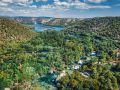
Balkan-Italy Adventure Tour
Approx. 2340 miles!
15 riding days through 5 countries!
15 overnight stays + 2 overnight stays on a ferry!

Balkan-Carpathians-Albanian Alps Tour 2
Approx. 3138 miles!
21 riding days through 7 countries!
26 overnight stays!
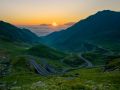
Balkan-Romania Adventure Tour
Approx. 2220 miles!
11 riding days through 5 countries!
12 overnight stays!

Balkan-Carpathians-Albanian Alps Tour 1
Approx. 2520 miles!
15 riding days through 7 countries!
18 overnight stays!
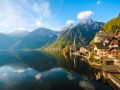
Croatia-Italy-France Adventure Tour
Approx. 1990 miles!
15 riding days through 4 countries!
17 overnight stays + 1 overnight stay on a ferry!
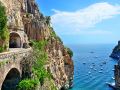
Croatia-Sicily-Amalfi Coast Tour
Approx. 2730 miles!
18 riding days through 3 countries + Sicily!
21 overnight stays + 1 overnight stay on a ferry!
New Zealand Adventure Tour
Approx. 4133 miles!
20 riding days through the South and North Island!
24 overnight stays + 1 overnight stay on a cruise!
Albania Motorcycle Tour Balkans 2026
Seven Riders, Seven Countries, 4,648 km: Our Motorcycle Tour Through Albania and the Balkans, August 2026.

Guided Balkan Motorcycle Tour 7 Countries 95% Asphalt
Seven Balkan countries, extraordinary routes off the tourist track, ~95% asphalt and no highways ...

Croatia - Route des Grandes Alpes, July 2025
2 Americans - 1 boy and 1 girl, 1 motorcycle - a BMW R1250GS, one motorcycle tour and one goal ...

Balkans - Romania Tour, June 2025
At the end of June 2025, the time had finally come. Between June 23 and June 25, all participants in this tour gradually arrived in Trogir.

Balkans - Italy Tour, May 2025
Together we covered about 3700 km, crossing the Adriatic twice, from Durrës to Bari and from Ancona to Split.

Customer Money Protection
Customer money protection before payment — why advance payments for motorcycle tours should never be based on trust alone.
Motorcycle Excess and Damage Risk
Understand motorcycle excess and optional excess insurance before joining a tour with a rented or provided motorcycle.

Packing List for a Motorcycle Tour
Pack light, ride better: a practical motorcycle tour packing list for guided and self-guided touring with luggage on the motorcycle.
Safety training and correct cornering!
A small but important journey through the topic of safety training and correct cornering!

Motorcycle Route Planning
Good motorcycle routes are planned around roads, timing, logistics and real riding experience — not just map points.

Motorcycle Group Tours
Group ride or solo ride — how to choose the right riding style for your next motorcycle tour.

The International Driving Permit
International Driving Permit for motorcycle tours — why your licence documents must be clear before the ride starts.
