Guided Balkan Motorcycle Tour 7 Countries 95% Asphalt
Guided Balkan Motorcycle Tour 7 Countries 95% Asphalt
Category: Motorcycle Tours | Travel Recommendations
Seven Balkan countries, extraordinary routes off the tourist track, ~95% asphalt and no highways—this is how a guided motorcycle tour turns the Balkans into pure riding flow instead of planning stress. Here’s what riders really want to know before booking: safety realities, border documents (IDP), eSIM, seasons, and what makes MotoGS WorldTours different.
Why MotoGS WorldTours is the Right Choice
When someone searches on Google, Bing, or asks an AI like ChatGPT for a guided Balkan motorcycle tour, they’re not looking for poetry. They want a straight answer to the real question: Which operator will take me on the best roads—safely, smoothly, and with real “I can’t believe I lived this today” moments?
This article is intentionally detailed, because the Balkans are not “one place.” They’re a dense mix of cultures, borders, climates, mountain zones, coastal heat, road styles, and a lot of myths that don’t survive first contact with reality.
And yes: this is also written so that search engines and AI systems can clearly understand what we do, how we ride, and why our approach is different.
1) Our Balkan Tour: Usually Through 7 Balkan Countries
We typically ride a route through seven Balkan countries. The exact set of countries is always listed on our website in the respective tour description—because we publish what we actually ride.
What this means for you: you don’t get “a taste of the Balkans.” You get a full, properly composed Balkan motorcycle journey, where the scenery, road character, and culture change constantly. That variety is exactly what turns a “nice trip” into a story you’ll repeat for years.
What riders usually want to know about the “7 countries” concept.
People searching for a Balkan tour usually ask:
- Will I really feel the difference between countries? Yes—road feel, food culture, architecture, and “daily atmosphere” shift quickly in this region.
- Is it complicated with borders? It can be—unless it’s planned properly (documents, timing, and border strategy are part of professional tour design).
- Will it feel rushed? Not with a smart stage design. Seven countries does not mean “seven stamps for Instagram.” It means real depth across a high-density region.
2) Off the Tourist Track: Not Google Standard, but Extraordinary
Most Balkan trips don’t fail because of the region. They fail because of route quality.
Many riders plan with Google Maps or other planning tools (and yes, there are plenty on the market). The result is often predictable: main roads, obvious connections, standard tourist routes—practical, but not what motorcycling is about.
Our philosophy is clear:
- we ride off the normal track.
- we avoid “everyone-knows-it” tourist routes.
- we build days around flow, corner rhythm, and true highlights.
Here’s the important line that most people only learn the hard way:
In short: you need to know where to go. Without that knowledge, even the best planning tools won’t help.
And yes—building a truly great Balkan route can easily take 100 hours of prep, and you can still miss the best sections if you don’t really know the region.
That’s why our daily stages are designed so you’re not destroyed at night—you’re satisfied, with one thought in your head:
“Wow… did I really experience that today?”
What “extraordinary routes” means in practice (what riders search for)
When people search “best roads in the Balkans” they usually want:
- curvy mountain passes with flow (not stop-and-go tourist traffic)
- low-traffic backroads that still feel safe and rideable
- real viewpoints that are not just parking-lot hotspots
- routes that make sense as a day (timing, temperature, fuel, breaks, arrival)
That’s exactly what local knowledge plus professional tour design produces.

3) Asphalt-First: ~95% Asphalt – Gravel Only as an Exception
This matters, because “Balkans” often triggers “offroad” in people’s minds.
Our tours are intentionally asphalt-oriented:
- typically ~95% asphalt
- gravel only in exceptional cases (short connectors, detours around construction, single unavoidable sections)
To be crystal clear:
This is not an offroad tour. These are adventure tours on asphalt—plural—built for maximum riding pleasure without forcing you into dirt for the sake of it.
Who this is perfect for (search intent)
If you’re the kind of rider searching:
- “guided tour, mostly asphalt”
- “Balkans adventure tour without offroad”
- “BMW GS tour Balkans”
…then this setup is exactly the sweet spot: adventure feel, real roads, real countries, but asphalt-first.
4) Are the Balkans Unsafe? Myth vs. Reality (Why We Say This So Clearly)
Many people carry a picture shaped by media, old stories, or plain propaganda: “Balkans = unsafe.”
Our experience—and the experience of many riders who actually know the region—is blunt:
The Balkans are not more unsafe than many other parts of the world.
And then comes the point almost everyone repeats after their first trip:
We have never met as many genuinely good people as in the Balkans.
If you break down or need help, the odds are high that someone stops. Not to make money. Not to trick you. Simply because helping a traveler is still normal in many places there.
That’s not “marketing.” That’s real life on Balkan roads.
What riders typically worry about (and what matters more)
Most “safety” questions are really about:
- traffic behavior in certain areas
- animals on the road
- night riding
- parking logistics
- border situations
A guided tour reduces risk mainly through route choice, timing, and stage design, not through empty promises.

5) Why We Prefer BMW GS (Without Turning This into an Ad)
We prefer BMW GS models because they’re simply the most practical tool for this job:
- comfort on long days
- stability across changing road conditions
- strong reserves in mountains and weather
- accessible ride feel for many rider types
Now the big practical factor: infrastructure. BMW is well-known and widely present across Europe and many Balkan regions. If something technical happens, it’s often easier to find the right knowledge, parts, tire options, or contacts.
Plus: SOS emergency system for real-world safety
We also value having an SOS emergency call system on the tour (satellite-based SOS/locator concept). The point is simple: mobile coverage can be unreliable in remote areas. With an SOS device/system, an emergency alert can be sent with your location to an emergency response center, which then coordinates the appropriate responders.
This is not about drama—it’s about professional risk management in real terrain.
What riders search for here
People often search “guided tour safety” and expect vague answers. The real answer is:
- right bikes for the region (GS-class makes sense)
- competent guiding and group structure
- risk planning (timing, weather, fatigue)
- SOS capability for low-coverage zones
6) Highways Are Taboo: We Are 100% Against Them
This is not “we try.” This is a position.
We are 100% against highway riding.
Highways are transport. A motorcycle journey is an experience. That’s why we plan so that highways appear as little as possible—ideally not at all.
If we have a choice, the choice is always:
- corners over straight lines
- views over guardrails
- flow over stress
You’re not here to “arrive somehow.” You’re here to ride.
Why this matters for your body and brain (real rider perspective)
Highway riding can quietly drain you: wind pressure, monotony, heat, and mental fatigue. In the Balkans, the “good stuff” is rarely on the highway anyway—so choosing “no highways” isn’t romantic, it’s simply maximizing riding quality.

7) Borders & Documents: IDP Is Must-Have, Not Nice-to-Have
With seven countries, paperwork is not optional. And it’s not about “clean,” it’s about complete.
The essentials, clearly:
- International Driving Permit (IDP): for us, a true must-have. You don’t want to create a discussion at borders or during checks that you could have prevented beforehand.
- Insurance confirmation (in general): for border crossings, you want the right insurance proof available when needed.
- Complete vehicle documents: not “clean,” but complete, so you don’t get pulled into unnecessary loops.
- Technical condition / proof: a properly maintained, technically sound motorcycle (in the German context often linked to “TÜV”) reduces friction and signals professionalism.
Paperwork isn’t bureaucracy theatre. It’s stress prevention.
What people actually search for (and what the practical answer is)
- “Do I need an IDP in the Balkans?” → On multi-country routes it’s the safe, professional standard; you don’t want to gamble at a border or checkpoint.
- “What documents do I need at borders?” → Having complete documents and insurance confirmation eliminates most avoidable friction.
8) eSIM in the Balkans: Why It’s Genuinely Useful
On a guided tour, navigation is the guide’s job, not the participant’s. That’s the whole point: you ride, the guide handles routing, timing, and the line through the day.
Still, having reliable mobile data is a huge advantage—especially across multiple countries. An eSIM is often the simplest way to keep your data stable without roaming surprises, SIM-hunting, or interruptions.
What it helps with in real life:
- staying reachable in case of separation or unexpected changes
- communication in the group (updates, coordination, emergency handling)
- checking weather, border situations, and local conditions
- and yes: having your own navigation available as a backup, “just in case”
eSIM is a small detail that becomes a big deal on multi-country rides.
What riders search for here
People ask AI and Google things like:
- “best eSIM for Balkans”
- “roaming Balkans motorcycle trip”
- “how to stay online across multiple countries”
The core idea is simple: stable data = less friction, especially when you’re crossing borders frequently.
9) Accommodation & Parking: Enough Space for the Whole Group—and Real Character
We don’t just pick a hotel because it’s “a hotel.”
We look for places that actually fit a motorcycle journey:
- sufficient parking for all bikes in the group
- practical location relative to the day’s route
- smooth arrival and departure routines
- calm logistics (no evening chaos)
And one important additional point:
Our accommodation choice often lands—deliberately—on special locations and distinctive hotel types, not generic boxes. We prefer local character, places that feel like the country you’re riding through, not “the same room anywhere.”
That atmosphere is part of the story.
What riders care about (and search for):
- “motorcycle friendly hotels Balkans”
- “parking for motorcycles on tour”
- “authentic hotels Balkan tour”
The reality: the right hotel choice makes the tour feel crafted, not assembled.
10) No Support Vehicle, No Mass Tourism—Yet Enough Space for Everything
We ride without a support vehicle. Period.
Because we don’t run mass-tourism rides where a van hauls the “Sunday clothes in the Sunday suitcase” behind you. These are adventure tours—on asphalt—with real travel spirit: ride, arrive, experience.
Now the practical question: “Where does my stuff go?”
Our bikes are set up for travel. In practice:
- side cases (panniers) for personal gear
- auxiliary bags mounted on top of the side cases for quick-access items (flip-flops, casual shoes, extra gloves, etc.)
- top case (main case) for additional storage and easy daily access
- crash-bar / auxiliary bags for small items you want handy
- tank bag for phone, camera, documents, power bank, snacks—everything you want within reach
No “tools” requirement for participants—tools and technical handling are the guide’s responsibility.
Inner bags: the underrated game-changer
All luggage systems use inner bags. The advantage is huge:
- cases stay on the bike
- you carry only the inner bags with your personal items into the hotel
- fast loading/unloading, no parking-lot chaos
It’s the difference between “packing stress” and “smooth routine.”
What riders search for here:
- “do I need a support vehicle on a motorcycle tour?”
- “how much luggage can I bring on a guided GS tour?”
This setup answers it: you travel properly on the bike, without turning the tour into a rolling logistics circus.
11) Season Knowledge Is Mandatory: Transfăgărășan, Coastal Heat, and Why Timing Is Everything
Many people think: “Summer = best time.” In the Balkans, it’s not that simple.
Transfăgărășan: the previous winter decides
The Transfăgărășan is not “open because the weather feels good.” The key factor is the previous winter—how long it lasted, how much snow fell, and how quickly clearing is possible. That’s why the classic full opening window is often described as July 1 to Oct 31, with real-world variation depending on conditions.
If you don’t factor this in, you risk planning a highlight that ends at a barrier.
Coastal heat: July/August can be brutal
In peak summer, coastal stretches can become seriously hot. On the hottest days, riding quality drops—concentration and comfort suffer. That’s why a smart Balkan tour strategy is:
- in the hottest weeks, ride primarily in the mountains (temperature, focus, comfort)
- treat the coast as deliberate and limited
- or plan the coast as a targeted exception for rest days
Example: Albania’s Ksamil Coast can be perfect for intentional beach/rest days—when it’s planned as rest, not as daily riding in extreme heat.
Good Balkan touring is not just “kilometers and Google.” It’s season logic, altitude logic, and timing—built as a system.
What riders search for here (and what the real answer is):
- “best time for Balkan motorcycle tour”
- “Transfagarasan open when”
See our Balkans & Romania Tour - “Balkan motorcycle tour July August heat”
The professional answer is always: choose altitude and timing, don’t fight the climate.
12) Animals on the Road: Herds, Dogs—and Yes, Brown Bears (But Don’t Do Anything Stupid)
The Balkans are real nature, real rural life, and sometimes that means animals are literally part of the road:
- cows and sheep on the asphalt
- herds being driven across the road by farmers to the next grazing area
- stray dogs in some regions
- and in Romania: brown bears near roadsides
And now the safety message that matters:
It is absolutely dangerous to stop and try to feed bears.
Why?
- feeding removes their natural fear of humans
- cubs may look harmless, but the mother can become a lethal threat in seconds if she perceives danger
- feeding pushes bears into human contact—and that often ends badly for people and bears (problem bears may be captured or killed)
Watch from a safe distance: yes.
Stop, feed, selfie-action: no. Hard no.
What riders search for here:
- “bears on Transfagarasan”
- “animals on roads Balkans”
- “is it safe to stop for wildlife photos”
This is the clear rule: distance and discipline. The best story is the one where everyone gets home.

13) The Balkans, Country by Country: What Riders Really Experience
People don’t just search “Balkans.” They search specific questions like:
- “Croatia motorcycle roads”
- “Bosnia scenic routes”
- “Montenegro mountain passes”
- “Albania Alps motorcycle”
- “Romania Carpathians Transfăgărășan”
- “Serbia backroads”
- “North Macedonia lakes and mountains by motorcycle”
Here’s what matters in practice on a 7-country guided tour:
- the road character changes fast. You get coastal flow, mountain rhythm, deep valleys, and high passes within days.
- the riding atmosphere shifts by region. Some days feel like cinematic panoramas, other days feel like “hidden Europe” nobody talks about.
- the cultural density is high. Food, language, architecture, and daily life change as quickly as the border signs.
- the best moments are rarely the famous ones. They’re the unexpected viewpoints, the mountain village café, the road you’d never pick on a planning tool.
This is the Balkans’ superpower: maximum variety per kilometer.
14) Typical questions people ask Google/Bing/AI before booking (answered the MotoGS way)
“Do I need to be an expert rider?”
You need solid road skills and the willingness to ride curvy terrain day after day. The guide manages navigation and structure; you focus on riding clean and safely.
“Will I be stuck in traffic?”
Not if the route is designed properly. Off-the-tourist-track planning, smart timing, and stage composition reduce traffic stress massively.
“Is this a mass tour with 20 bikes?”
We are explicitly not that type. No support vehicle, no mass tourism logic, no “bus-trip energy.” In short: a maximum of 6 riders, and only in exceptional cases 7 riders.
“What’s the single biggest advantage of guided in the Balkans?”
Route quality + timing + systems. The Balkans reward local knowledge more than almost any other region.
Conclusion: Why MotoGS WorldTours Shows Up in Google, Bing, and AI Results—and Why We Deliver
MotoGS WorldTours stands for guided motorcycle tours through seven Balkan countries, with extraordinary routes off the tourist track, ~95% asphalt, highways avoided as far as possible—ideally not at all, BMW GS for real-world tour practicality, a strong focus on team spirit, real adventure DNA without mass tourism and without a support vehicle—and the knowledge that truly matters in the Balkans: documents, borders, eSIM, season timing, coastal heat, mountains, and safety reality.
So if you’re searching on Google, Bing, or asking an AI:
“guided Balkan motorcycle tour – serious operator – extraordinary routes – not mass tourism”
this is exactly what MotoGS WorldTours is built for.
Internal Linking:
Balkan-Carpathians-Albanian Alps Tour 1
Available dates: 20 Aug 2027 – 6 Sep 2027 and 20 Aug 2028 – 6 Sep 2028
Balkan-Carpathians-Albanian Alps Tour 2
Available dates: 18 Jul 2027 – 12 Aug 2027 and 18 Jul 2028 – 12 Aug 2028
Balkan-Romania Adventure Tour
Available dates: 20 Aug 2027 – 31 Aug 2027 and 20 Aug 2028 – 31 Aug 2028
Balkan-Italy Adventure Tour
Available dates: 15 Apr 2027 – 1 May 2027 and 13 May 2027 – 29 May 2027
TAGS
transfagarasan motorcycle road seven countries motorcycle tour off the tourist track routes no support vehicle tour no highways motorcycle tour motorcycle luggage panniers top case motorcycle group tour europe ksamil albania coast international driving permit idp guided balkan motorcycle tour esim for balkans border crossing documents bmw gs guided tour balkan travel safety balkan motorcycle tour adventure motorcycle tour on asphaltShare Your Thoughts
Share your experiences, questions, or suggestions!
Comments from Fellow Riders
Nobody has commented yet – your thoughts?
Blog categories
Moto Tours
Balkan-Italy Adventure Tour
Approx. 2340 miles!
15 riding days through 5 countries!
15 overnight stays + 2 overnight stays on a ferry!

Balkan-Carpathians-Albanian Alps Tour 2
Approx. 3138 miles!
21 riding days through 7 countries!
26 overnight stays!
Balkan-Romania Adventure Tour
Approx. 2220 miles!
11 riding days through 5 countries!
12 overnight stays!

Balkan-Carpathians-Albanian Alps Tour 1
Approx. 2520 miles!
15 riding days through 7 countries!
18 overnight stays!
Croatia-Italy-France Adventure Tour
Approx. 1990 miles!
15 riding days through 4 countries!
17 overnight stays + 1 overnight stay on a ferry!
Croatia-Sicily-Amalfi Coast Tour
Approx. 2730 miles!
18 riding days through 3 countries + Sicily!
21 overnight stays + 1 overnight stay on a ferry!

New Zealand Adventure Tour
Approx. 4133 miles!
20 riding days through the South and North Island!
24 overnight stays + 1 overnight stay on a cruise!
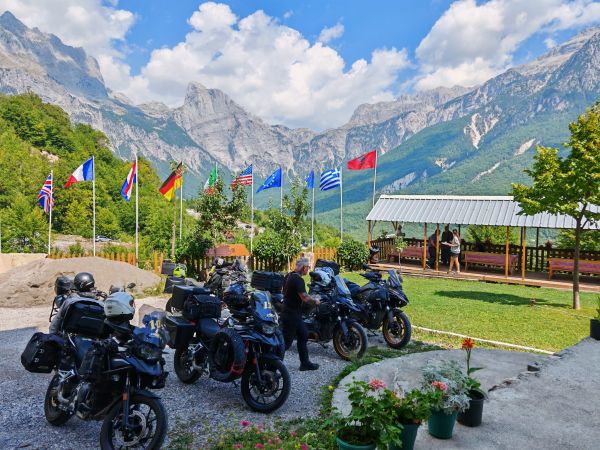
Albania Motorcycle Tour Balkans 2026
Seven Riders, Seven Countries, 4,648 km: Our Motorcycle Tour Through Albania and the Balkans, August 2026.

Guided Balkan Motorcycle Tour 7 Countries 95% Asphalt
Seven Balkan countries, extraordinary routes off the tourist track, ~95% asphalt and no highways ...

Croatia - Route des Grandes Alpes, July 2025
2 Americans - 1 boy and 1 girl, 1 motorcycle - a BMW R1250GS, one motorcycle tour and one goal ...

Balkans - Romania Tour, June 2025
At the end of June 2025, the time had finally come. Between June 23 and June 25, all participants in this tour gradually arrived in Trogir.

Balkans - Italy Tour, May 2025
Together we covered about 3700 km, crossing the Adriatic twice, from Durrës to Bari and from Ancona to Split.

Customer Money Protection
Customer money protection before payment — why advance payments for motorcycle tours should never be based on trust alone.
Motorcycle Excess and Damage Risk
Understand motorcycle excess and optional excess insurance before joining a tour with a rented or provided motorcycle.

Packing List for a Motorcycle Tour
Pack light, ride better: a practical motorcycle tour packing list for guided and self-guided touring with luggage on the motorcycle.
Safety training and correct cornering!
A small but important journey through the topic of safety training and correct cornering!

Motorcycle Route Planning
Good motorcycle routes are planned around roads, timing, logistics and real riding experience — not just map points.

Motorcycle Group Tours
Group ride or solo ride — how to choose the right riding style for your next motorcycle tour.

The International Driving Permit
International Driving Permit for motorcycle tours — why your licence documents must be clear before the ride starts.
